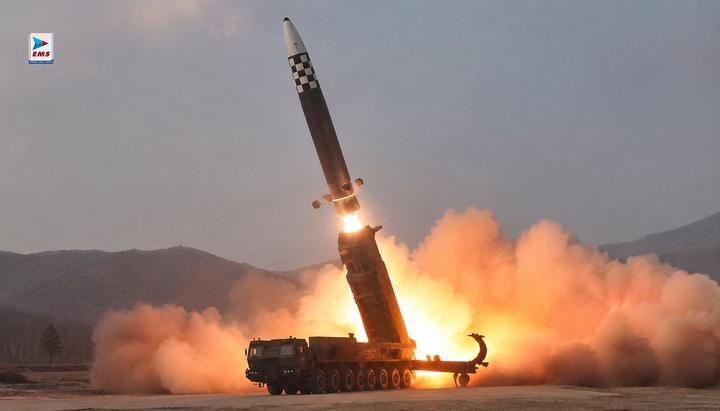
North Korea has once again heightened global concern by successfully testing state-of-the-art weaponry. According to official reports, under the supervision of Supreme Leader Kim Jong Un, the country conducted tests of nuclear-capable cruise missiles, AI-powered missiles, and ballistic missiles equipped with new warheads. This also included 240mm rocket artillery featuring advanced navigation systems.
Expressing complete satisfaction with the performance of these missiles, Kim Jong Un has ordered their deployment to frontline positions near the South Korean border to render the nation’s military strength impregnable.
Meanwhile, the South Korean military has confirmed that the short-range missiles launched by North Korea covered a distance of approximately 80 kilometers.
Since the collapse of diplomatic talks with the United States in 2019, North Korea has accelerated its nuclear programs at a rapid pace. This raises a critical question: how does a small nation facing stringent international sanctions manage to acquire the technology and funding to produce such sophisticated weapons ?
According to experts, North Korea possesses a vast team of thousands of highly skilled scientists and engineers dedicated to its nuclear and missile programs. Many of these experts received high-level training from the former Soviet Union and China. Within the country, rigorous research and development for these lethal nuclear weapons are conducted at a highly secretive and specialized institution named Munsu.
Despite heavy global sanctions, North Korea continues to spend billions of dollars on its military programs, fueled by several clandestine and strategic sources. Currently, the deepening ties with Russia are pivotal; in the wake of the Ukraine war, North Korea has provided substantial quantities of weapons and personnel to Russia, receiving fuel, advanced military technology, and financial aid in return.
Furthermore, China, being its largest economic partner, continues to informally supply essential goods. Cyber-attacks aimed at stealing foreign currency, illegal coal exports, and placing immense pressure on the domestic population to divert resources toward the military sector form the core of this funding.
Meanwhile, despite the U.S.-led desire for dialogue, North Korea has made it clear that no bilateral talks are possible as long as the precondition of abandoning nuclear weapons remains. The deployment of these lethal weapons and nuclear missiles to the frontline in East Asia has pushed concerns in South Korea and the United States to their peak, prompting them to further intensify their joint military exercises in the region.