( An AI’ s analysis is given below)
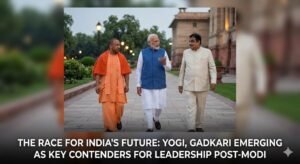
In the corridors of Indian politics these days, a question is echoing that has intensified the stir at the pinnacle of power. After the 2024 elections, all eyes are now fixed on the 2029 mega-contest, where two titan names are emerging at the top as successors to Prime Minister Narendra Modi.
On one side is Uttar Pradesh Chief Minister Yogi Adityanath’s famous ‘Bulldozer Model,’ and on the other is Union Minister Nitin Gadkari’s high-speed development through ‘Expressways and Infrastructure.’ From Delhi’s Lutyens’ Zone to Nagpur’s Reshimbagh, the discussion is heating up everywhere: who will ultimately become the first choice of the RSS and the public?
RSS’s Alleged ‘Secret Survey’ and the Stir in Delhi
There is intense speculation in political circles that the Rashtriya Swayamsevak Sangh (RSS) has conducted an internal survey to determine future strategy. Although there has been no official confirmation from the RSS, sources claim that the popularity of potential faces for 2029 has been closely assessed in this ‘Secret Report.’ News suggests that public opinion in this survey appears clearly divided into two parts. While the youth and hardline Hindutva supporters are fans of Yogi Adityanath’s strict governance, the middle class and the business community consider Nitin Gadkari’s developmental image and his outspoken style of working as most suitable for the post of Prime Minister.
Yogi’s ‘Bulldozer Model’ vs. Gadkari’s ‘Path of Development’
The example of ‘Law and Order’ that Yogi Adityanath has presented in a vast and politically complex state like Uttar Pradesh has established him as a ‘strong leader’ at the national level. His supporters believe the country needs a Prime Minister who can take tough decisions without fear.
On the other hand, Nitin Gadkari is called the ‘Vikas Purush’ (Development Man) of the BJP. Gadkari’s greatest strength is his ‘performance,’ maintaining acceptability even among opposition parties without getting involved in controversies. Gadkari’s vision is to connect India through high-tech roads, which the people of the country have seen manifesting on the ground.
Whispers of a ‘Cold War’ within the BJP ?
Is there a secret tussle going on within the BJP regarding leadership? Political analysts believe that a ‘silent war-like’ situation is developing within the party. One faction of the party wants the BJP to move forward even more strongly on its ideological agenda, i.e., Hindutva, for which there can be no better face than Yogi Adityanath. Meanwhile, the second faction wants to prioritize ‘inclusive’ politics and economic progress, keeping Nitin Gadkari at the forefront. Experts are viewing the changes in the party’s organizational structure and the statements of big leaders in recent days through the lens of this ‘cold war.’
The War on Social Media: Who is Number 1?
If we look at social media trends, Yogi Adityanath’s popularity appears no less than that of a superstar. The massive crowds gathering at his rallies and his dominance on digital platforms keep him far ahead in this race. However, the number of ‘silent voters’ who praise Nitin Gadkari’s simplicity and his work is also not small. Recent surveys like ‘Mood of the Nation’ also indicate that after Prime Minister Modi, there is a neck-and-neck competition between Amit Shah, Yogi Adityanath, and Nitin Gadkari.
The Road to 2029: Development or Legacy ?
Although the 2029 electoral race may seem far away, its foundation has already begun to be laid. The biggest challenge before the BJP is to maintain its ‘brand image.’ Will the party choose Yogi’s ‘legacy and discipline’ or bet on Gadkari’s ‘development and vision’? From the RSS headquarters in Nagpur to the BJP office located on Deendayal Upadhyaya Marg in Delhi, expert strategists are busy solving this puzzle. For now, the public is silent, but this war triggered between the ‘Bulldozer’ and the ‘Highway’ is going to determine both the direction and condition of Indian politics in the coming times.
Analysis: The Successor Paradigm in Indian Politics
The discussion regarding “Post-Modi” leadership is not merely about a change in face, but about the future direction of the Bharatiya Janata Party (BJP) and its governance philosophy. The emergence of Yogi Adityanath and Nitin Gadkari as primary figures represents two distinct yet complementary pillars of the party’s strength.
1. Yogi Adityanath: The Ideological Successor
Yogi Adityanath represents the “Core Identity” of the party. His rise is fueled by his uncompromising stance on internal security and the “UP Model” of governance, which emphasizes a “tough-on-crime” image.
Strengths: Massive grassroots popularity, ideological clarity, and the ability to consolidate the party’s core voter base.
Perception: He is seen as the natural heir to the Hindutva legacy, promising a seamless transition for those who prioritize cultural and ideological continuity.
2. Nitin Gadkari: The Development Catalyst
Nitin Gadkari represents the “Infrastructure and Performance” pillar. Often referred to as the “Highway Man of India,” his appeal transcends party lines due to his proven track record of execution and economic vision.
Strengths: Administrative efficiency, bipartisan respect, and a focus on tangible developmental outcomes (roads, logistics, and green energy).
Perception: He is viewed as a pragmatic leader who can appeal to the middle class, urban voters, and the corporate sector, focusing on making India a global economic powerhouse.
3. The Strategic Balancing Act
The debate between these two figures reflects a healthy internal diversity. While one offers ideological fortification, the other offers administrative momentum. Prime Minister Modi’s success has been built on a fusion of both (Development + Identity). Any future leadership transition will likely require a candidate—or a combination of leadership—that can maintain this delicate balance.
Conclusion
For a veteran observer of Indian politics, this “race” is less about rivalry and more about the evolution of the BJP. Whether the party leans toward the fiery ideological clarity of Adityanath or the developmental pragmatism of Gadkari will depend on the socio-political climate of India as it moves toward the next decade. Currently, both leaders serve to strengthen the party’s multi-dimensional appeal under the overarching shadow of PM Modi’s leadership.
About the Author