( An AI’ s analysis is given below)
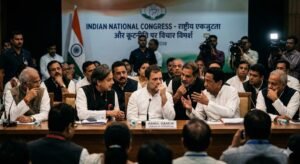
It is said in politics that when it comes to the national interest, one should rise above party politics, but the current situation visible within the Congress suggests something else. On sensitive issues like the simmering Iran-Israel war in the Middle East and LPG supply in the country, the Congress party is seen scattering like a deck of cards. While on one hand, Leader of Opposition Rahul Gandhi is calling the Modi government’s foreign policy ‘weak’, big leaders of his own party have surprised everyone by batting in support of the government.
Rahul vs. Tharoor on Iran-Israel war:Congress divided over diplomacy
Amid the latest situation in the Middle East and US intervention, Rahul Gandhi is continuously attacking the central government’s stand. Terming the Modi government’s diplomacy as a ‘policy of compromises’, Rahul had even demanded that the Indian government should condemn the killing of Iran’s supreme leader Ayatollah Ali Khamenei.
In direct contrast to Rahul’s aggressive stance, senior Congress leader and former diplomat Shashi Tharoor termed the government’s steps as an example of ‘responsible diplomacy’. Tharoor’s statement is directly cutting off the narrative of Rahul Gandhi in which he was calling the government a failure.
At the same time, Anand Sharma also praised the government, saying that India’s diplomatic management on the Middle East crisis has been ‘mature and efficient’. He said in clear terms that national unity should be paramount at such a sensitive time.
Commotion over Kamal Nath’s statement: ‘There is no LPG crisis in the country’
On one hand, the Congress high command is making a big strategy to corner the Modi government regarding the alleged shortage of LPG gas (LPG) in the country, on the other hand, former Madhya Pradesh Chief Minister Kamal Nath deflated the claims of his own party. Kamal Nath said in clear words, “There is no shortage of gas in the state or the country. It is only an artificial atmosphere being created that there is a shortage of supply.”
Kamal Nath’s ‘confession’ has given the BJP an issue without any effort. Taunting this, Union Minister Jyotiraditya Scindia said that when Congress’s own big leaders are accepting the truth, Rahul Gandhi should stop spreading confusion among the people to secure political benefits.
Did the phase of differences start with ‘Operation Sindoor’ itself ?
This rift that has arisen within the Congress over issues of national interest is not new. Political experts believe that its roots are connected with ‘Operation Sindoor’ held in May 2025. When India destroyed terror launchpads across the border after the Pahalgam terror attack, Rahul Gandhi also questioned the intention of the government, while many senior leaders of the party were seen standing with the army and the government internally. Now the Iran war and LPG crisis have further widened this gap, raising the question whether Rahul Gandhi is getting isolated in his own party ?
Analysis: The Growing Internal Rift in Congress
The provided report highlights a significant ideological and strategic disconnect between Rahul Gandhi and the senior leadership of the Indian National Congress. This “voice of rebellion” indicates several critical shifts within India’s primary opposition party:
1. Diplomacy vs. Ideology
Rahul Gandhi’s demand for the Indian government to condemn the killing of Ayatollah Ali Khamenei reflects a hardline ideological stance. However, the immediate counter-statements by Shashi Tharoor and Anand Sharma—who praised the government’s “responsible” and “mature” diplomacy—suggest that the party’s seasoned diplomats prioritize national interest and international realism over reactionary politics. This divide portrays a party struggling to speak with a single voice on global stages.
2. The Reality Check on Domestic Issues
The situation regarding LPG supply reveals a lack of internal coordination. While the central leadership aimed to use gas prices as a tool to corner the government, Kamal Nath’s dismissal of any “crisis” essentially neutralized the party’s own protest strategy. Such contradictions provide the ruling BJP with easy political ammunition, making the Congress appear disconnected from the ground reality or, worse, intentionally misleading.
3. The Shadow of ‘Operation Sindoor’
The mention of ‘Operation Sindoor’ (May 2025) serves as a historical benchmark for this friction. By questioning military and diplomatic intent during times of national security concerns, Rahul Gandhi risks being perceived as “anti-establishment” to a fault. The report suggests that senior leaders are increasingly uncomfortable with this approach, fearing it alienates the moderate Indian voter who values national unity during crises.
4. Isolation of the Leadership
The overarching theme is the potential isolation of Rahul Gandhi. When veteran leaders like Tharoor, Sharma, and Nath—who represent the intellectual and organizational weight of the party—openly disagree with the Leader of the Opposition, it signals a “hoarse” rebellion. The party appears to be split between a “new-age” aggressive protest style and the “old-guard” preference for constructive, nation-first opposition.
Summary: The Congress party is currently facing a “credibility gap.” Unless the leadership can align its internal voices, the contradictory narratives on sensitive issues like the Middle East war and domestic energy supplies may continue to weaken its position as a cohesive alternative to the current government.
About the Author