( An AI’ s analysis is given below)
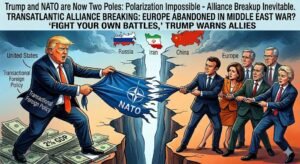
Amidst the ongoing conflict between the US, Israel, and Iran, questions are arising as to whether NATO is now on the brink of a split. This is because while US attacks continue, its own European allies are openly distancing themselves. Countries like France, Spain, and Italy are withdrawing military support, while Britain is also avoiding direct involvement. Meanwhile, Donald Trump’s statement that America will no longer come to their aid is deepening this rift.
Amidst the ongoing military action by the US and Israel against Iran, Trump has launched a sharp attack on his own allies, the United Kingdom and France. Trump stated in clear terms that countries that did not stand with America in this war will now have to fight their own battles, and America will not come to their aid every time. He called France “very unhelpful” and warned that America would remember this attitude, while targeting the UK, he said that if there are issues with oil and fuel in the Strait of Hormuz, they should go and secure it themselves.
Other countries must prove their military capabilities
Trump also said that other countries, especially in Europe, must now prove their military capabilities and should not rely solely on the US Navy. Referring to Britain’s Royal Navy, he questioned whether it is prepared to play any role in such a crisis.
Following these statements, US Defense Secretary Pete Hegseth also took a tough stance, saying that other countries should now learn to fight for themselves, as it is not solely America’s responsibility.
Trump also expressed open dissatisfaction with NATO’s role, saying that this war was a test in which the allies did not support as expected. He even went as far as to say that America does not need NATO, but the allies should have stood with America. According to him, the alliance is making a huge mistake in this matter.
Questions raised on NATO’s solidarity
In this context, serious questions are being raised about NATO’s solidarity. To understand this entire scenario, the biggest and oldest dispute is regarding defense spending. NATO has a clear rule that member countries should spend at least 2% of their GDP on defense, but for a long time, many European countries have lagged behind this target. America has been consistently alleging that Europe is “free-riding” in terms of security and the burden is primarily being borne by Washington. Donald Trump has previously called NATO “obsolete.” Although Germany, Poland, and the Baltic states have increased defense spending after the Russia-Ukraine war, mistrust has not been completely eliminated.
The Ukraine war, on one hand, showed NATO more united than before, but on the other hand, it also exposed internal differences. America has provided the most military and economic assistance to Ukraine, and its strategy has been to weaken Russia in the long term. Meanwhile, some European countries are not in favor of dragging out the war, as its economic and security impacts directly affect them. In this situation, despite having the same goal, the methods to achieve it appear different.
Impact of American politics is visible
The impact of American politics is also clearly visible in this entire equation. Donald Trump has already signaled that he will not be obligated to provide security guarantees to countries that do not spend 2% on defense. This has increased concerns in Europe about whether America will remain as committed to NATO’s collective defense principle, i.e., Article 5, in the future. Amidst these circumstances, the idea of ‘Strategic Autonomy’ is also gaining strength within Europe. Especially countries like France have long been talking about independent defense capabilities to reduce dependence on America. This thinking has now become part of the discussion at the policy level.
There are also different priorities between the two sides regarding China and the Indo-Pacific. America wants NATO’s role to be active against China as well, while Europe wants to take a balanced approach keeping economic relations in mind. Overall, NATO is still a strong alliance and its expansion continues, but Trump’s statements amidst the Iran war have made it clear that internal differences are now coming out more openly than before. The alliance remains, but the internal tension within it is constantly increasing.
Analysis: The Cracks in the Transatlantic Shield
The current geopolitical friction between the United States and its European allies highlights a fundamental shift in the 75-year-old NATO alliance. Here is a breakdown of the crisis:
1. The “Transactional” Turn in US Foreign Policy
The rhetoric from Donald Trump and Defense Secretary Pete Hegseth marks a shift from Ideological Commitment to Transactional Diplomacy. For decades, NATO was based on the principle that “an attack on one is an attack on all” (Article 5). By framing security as a “paid service” (the 2% GDP rule), the US leadership is signaling that the American security umbrella is no longer a given, but a commodity.
2. Strategic Autonomy vs. Global Policing
The reluctance of France, Spain, and Italy to join the Iranian front demonstrates a growing desire for European Strategic Autonomy.
The US View: Sees the Middle East and the Strait of Hormuz as global security priorities that allies must help police.
The European View: Focuses on regional stability and fears that direct involvement in an Iran-Israel conflict could lead to energy price hikes, refugee crises, and domestic unrest.
3. The Strait of Hormuz: A Litmus Test
The Strait of Hormuz is the world’s most important oil transit point. Trump’s comment—telling the UK to “get it themselves”—is a direct challenge to the “Special Relationship” between the US and Britain. It suggests that if Europe wants energy security, it must deploy its own naval assets (like the Royal Navy) rather than relying on the US Fifth Fleet.
4. Divergent Threats: Russia vs. China vs. Iran
NATO’s primary identity was built on countering the Soviet Union (and now Russia). However, the alliance is struggling to find a common consensus on other fronts:
Russia: Generally unified, though fatigue is setting in.
Iran: Deeply divided due to different diplomatic histories (e.g., the JCPOA nuclear deal).
China: A major point of contention; the US views China as a systemic rival, while Europe views it as a vital economic partner.
5. Conclusion: Is NATO Breaking?
NATO is not “breaking” in a legal sense, but it is reformatting. We are moving toward a “Multi-speed NATO” where the US leads on global issues, while Europe is being forced—partly by US pressure and partly by necessity—to build its own independent military structures. The danger lies in the deterrence gap: if adversaries believe the US will not defend Europe, the risk of global instability increases significantly.
The “split” is not about whether NATO exists, but about whether the Trust that fueled it for decades still holds. Currently, that trust is at an all-time low.
About the Author