( Analysis is given below)
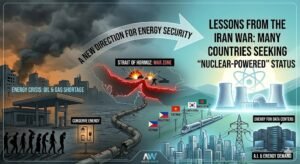
The war involving Iran has disrupted the global energy supply chain. The situation in many countries has deteriorated to such an extent that they have been forced to impose emergency measures. Governments are appealing to citizens to consume less electricity. In Sri Lanka, a public holiday has even been declared. In these difficult times, nations are being reminded of the potential of nuclear energy.
In view of the shortage of petrol and diesel, the Philippines has declared a state of emergency in the country. Due to the war, the Philippines’ oil supply chain has been devastated. South Korea has initiated steps for energy conservation. The government has advised people in Seoul to take shorter showers to save water and ultimately conserve electricity. They have also been asked not to charge phones at night. Vietnam Airlines is suspending flight services on several routes to save energy. Sri Lanka declared a holiday on wednesday specifically to save energy.
No one had even imagined that the energy market of the world would be so badly shaken due to the Iran war. This has never happened before in the modern world. The battle between two powerful nations in the narrow passage of Hormuz has devastated the global energy supply. Following this, Southeast Asian countries have begun to seriously consider nuclear options for energy.
Nuclear power is being reconsidered in Southeast Asia as countries in the region prepare to meet growing energy demands and also compete for Artificial Intelligence (AI) based data centers.
Energy is needed, but how to rely on petrol-diesel supply ?
Data centers have a massive requirement for energy. However, South Asian countries are quite poor in terms of energy availability. Analysts say the Iran war is exposing the vulnerability of Asia’s energy supply, which is why governments in Southeast Asia are working seriously to find alternatives to oil and gas.
Several Southeast Asian nations are reviving their stalled nuclear plans and setting ambitious targets; if these countries move forward toward these goals, nearly half the countries in this region could have nuclear power available by the 2030s. Even countries that currently have no plans have shown interest in this field.
Alvie Asuncion-Astronomo of the Philippine Nuclear Research Institute stated that the rise in crude oil prices due to increasing conflicts has motivated countries to accelerate their nuclear efforts. The situation in the Philippines worsened so much that a state of emergency had to be declared.
This week, Vietnam and Russia moved forward with a nuclear energy agreement as concerns over energy security grew in the region. In South Asia, Bangladesh is continuing efforts to make its new nuclear power plant operational. It is also receiving support from Russia—so that the energy shortage in the country can be alleviated.
Analysis
………………………………
The Geopolitics of Energy and Asia’s New Sunrise
……………………………………………………………………
This war is not merely a military conflict; it is an event capable of redrawing the global energy map. In this context, it is essential to focus on three primary dimensions-
1. The ‘Hormuz Trap’ and Asia’s Suffocating Stance
Approximately 20-30% of the world’s oil supply depends solely on the Strait of Hormuz. When this route is obstructed, countries like the Philippines or South Korea do not just face an energy crisis; their ‘national security’ is put at risk. Consequently, for these nations, nuclear energy is no longer just an ‘option’ but has become a ‘survival strategy.’
2. The AI Revolution and the ‘Invisible’ Hunger for Power
In today’s world, the influence of Artificial Intelligence (AI) is growing exponentially. However, the massive data centers required to run this AI consume an enormous amount of electricity. While Southeast Asia aspires to advance in this technology, traditional coal or gas cannot sustain them. Nuclear energy is the only medium that can provide uninterrupted 24×7 power. This is the ‘new fuel for a new era.’
3. Russian Influence and New Equations in Asia
Russia’s assistance to countries like Vietnam and Bangladesh is a significant signal. While Western nations are imposing sanctions, Russia is strengthening its friendships by providing nuclear technology to Asian countries. This holds the potential to create a new ‘Nuclear Bloc’ in Asia in the future.
4. Conclusion from a Journalistic Perspective
Indirectly, this war has pushed the world toward ‘Green Energy.’ However, it places more emphasis on nuclear power than solar energy because it is more potent and sustainable. A nation that possesses its own nuclear power will no longer be dependent on Middle Eastern wars or fluctuating oil prices. This, indeed, is the ‘Energy Independence’ of the modern age.
About the Author