( Analysis is given below)
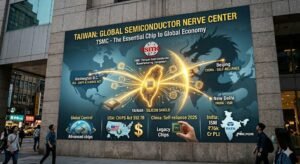
TSMC of Taiwan is not just a company—it is a major epicenter of the global economy. If China seizes it, the world’s technological expertise, AI, and military power could suddenly be controlled by Beijing.
Silicon Island: Where Modern Civilization is Built
The world’s most important company is located neither in powerful nations like the US or China, but on a tiny island of just 36,000 square kilometers. This island is Taiwan, and the company is TSMC. There are no natural oil resources or nuclear bombs here, but there exists the magical power of ‘Silicon’ that manufactures 90% of the world’s most advanced chips. From the smartphone in your hand to the F-35 fighter jets flying in the sky, everything is powered by these chips.
China’s Motive: Occupation of the ‘Future’, Not Just Land
For decades, China has been claiming Taiwan as its own. But the current dispute is not limited to nationalism alone. According to reports, TSMC produces 60% of the world’s general semiconductors and 90% of advanced chips (less than 5 nanometers). If China takes control of this island, the entire world economy will fall into Beijing’s hands. Every nation will have to depend on China for AI, defense, and technological competition.
In the words of historian Chris Miller, “The importance that oil resources had in the 20th century, advanced chips have even more importance today.”
‘Davidson Window’ and the Fear of 2027
According to the US intelligence agency CIA and military experts, China has ordered its military to be ready for an invasion of Taiwan by 2027. Although Chinese President Xi Jinping has denied any such specific deadline, China’s military exercises in the sea and military modernization are sending a terrifying signal. For America, Taiwan’s security is not just a democratic friendship, but a strategy to protect its own technological existence.
What if War Breaks Out ?
A Catastrophe in the Global Economy
According to Bloomberg estimates, if a conflict breaks out between the US and China over Taiwan, the global economy would suffer a loss of $10.6 trillion in the first year. This would be more devastating than the COVID-19 pandemic or the 2008 financial crisis. Production for companies like Apple would stop, and the automobile industry could come to a complete standstill.
Silicon Shield: An Invisible Armor
However, there is a big twist in this conflict. TSMC has a ‘contingency plan’ through which they can completely disable their advanced machinery if attacked by enemies. This means China might get the factories, but it will lose the ability to operate them. Taiwan calls this technological supremacy its ‘Silicon Shield’. China itself depends on Taiwan for more than half of its semiconductor requirements.
Conclusion:
In today’s era, the definition of power has changed. Whoever produces the smallest chip will rule the world. Taiwan is not just an island; it is the ‘nerve center’ of the modern world. The entire world is watching what turn this cold war, aimed at controlling this nerve center, takes in the coming days.
Global Semiconductor Policy: An Analysis
TSMC of Taiwan is not just a company—it is a major focal point of the global economy. If China were to seize it, the world’s technological expertise, AI, and military power could suddenly be controlled by Beijing.
In today’s era, semiconductors or chips are considered the ‘New Oil’. To establish their dominance in this field, the world’s major powers have brought significant changes to their respective policies.
To reduce dependence on Taiwan and strengthen their security shield, countries like the USA, China, and India have adopted different strategies.
1. USA’s ‘CHIPS and Science Act’
The USA enacted this historic law in 2022 to protect its technological sovereignty.
Financial Assistance: Direct subsidies of approximately $52.7 billion are being provided for semiconductor manufacturing and research.
Export Controls: The USA has imposed strict restrictions to ensure that China cannot access sophisticated AI chips and chip-making machinery.
Goal: To encourage companies like Intel, TSMC, and Samsung to establish factories (Fabs) on American soil.
2. China’s ‘Made in China 2025’ and Self-reliance
China is investing massive capital in the semiconductor sector through its ‘Big Fund’.
Self-reliance: China’s goal is to meet 70% of its chip requirements internally by 2025.
Focus on Legacy Chips: Due to a lack of technology for advanced chips, China is currently trying to capture the market for commonly used (Legacy Chips), such as those used in vehicles and household appliances.
3. India’s Semiconductor Mission (ISM)
India has also joined this race.
Assistance of ₹76,000 Crore: The Government of India is attracting companies through the ‘Production Linked Incentive’ (PLI) scheme.
Gujarat and Assam: Companies like Tata Group and Micron are establishing chip assembly and manufacturing units in India.
About the Author