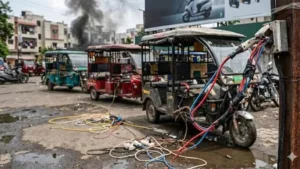
Electric vehicle (EV) charging negligence is proving to be fatal amidst the rising number of EVs. A recent fire caused by a short circuit during EV charging in Indore, which resulted in the deaths of eight members of a single family, has highlighted this danger. Despite this, charging points are being set up in the city without any safety standards. In homes, vehicles are being put on charge without safety measures.
Similarly, naked and open wires are hanging at public charging stations, leading to a constant possibility of electric shocks or fire accidents. Officials are merely calling for compliance with safety standards, but no claims are being made regarding taking action against such negligence. Experts say that charging directly from domestic electricity connections is risky.
For this, a separate secure charging point, suitable wiring, and a connection according to the load are necessary. But the reality is that most people are charging EVs with the help of normal sockets and temporary wiring. 65 connections have been given for EV charging in the city. People are charging electronic three-wheelers and four-wheelers in open fields.
Global Analysis: The Infrastructure Paradox in the Green Transition
While the transition to Electric Vehicles is a cornerstone of the global fight against climate change, the tragedy in Indore serves as a grim case study of a global systemic failure: the gap between rapid technology adoption and lagging safety infrastructure.
1. The “Domestic DIY” Danger
Across the globe—from developing urban hubs to suburban neighborhoods in the West—users often treat EV charging as a “plug-and-play” activity similar to charging a smartphone. However, an EV is a high-capacity energy storage system. Using standard domestic sockets without an RCCB (Residual Current Circuit Breaker) or ELCB (Earth Leakage Circuit Breaker) creates a massive thermal stress point. This isn’t just a local issue; it is a global educational hurdle.
2. Infrastructure vs. Regulation
The report highlights “naked wires” and “open boards” in public spaces. This reflects a broader global challenge where the private sector rushes to meet charging demand before municipal safety regulations or enforcement mechanisms are fully mature. The transition to green energy requires more than just “more chargers”; it requires standardized electrical auditing.
3. The “Heat Soak” Phenomenon
The official observation that a vehicle driven over a long distance was “immediately plugged in” points to a technical risk often overlooked by users: Thermal Management. Fast charging an already hot battery pack increases the risk of thermal runaway. Global safety protocols must emphasize a “cool-down” period, especially in warmer climates.
4. The Load Factor and Urban Planning
Most residential grids were designed for lighting and light appliances, not for the sustained high-ampere draw of an EV. As seen in this report, bypassing dedicated circuits leads to cable degradation and “tripping.” Globally, cities must mandate Load Balancing and dedicated EV circuits in building codes to prevent residential blocks from becoming fire hazards.
Summary of Essential Safety Standards
Feature Necessity
Wiring Copper (min 6-10 sq mm), strictly avoiding Aluminum.
Protection Dedicated MCB and RCCB for every point.
Circuitry Isolated circuits; never share load with ACs or Geysers.
Environment Waterproof panels and surge protection systems.
The Indore tragedy is a localized event with a universal message: The sustainability of the EV revolution depends not on the speed of the transition, but on the safety of the infrastructure supporting it.
Given the universal need for better public education on this topic, We have drafted two comprehensive resources that can be used for public awareness campaigns: an Infographic Outline and a practical Safety Checklist.
Resource 1: Infographic Outline (Public Awareness Campaign)
This infographic is designed to be a clear, simple, and high-impact visual that quickly highlights the dangers and necessary precautions for EV charging.
Theme: “The Green Mile: Charging Safely for a Sustainable Future”
Target Audience: New and current EV owners, residential property managers, and public utility operators.
Visual Layout: A clear, modern design using a vertical timeline or flow-chart style, split into three distinct phases.
[Infographic Section 1: The Invisible Hazard (The Problem)]
Visual: A powerful image contrasted against a modern electric vehicle. A stylized, thermal image of a standard domestic socket melting. Red “hazard” arrows point from the socket to the vehicle. A digital load meter shows the needle spiking into the “Critical” red zone.
Text (Large, bold): “EV CHARGING: NOT LIKE CHARGING A PHONE.”
Bullet Points:
A high-capacity EV draws extreme energy over sustained hours.
Bypassing safety protocols is a fatal risk.
Case Study (Global Context): The recent tragedy in Indore (8 lives lost) shows that negligence can be deadly.
[Infographic Section 2: Home Charging: Your Safe Haven (The Solution)]
Visual: A dedicated, professionally installed wallbox charger in a clean garage environment. A blueprint inlay shows a clear, isolated electrical diagram.
Text (Large, bold): “NEVER NEGOTIATE YOUR HOME SAFETY.”
Bullet Points:
Dedicated Circuit: Never share your EV circuit with other high-power appliances (e.g., ACs, Geysers). This prevents overloads.
The Safety Triangle: Ensure you have:
A dedicated MCB (Miniature Circuit Breaker).
A critical RCCB/ELCB (Residual Current Circuit Breaker) to detect current leakage.
A strong, verified Grounding (Earth) connection.
Professional Install: Always use a certified electrician for installation. Do not trust DIY or standard domestic sockets.
[Infographic Section 3: The Load Limit and Thermal Management]
Visual: Two charts. The first is a graph showing the grid’s “Approved Load” vs. “Actual Demand” with a safe margin. The second visual is a split view of an EV battery: ‘Before Charge’ (hot/red) vs. ‘After 15 min Cool Down’ (safe/green), and a separate visual of an EV charging cable compared to a small domestic wire.
Text (Large, bold): “MANAGE THE HEAT, RESPECT THE GRID.”
Bullet Points:
Know Your Load: An EV (especially a fast charger) adds significant demand. Confirm your home’s sanctioned electrical load is sufficient. Upgrading your service may be required.
The Cool Down Rule: Do not plug in your EV immediately after a long drive. Allow the battery to cool down for at least 15 minutes before starting the charge.
Cable Check: Use appropriate gauge copper wiring (typically 6-10 sq mm), not thin or aluminum wire.
Resource 2: Public Safety Checklist for EV Owners
This checklist is designed as a physical/digital card that can be handed to every new EV buyer by the dealer, or distributed by utility companies.
Title: “Your Essential EV Charging Safety Checklist”
(Keep a copy in your vehicle glove box and near your charging station)
Phase 1: Installation and Hardware
[ ] Dedicated Circuit Verified: Does your EV have its own, exclusive electrical circuit and breaker (MCB)? (Sharing with other major appliances is unsafe).
[ ] Leakage Protection Installed: Do you have an RCCB (Residual Current Circuit Breaker) or ELCB (Earth Leakage Circuit Breaker)? This is your most important safety barrier against electric shock and electrical fire.
[ ] Verified Earth/Grounding: Has your electrician physically verified that the grounding connection for your EV circuit is secure and effective?
[ ] Standard Wiring (Not DIY): Are you using professionally installed, standard wiring of the correct gauge (typically 6-10 sq mm copper)? Never use thin wires, temporary cords, or multiple extension strips.
[ ] Approved Load Checked: Have you confirmed with your utility provider that your home’s total sanctioned electrical load is sufficient for your EV? (Overloading can lead to cable damage and grid issues).
Phase 2: Charging Routine
[ ] The ’15-Minute Rule’: Do you wait at least 15 minutes to allow your EV battery to cool down after driving before you plug it in?
[ ] Visual Cable Check: Do you inspect your charging cable and plug for cuts, frays, or damage before every use?
[ ] Dry Conditions: When using public charging stations, are you checking for “naked” or exposed wires, especially during rainy or humid conditions? Avoid using stations with apparent safety lapses.
Phase 3: Public Charging Safety (Specific Concerns)
[ ] Water Hazard Awareness: Are the charging panel and socket waterproof? Are they protected from rain/splashes?
[ ] Immediate Reporting: Will you agree to immediately report any public charging station showing safety failures (e.g., exposed wires, tripping breakers, overloads) to the electric department or the service provider?
About the Author