( The analysis is given below)
By – Jawahar Mishra
…………………………………………………………………..
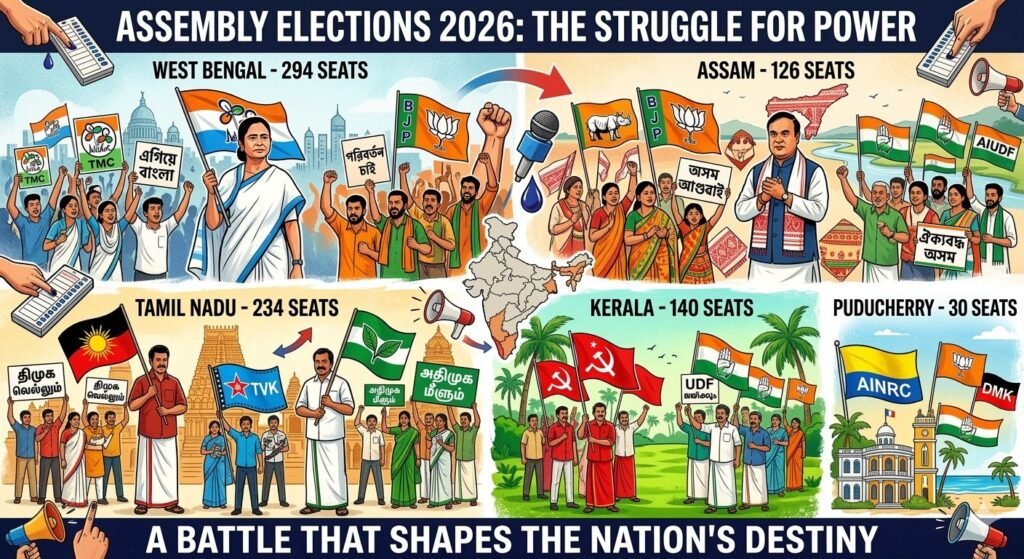
The bugle has been sounded for assembly elections in West Bengal, Assam, Tamil Nadu, Kerala, and the Union Territory of Puducherry. The election results in these five states will not only decide the future governments in these states but also set the direction of national politics. The battle for power in these states is particularly interesting because the ruling coalition at the Center, the NDA, holds power in two states, while the opposition coalition ‘INDIA’ rules in three.
The closest attention will be focused on the West Bengal elections. Mamata Banerjee has been the Chief Minister there for three consecutive terms. The interesting equation is that the Congress, which was previously in power, and the Left Front, which was in power for more than three decades, are now marginalized in Bengal politics, while the BJP has become the main opposition party.
Even in the last election, the BJP had created an atmosphere of change in Bengal, but it could not reach the 100-mark in the 294-member assembly, while Mamata’s Trinamool Congress won 215 seats. The difference in the vote share between the two parties was also a substantial 10 percent.
While the jump from 3 seats to 77 seats is no less than miraculous, the majority mark is 147.
Despite all the maneuverings, the BJP could only travel half the distance. Perhaps the BJP’s biggest achievement was the defeat of Chief Minister Mamata Banerjee—who contested from the prestigious Nandigram seat—by Suvendu Adhikari. There is a possibility of anti-incumbency sentiment against Mamata and the Trinamool after three consecutive terms, but to reap the electoral benefits, a credible and acceptable face and a strong organization are needed. The huge minority vote bank is the Trinamool Congress’s big electoral strength. That’s why the BJP keeps trying to polarize Hindu voters in its favor. How much the BJP can bridge the gap between itself and the Trinamool through this effort and the active participation of the RSS will largely depend on the election results in West Bengal.
The Congress and the Left Front, which fought the last election together, will contest separately this time. Their limited electoral role will make it interesting to see whether they dent the Trinamool’s minority vote bank or whether they split the anti-incumbency voters, causing loss to the BJP. One thing is certain: this election will be a “do-or-die” battle for both Mamata and the BJP. This election will be the most challenging for Mamata. Therefore, this is also considered the most favorable opportunity for the BJP to form a government in Bengal. If Mamata manages to get the mandate for the fourth time, it will be difficult for the Congress to ignore her role in national politics through the ‘INDIA’ coalition.
The politics of Tamil Nadu has been bipolar between the DMK and the AIADMK for a long time, but that balance has been disturbed after the demise of Jayalalithaa. Through the unification of the AIADMK and an alliance with it, the BJP is exploring the possibilities of change in power there. But this does not seem easy despite the controversies regarding Sanatan Dharma and the Hindi language that keep arising during the M.K. Stalin government’s tenure.
If film actor-turned-politician Thalapathy Vijay emerges as a big force with his party TVK, all equations could go awry. If the DMK coalition manages to save power, it will boost the morale of the ‘INDIA’ coalition at the national level. However, in view of the anti-Sanatan and anti-Hindi image, the path of national politics will not be easy for Stalin. If TVK’s presence creates power possibilities for non-DMK parties, it will be like a “lottery” for the BJP in a deep South Indian state.
In the five electoral states, the BJP has the best prospects of winning in Assam. Assam, which has been surrounded by issues like infiltration and demographic change, has a BJP government for the second consecutive time. Himanta Biswa Sarma, who led the expansion of the BJP in the northeast, is currently the most vocal critic of the Congress and Rahul Gandhi. By inducting former Congress state president Bhupen Borah into the BJP, Himanta dealt another blow to the Congress just before the elections. It will be interesting to see who among the BJP and Congress manages to forge a better electoral alliance. These elections will also decide the political future of Gaurav Gogoi.
There aren’t many prospects for the BJP in Kerala’s bipolar politics. Though actor Suresh Gopi won a Lok Sabha seat and the BJP managed to appoint a Mayor in Shashi Tharoor’s constituency, the battle is still mainly between the LDF and UDF. No matter who wins, power will remain with the ‘INDIA’ coalition. However, Kerala is the last bastion of the Left; its collapse would signal a full stop on Left politics in India.
Puducherry’s politics mirrors Tamil Nadu’s. Last time, the NR Congress and BJP formed the government after a poor performance by the Congress. The mandate this time will depend on how the alliance chessboard is played.
Strategic Analysis
……………………………………………………………………
The upcoming elections in these five regions represent a “Midterm Litmus Test” for both the NDA and the ‘INDIA’ bloc. Here is a breakdown of the strategic stakes:
The Bengal “Prestige” Battle: West Bengal remains the crown jewel of this election cycle. For the BJP, a win here would be a psychological breakthrough, proving they can dismantle strong regional identity-based parties.
For Mamata Banerjee, a fourth term would solidify her as the most potent challenger to the central leadership, potentially shifting the power dynamics within the ‘INDIA’ bloc away from the Congress.
The “Vijay” Factor in Tamil Nadu: The entry of Thalapathy Vijay (TVK) is the “X-factor.” Much like how Chiranjeevi or Pawan Kalyan impacted Andhra politics, Vijay could act as a spoiler. If he eats into the DMK’s youth vote, it inadvertently helps the AIADMK-BJP alliance.
The Last Stand of the Left: Kerala is more than just a state election; it is an existential battle for the Left parties. If the UDF (Congress-led) wins, the Left will have no state government left in India, which could lead to a massive decline in their national relevance and bargaining power.
Assam as a Blueprint: Under Himanta Biswa Sarma, Assam has become the BJP’s laboratory for a “Strongman + Development + Identity” model. A convincing win here would validate Sarma’s aggressive style of politics and further weaken the Congress’s footprint in the Northeast.
National Narrative: If the ‘INDIA’ bloc retains Kerala and Tamil Nadu and holds Bengal, the narrative will be that the BJP is restricted to the Hindi heartland. Conversely, if the BJP makes deep inroads in Bengal and maintains Assam, it will signal a mandate for their national policies heading into the next few years.
About the Author