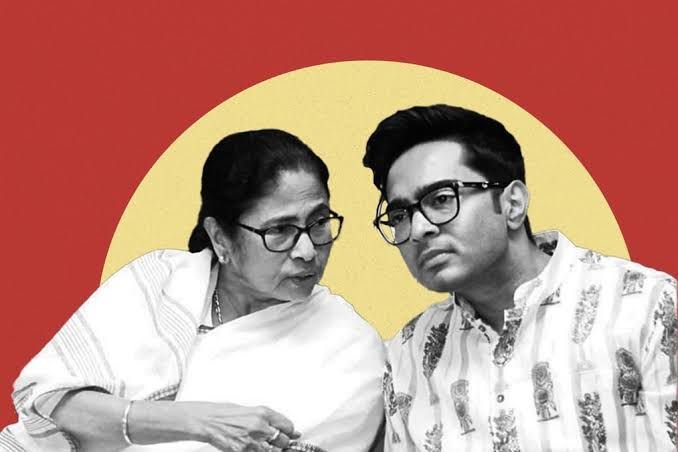

Having carved a niche for herself in Bengal politics through her struggles, Mamata Banerjee is now on the verge of losing not only power but her party, TMC, as well. Even though her nephew, Abhishek Banerjee, is being called the ‘villain’ for this situation, the real fault lies in Mamata Banerjee’s management. This is the issue of ‘Nephew Management.’
………
A few days ago, a TMC leader in Cooch Behar had an announcement made over a loudspeaker that those who paid ‘cut-money’ to him for the Pradhan Mantri Awas Yojana (PMAY) should come and take it back from him. It was revealed that villagers had paid this leader between 5,000 to 25,000 rupees per person. Similarly, in Jalpaiguri, a couple complained that a local TMC leader had taken cut-money from them to facilitate a house under PMAY, which he was now refusing to return. The police have arrested the accused. Many such cases are coming to light in Bengal every day.
……….
Cut-money means commission, bribery, or extortion. Cut-money is also linked as a major reason for the electoral downfall of the Trinamool Congress. After the BJP, even disgruntled leaders within the Trinamool Congress are now calling Abhishek Banerjee the ‘kingpin’ of cut-money.
……..
The historical results of the West Bengal Assembly elections have completely overturned the state’s politics. The Trinamool Congress, which had been in power for 15 years, has had to face a humiliating defeat, with the party restricted to just 80 seats. After this defeat, while Mamata Banerjee’s prestige has suffered a deep blow, her nephew, Abhishek Banerjee, has become the center of the most insult and anger within the party. There is an open rebellion against Abhishek within the TMC, and his supporters are facing the wrath of party workers on the streets.
……..
In such a situation, the question arises: where did Mamata Banerjee go wrong, and why did she let Abhishek become her ‘Achilles’ heel’ (weakness) ?
…….
The history of Indian politics is witness to the fact that whenever a big leader has given more encouragement than necessary to their family members or close relatives, dissatisfaction has erupted both within and outside the party. In such cases, those leaders have been considered more mature who handled the situation before it deteriorated. An interesting comparison can be drawn between Mamata Banerjee and former Uttar Pradesh Chief Minister Mayawati, where both have faced similar challenges. But their reactions were different. Both are serious faces of politics who started from scratch and built a vast empire on their own strength. Both are fighters, connected to the grassroots, and have a firm grip on their vote banks. But in the front of ‘nephew-management,’ that is, handling their political successors, Mamata Banerjee lagged far behind Mayawati in this game.
……
Abhishek’s Immature Promotion !
……………………………………………………………….
As soon as Mamata Banerjee came to power in Bengal in 2011, she made Abhishek Banerjee the president of the Trinamool Youth Congress. At just 26 years of age, he won the 2014 Lok Sabha elections and reached Parliament. In his short political journey, he created an identity as a leader who made sharp statements. His confidence was growing, and so was the freedom he received from Mamata Banerjee.
……….
In the 2016 assembly election campaign, he was taking on Amit Shah and Modi directly. Trinamool got a second chance in Bengal and a ‘number 2’ position. Seeing his rising stature, senior leaders of the party were getting sidelined and dissatisfied, and Mamata Banerjee was paying no attention to all this.
In 2022, Abhishek was even heard saying that politicians should retire at the age of 60. Analysts believed that by sidelining Mamata, he wanted to capture the Trinamool completely as soon as possible.
After becoming the National General Secretary of the TMC, all decisions related to the party organization and elections went into Abhishek’s hands. Abhishek Banerjee tried to change the old structure of the party, which was called ‘corporate-style politics.’ He started sidelining old leaders with the help of election strategists (such as I-PAC). The result was that strong leaders like Suvendu Adhikari, who was once Mamata’s most trusted, left the party and joined the BJP, and today he has ousted Mamata from power and achieved the Chief Minister’s chair. After losing the election, a former MLA of the party had openly said, “Abhishek’s arrogance of power and nepotism ruined the entire party. Mamata Banerjee knew everything, but out of affection for her nephew, she remained a ‘Dhritarashtra’ and could do nothing.”
……..
In contrast, when such a situation arose before Mayawati, she removed her nephew Akash Anand from the post of National Coordinator of the BSP and clearly stated, “Until Akash is completely mature, he will not remain in this big position.”
……
Mamata remained a shield in BJP’s ‘Bhai-po Tax’ attack
……………………………. ………………………………….
The BJP used Abhishek Banerjee as Mamata Banerjee’s biggest weakness. In cases like coal smuggling, cattle smuggling, and teacher recruitment scams, the needle of investigation by central agencies (ED and CBI) was always hovering around Abhishek. The top leadership of the BJP set a narrative throughout the election that while Mamata Banerjee lived simply and wore flip-flops, her nephew and his family were running corruption and a syndicate raj.
……..
Amit Shah and Suvendu Adhikari repeatedly mentioned ‘Bhai-po Tax’ (Nephew Tax) in election rallies and instilled in the public mind that the sole goal of the Mamata government was to make Abhishek Banerjee the next Chief Minister. Mamata would come forward every time to protect her nephew, which sent a message to the public that she was acting as a shield for her nephew more than for the law and order of the state.
…….
Where did Mamata Banerjee go wrong ?
………………………………………………………………
For three major reasons:
Weakened by affection for the nephew – Mamata Banerjee had always portrayed herself as a selfless leader who has no family, but in Abhishek’s case, her ‘strong politician’ image became weak.
Feedback system and Syndicate Raj – The new corporate circle that formed around Abhishek did not let the real discontent of the ground reach Mamata. Corruption and job scams were dismissed as a ‘conspiracy of the opposition,’ while anger was simmering among the public.
…..
Not putting the brakes in time: If any new leader starts challenging established grassroots leaders in politics, the top leadership should intervene immediately. Instead of stopping Abhishek, Mamata gave him a ‘free hand,’ which has created a danger of the TMC breaking apart.
……
Future Politics ?
………………………………
The results of the 2026 Assembly elections have ended the 15-year dominance of the Trinamool Congress. This defeat is not just a change of power, but a direct strike by the public on Mamata Banerjee’s excessive affection for her ‘son-like nephew.’ Mamata Banerjee is still considered a big leader today, but her insistence on placing Abhishek Banerjee at the top without struggle has ruined the entire party.