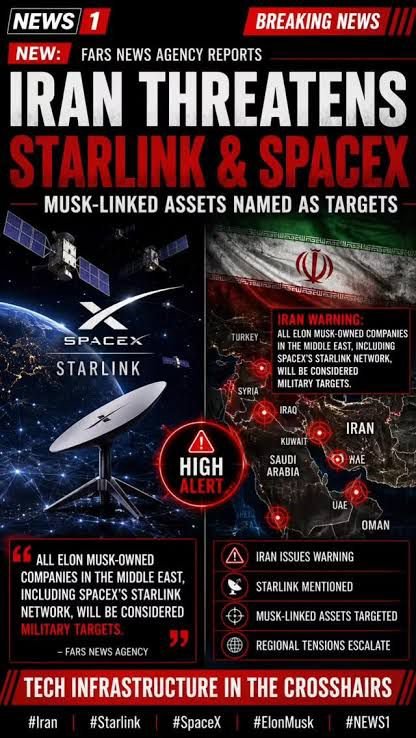
Amidst the ongoing Middle East conflict, Iran has declared Elon Musk’s companies—including Starlink, the social media platform X, and other business interests—as legitimate military targets. Following their inclusion on the Islamic Revolutionary Guard Corps’ (IRGC) hit list, threats of missile and cyberattacks against Musk’s technology and infrastructure have been issued.
Iran’s Strategic Warning
In the wake of escalating tensions in the Gulf, Iran has issued an open warning, declaring that it will consider the assets of Starlink, X, and other Musk-owned enterprises in the Middle East as legitimate targets for its military. Tehran alleges that Musk’s companies have provided critical support to the United States and Israel in their operations against Iranian interests.
Expansion of Target Bank
According to reports from state-controlled media outlet ‘Fars,’ Iran is systematically expanding its list of potential strike targets. This list now formally includes Musk’s regional corporate assets, physical Starlink ground stations—specifically citing facilities in Israel, Jordan, Qatar, the United Arab Emirates, and Oman—as well as other SpaceX regional partnerships.
Iran’s Allegations of Complicity
Iranian officials claim that Musk’s companies have cooperated in high-tech operations conducted by the US and Israel, including drone strikes and the deployment of unmanned naval vessels. Iran maintains that the utilization of this private technology in military contexts constitutes a violation of the rules of war, justifying their intent to strike these offices and service hubs via missile or cyberattacks.
Connection to US Rhetoric
This aggressive posturing follows public statements from US President Donald Trump regarding the conflict, including assertions about launching powerful strikes on Iran and seizing key energy infrastructure like Kharg Island. These threats represent an intensification of the broader geopolitical confrontation between Washington and Tehran.
IRGC Hit List and Tech Focus
The inclusion of Musk’s companies is part of a broader strategic shift by the IRGC. Earlier this year, the organization transitioned its focus from conventional military hardware to Information and Communication Technology (ICT) and Artificial Intelligence (AI) firms. Reports indicate that the IRGC’s official hit list now includes over 18 major American technology and logistics corporations.
Potential Impact on Starlink
The direct targeting of Starlink’s ground stations poses a significant risk to satellite-based connectivity across the region. The operational security of these facilities is now a matter of acute concern, as the scale of any potential Iranian attack would directly dictate the level of disruption to communication services in the Middle East.
.
Analysis
………………….
Iran’s decision to classify commercial technology entities like Starlink and X as “legitimate military targets” marks a significant escalation in modern asymmetric warfare. By blurring the lines between traditional military infrastructure and private telecommunications, Tehran is signaling that it no longer views the digital and physical assets of multinational corporations as neutral or immune to conflict.
.
The timing of this threat, occurring amidst high-stakes negotiations between the US and Iran to end the regional war, suggests that Iran is utilizing “asymmetric deterrence.” By threatening the communication networks that facilitate modern military coordination, Iran is attempting to impose a significant cost on the US and its allies that extends well beyond the physical battlefield. The inclusion of these companies on a broader “hit list” reflects a strategic pivot toward targeting the technological and economic backbone of Western influence in the region. If realized, such attacks would not only threaten commercial infrastructure but could also disrupt vital civilian communications, potentially forcing the US to expand its defensive posture to include the protection of private corporate assets alongside its military hardware.