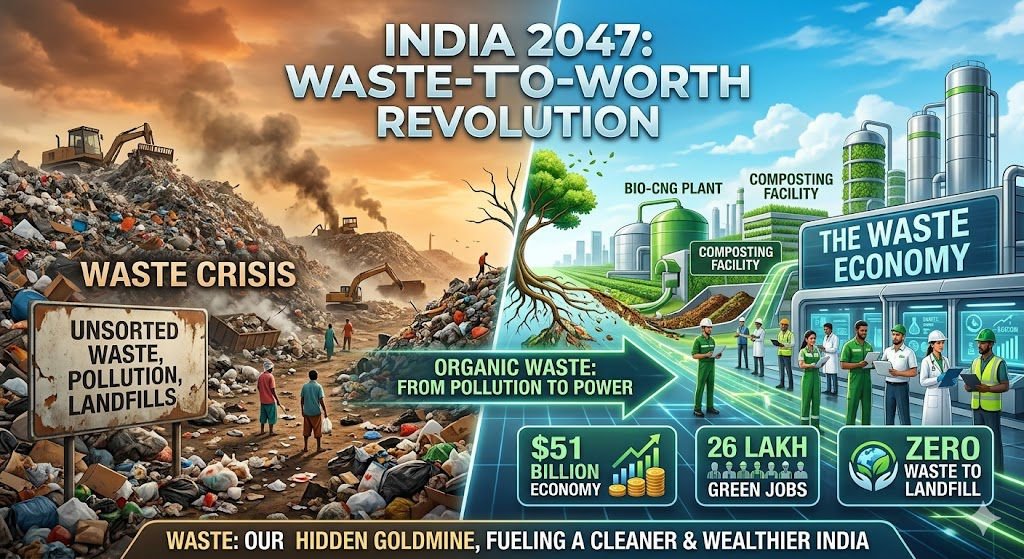
Highlights – Can India’s waste become the biggest secret treasure of a $51 billion economy and 2.6 million jobs by 2047 ? Will the organic waste rotting in dumping grounds solve both the energy crisis and pollution by turning into Bio-CNG ? Will the mountain of 208 million tons of waste lead India toward an environmental disaster, or will this same waste prove to be the country’s biggest Green Revolution ?
In Indian cities, the massive mountains of waste—long considered merely a major nuisance and a breeding ground for disease—are actually poised to become the largest economic engine capable of changing the nation’s destiny. According to a recent and highly startling study by the ‘Council on Energy, Environment and Water’ (CEEW), India’s urban organic waste (leftover food, vegetable peels, and garden waste) could build a massive market worth about $51 billion (over ₹4.2 lakh crore) by the year 2047. But the real suspense lies in whether India can turn this waste crisis into its greatest strength in time.
The Ticking Time Bomb: The Horrifying Truth Behind Waste Mountains
……………………………….
. The report’s data reveals that about 1.71 lakh tons of municipal solid waste are generated in India every day, half of which is entirely organic (wet waste). Shockingly, even in this modern era, only 61 percent of this total waste is processed.
The remaining waste continues to rot in drains, illegal dumping sites, or landfills. When this waste is burned in the open, it increases deadly PM2.5 pollution in cities by up to 10%. Even more dangerous is the methane gas released from rotting waste, which is many times more lethal than carbon dioxide.
Between 1994 and 2020, emissions from India’s waste sector increased by 226 percent. If strict steps are not taken today, this waste will cross 208 million tons annually by 2047, which is a sign of a major environmental catastrophe.
The Mega-Bet of 2.6 Million Jobs: The Rise of a New ‘Green Workforce’
………………………………..
According to the CEEW study, if India adopts the right technology, this sector could deal the biggest blow to the country’s unemployment crisis.
The Mathematics of Bio-methanation Plants
To run a typical plant with a capacity of 100 tons per day, about 31 employees (chemists, technicians, operators, and laborers) are required.
The Power of Composting Plants: A composting plant of the same scale provides direct employment to about 28 people.
The Mega-Goal of 2047
LIf a “fast policy” is implemented in the country, direct jobs in this sector could jump from the current 4 lakh to 26 lakh. This will create a massive ‘Green Workforce’ in fields ranging from waste collection to logistics, energy production, and the sale of manure.
Three Paths to Becoming a Millionaire from Waste—Which Way is India’s Future Headed ?
………………………………..
CEEW has placed three potential futures (models) before India, which will determine what our cities will look like in 2047:
Business-as-Usual: Extremely slow progress, waste dumping continues. The market size is negligible, and emissions will rise to 120 million tons.
Fast Policy Model (95% waste processing): Massive investment of $24 billion. This will lead to a net reduction of 68 million tons in emissions.
Mega-Transformation Model (100% Bio-CNG production): A $62 Billion (Massive Market). This will offset over 100 million tons of emissions.
At the center of this entire transformation lies a magic fuel—Bio-CNG. When wet waste is compressed, it becomes the cleanest alternative to fossil fuels (petrol-diesel). Currently, 96% of India’s capacity is tied up only in making manure (composting), while the contribution of ‘bio-methanation,’ which offers the highest profits and energy security, is only 4%. Balancing this is the biggest challenge.
‘Solid Waste Management Rules 2026’ Implemented: But Will the Ground Reality Change ?
………………………………
Since April of this year, the Solid Waste Management Rules, 2026 have been implemented in India, which make it legally mandatory to segregate waste at the source (home/hotel). India has plans from 16 ministries like Swachh Bharat Mission-Urban, GOBARdhan, and SATAT, but the real suspense and problem lie in their coordination and poor implementation. Municipalities still pay contractors based on the ‘weight of the waste’ rather than the ‘quality of waste segregation.’ The result ? Mixed waste goes directly to the dumping grounds, causing fires and spreading pollution.
According to CEEW fellow Prarthana Borah, “Waste management is not just a cleaning job, but basic infrastructure for clean air.”
5 Achuk (Unfailing) Mantras for a Solution
100% segregation of wet and dry waste at the household and hotel levels.
………………………………..
Municipal contracts should be based on ‘performance’ rather than ‘weight.’
Employees should be trained in modern waste processing.
A reliable and strong market for compost and Bio-CNG should be created in the country.
Private investors should be attracted through Green Bonds and Hybrid Annuity Models.
If India overcomes these obstacles, in the near future, waste will prove to be the biggest means of eradicating the country’s poverty and bringing $51 billion in prosperity.