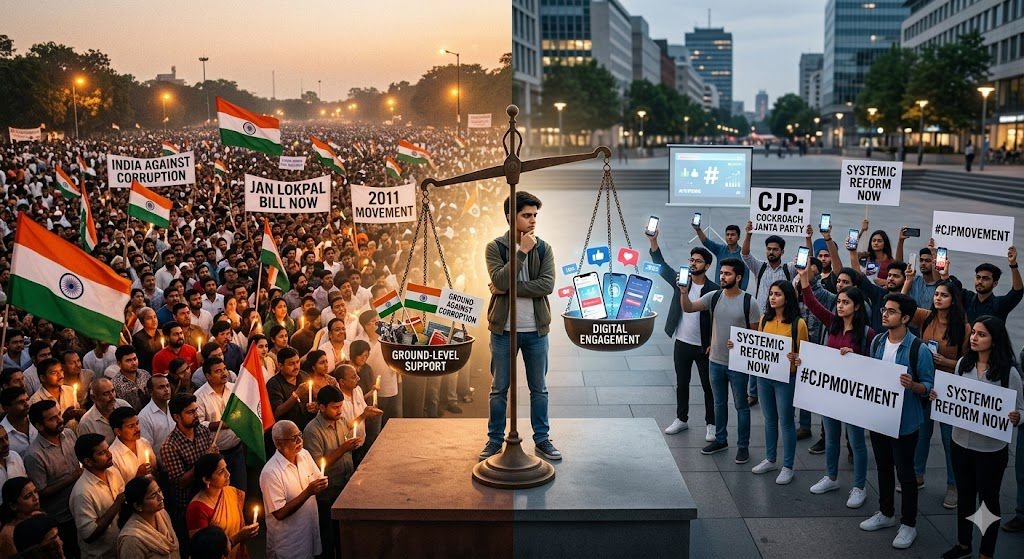
The Cockroach Janta Party (CJP) movement is now preparing to take to the streets of India, with its main target being Education Minister Dharmendra Pradhan. Led by Abhijit Dipke, this campaign has gained significant popularity on social media. The support of Sonam Wangchuk has further strengthened this movement.
However, critics argue that there is a large gap between social media popularity and ground-level support. Can the CJP make an impact like the Anna Hazare movement ? This has now become a major topic of discussion.
The Rise of the Cockroach Controversy
………………………………………………………………..
A comment by the Chief Justice of India gave birth to the ‘Cockroach Controversy’, which could potentially take the form of a show of strength on the streets of India. Following the CJI’s remark, Abhijit Dipke started a campaign called ‘Cockroach Janta Party’ (CJP), which has achieved immense popularity on social media, even surpassing the BJP in terms of engagement. Currently, the party is planning to take to the streets, specifically to demonstrate against the Education Minister.
This upcoming movement is being compared to the Anna Hazare movement during the UPA government era, which has now sparked hope among the people.
The Emergence of CJP
………………………………………………..
In recent weeks, the CJP has emerged as a symbol of the growing frustration among the youth and a lack of faith in the education system. Its founder, Abhijit Dipke, has announced that he will return to India, protest in Delhi, and hit the ground with his supporters.
Support from Sonam Wangchuk
……………………………………………………………..
Renowned environmentalist and educator Sonam Wangchuk has extended his support to the CJP. He stated that if the Education Minister does not resign by June 5, he will join the CJP’s protest on June 6. Abhijit Dipke has also shared his video.
Abhijit’s Statement
…………………………………………..
Abhijit Dipke has claimed that his protest will be peaceful. He stated that his intention is not against any individual or political party, but a demand for accountability in the system. However, some critics opine that there is a huge difference between social media popularity and an actual ground-level movement.
Comparison with the Anna Movement
……………………………………………………………….
The Anna movement started in 2011 against corruption, at a time when several major scams were making headlines. At that time, Anna Hazare went on a hunger strike demanding the Jan Lokpal Bill. Compared to that, there is currently a significant lack of ground-level support for the Cockroach Janta Party.
Call to Action for CJP
……………………………………………
The strength of the Anna movement lay in its clear demands, an active network, and national leadership. Social media was emerging at that time, but the real power was the people on the streets. Currently, the challenge for the CJP is how to take its movement forward and maintain non-violence during peaceful demonstrations.
Analysis
………………..
The movement under the banner of the ‘Cockroach Janta Party’ (CJP) represents a modern form of how political dissent is organized in the digital age. By expressing frustrations related to the education sector through social media, Abhijit Dipke has succeeded in capturing the attention of a segment that has lost faith in traditional grievance redressal systems.
While a comparison with the 2011 Anna Hazare movement seems inevitable, it highlights the primary obstacle CJP faces: the ‘digital-physical gap.’ Where the 2011 movement used social media as a megaphone for pre-existing active networks, CJP appears to be attempting to reverse this sequence—aiming to build physical ground strength from a digital infrastructure.
To transform such a movement from a ‘viral trend’ into a systemic change-making force, symbolic demonstrations are not enough. It requires :
Organized Agenda – A well-thought-out policy alternative and clarity of demands.
Sustained Mobilization – The ability to keep the movement alive after the initial wave of digital anger subsides.
Credibility – The support of personalities like Sonam Wangchuk has certainly provided this movement with an intellectual and moral foundation.
Ultimately, the success of this movement will depend on whether it can convert online engagement into a sustained political pressure that is difficult for the ruling establishment to ignore.