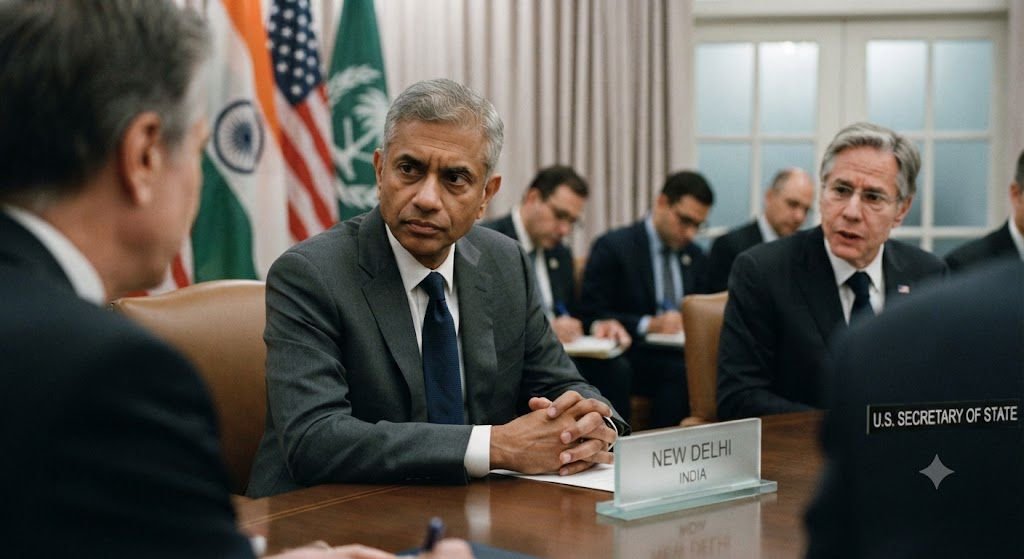
The United States, currently engaged in a conflict with Iran, has now realized that if anyone can pull it out of the quagmire of West Asia or has the capacity to halt this war, it is only India. According to reports emerging from Washington over the past 24 hours, serious discussions have taken place among American strategists and defense experts regarding India’s role. The U.S. is well aware that while India maintains extremely strong ties with Israel and the United States, it also shares historical diplomatic relations with Iran. Therefore, in this hour of crisis, India’s mediation and its stance matter the most.
…………………………………..
India has maintained an extremely robust position throughout this entire sequence of events. India is formulating its policies without succumbing to any pressure. Statements emanating from the White House make it clear that they acknowledge India’s sovereignty and its diplomatic capability. India holds the upper hand in this conflict because its economy is fully prepared to withstand this shock, whereas the warring nations are reaching the brink of economic recession. In an assertive manner, India has demonstrated that it will not become a follower of any faction; rather, major global powers will formulate their strategies in accordance with India’s interests.
…………………………………..
Analys
…………………………………..
Strategic Evaluation
The text highlights a significant paradigm shift in contemporary geopolitics: the elevation of India to a crucial balancing power in West Asian dynamics.
Diplomatic Equidistance and Trust: India’s foreign policy framework rests on strategic autonomy. By maintaining deep, trusted partnerships with the United States and Israel on one side, while preserving historic, stable diplomatic and economic channels with Iran on the other, New Delhi occupies a unique position. In moments of severe regional escalation, traditional Western mediation channels often face trust deficits with anti-Western actors like Iran; India, however, remains uniquely positioned to communicate credibly across ideological divides.
Economic Resilience as Soft Power: The commentary correctly underscores that economic stability is a prerequisite for diplomatic leverage. As prolonged conflicts strain the fiscal health and energy security of direct participants and Western economies, India’s robust domestic growth trajectory and measured economic management afford it the strategic breathing room to prioritize national interest over external alignments.
From Non-Alignment to Multi-Alignment: The narrative moves away from traditional Cold War non-alignment toward proactive multi-alignment. Rather than acting as a junior partner or a bloc follower, India’s assertive stance signals to global superpowers that durable security frameworks in Asia and beyond cannot bypass Indian geopolitical calculations.
About the Author