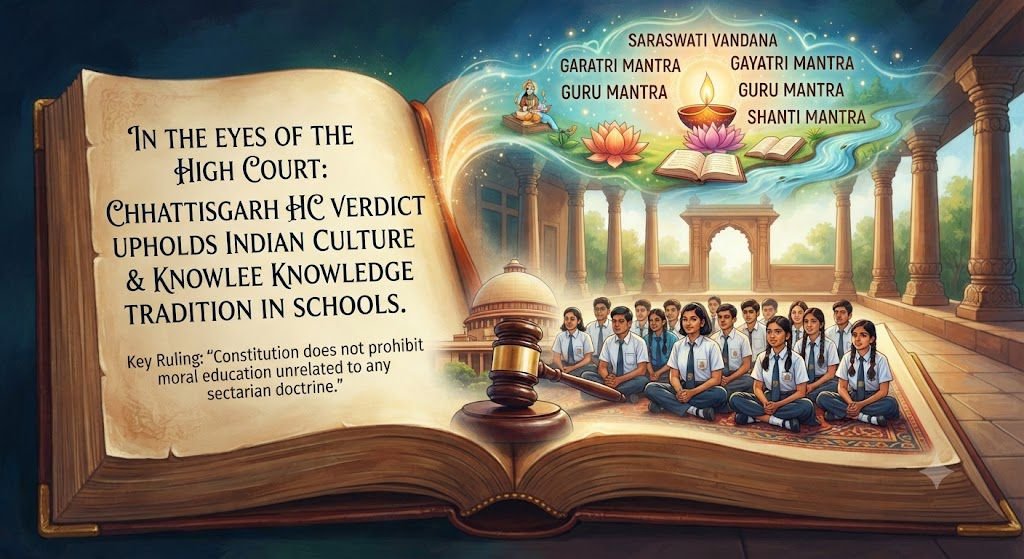
The recent verdict of the Chhattisgarh High Court is a precedent for those who often raise questions about the Indian Hindu knowledge tradition and the fundamental moral principles of the religion. Therefore, this is not limited to the validity of a government circular alone, but also serves as an answer to that core question which has been running in the country for a long time—whether Indian culture and its knowledge tradition should be a part of school education or not. In fact, while dismissing the petition challenging the state government’s directive regarding the recitation of Saraswati Vandana, Gayatri Mantra, Guru Mantra, and Shanti Mantra in government schools, the High Court clarified that the Constitution does not prohibit “moral education unrelated to any sectarian doctrine.” This remark should be seen as an important judicial interpretation that establishes a balance between the Indian education system, the Constitution, and cultural heritage.
…………….
The primary objective of the Hindu tradition is the development of excellent values within humanity
……………………………………………………………….
It must be said that the concept of Indian education is always based on the principle of “Sa Vidya Ya Vimuktaye” (Knowledge is that which liberates). Here, the purpose of education is not merely to obtain employment, but to prepare citizens who possess character, discipline, sensitivity, and social responsibility alongside knowledge. For this reason, from the Gurukul tradition to modern schools, prayer, Shanti Path, Guru Vandana, and moral values hold a special place. The primary objective of these traditions is the development of excellent values within humanity. The system implemented by the Chhattisgarh government in its schools had the stated objective of connecting students with Indian knowledge tradition, cultural consciousness, and moral values. The National Education Policy-2020 also clearly accepts the Indian knowledge system, local traditions, and value-based education as important parts of the school curriculum. In such a situation, this effort of the state government can be accepted as an extension of that broader policy.
……….
The petitioners had attempted to give this arrangement the form of religious education by citing it as a violation of Articles 14, 21, 25, 28, 29, and 30 of the Constitution. Their argument was that such mantra recitation in government schools might make students of minority communities uncomfortable. This was a constitutional question, the answer to which could not be given based solely on emotions, but only through the language and intent of the Constitution. Here, the High Court’s decision becomes significant. The court clarified that the intent of Article 28(1) is to prevent the teaching of rituals, worship methods, or religious doctrines of any particular religion in state-funded institutions, but this does not mean that cultural values related to moral education, civic duty, social harmony, and character building should also be considered prohibited.
…………….
In the Indian tradition, the Gayatri Mantra is accepted as a symbol of prayer for wisdom
……………………………………………………………….
The court also observed that there is no mandatory provision in the government order that compels any student to act against their religious beliefs. Importantly, the order did not contain any provision for punitive action against any student; therefore, this decision also indirectly casts a question mark on the ideology that creates an artificial conflict between Indian culture and the Indian Constitution.
………….
In the Indian tradition, the Gayatri Mantra is accepted as a symbol of prayer for wisdom, the Shanti Mantra as a wish for the welfare of the whole world, and the Saraswati Vandana as a symbol of dedication to knowledge. The core essence of these is moral and humanistic. Viewing these merely from a narrow religious perspective would be akin to limiting the vastness of the Indian knowledge tradition. Another important aspect of this decision is linked to the National Education Policy-2020. The new education policy goes beyond technical competence and emphasizes the construction of the entire personality. In it, the Indian knowledge tradition, cultural heritage, moral values, and constitutional duties have been described as integral parts of education. If schools turn children into mere machines to pass examinations and do not develop discipline, compassion, gratitude, national consciousness, and social responsibility within them, then education will remain incomplete.
……………….
Today, when society is facing many social challenges, rising violence, addiction, digital obsession, and moral crises, the need for value-based education in schools is felt more than ever before. These values should not be limited to any one religion (Hindu) and considered narrow, because the best principles of any religion are the shared needs of a civilized society. If the positive traditions of Indian culture help in developing self-discipline, concentration, sense of duty, and the feeling of excellent citizenship among students, then instead of prejudice, they should be viewed with discernment.
…………
The decision of the Chhattisgarh High Court represents this balanced ideology. The court neither compromised with the secular spirit of the Constitution nor viewed Indian cultural heritage with suspicion. It clarified that there is a fundamental difference between moral education and sectarian education and that both cannot be considered synonymous. In fact, this decision will not remain limited to Chhattisgarh. It will be a reference point for many discourses related to education, culture, and the Constitution in the future. This also conveys the message that in Indian democracy, the Constitution and culture are not rivals but complementary to each other. Their purpose is to foster a sense of harmony, morality, and responsibility in society while respecting individual freedom. Along with this, it has also become clear that those who see the Indian Hindu religion and culture through a narrow lens should expand their perspective. The moral values of the Hindu religion are beneficial to all; that is, they take every human being’s life forward in an excellent direction. This is far above the limited scope of any community, opinion, sect, or religion. Therefore, all the principles of the Hindu religion are for the welfare of all humanity; they are equally beneficial for everyone.
………..
Analysis – Coordination of Education and Culture from a Judicial Perspective
The verdict of the Chhattisgarh High Court has brought an intellectual and constitutional turn in the Indian education system. Analyzing this decision brings several important points to the fore:
Morality vs. Sectarianism – The court has drawn a line very beautifully between ‘moral education’ and ‘religious/sectarian education.’ The mantras present in the Indian knowledge tradition (such as the Gayatri Mantra) are not just rituals; rather, the message of intellectual and moral excellence contained in them is intended for all of humanity. Limiting this to the bondage of one religion is a narrow ideology.
……….
Secularism of the Constitution – Often, secularism is misunderstood as ‘distance from religion.’ However, this verdict clarifies that the Indian Constitution does not forbid teaching cultural consciousness and human values. Rather, if any tradition helps in discipline, sense of duty, and character building, it can be included within the constitutional framework.
………….
Coordination with National Education Policy (NEP-2020) – This decision and the goal of NEP-2020 are completely in sync. Modern education is intended for the development of the entire personality, not remaining limited only to bookish knowledge. The inclusion of the Indian knowledge system will help in keeping children connected to their roots and shaping them into sensitive citizens in today’s digital age.
……….
Universal Welfare Perspective – As mentioned in the essay, the core principles of the Hindu religion are for universal welfare. When violence, addiction, and mental crisis are increasing in society, these positive values of Indian culture can act like a medicine.
Conclusion – This decision clarifies that the Constitution and culture are not rivals but complementary to each other for the formation of a healthy society. It will inspire the adoption of a discerning and integrated perspective in the field of education instead of prejudice.
About the Author