By- Jawahar Mishra
Spiritual scientist
Naturopathy Specialist
Senior Journalist
……………………………………………………………..
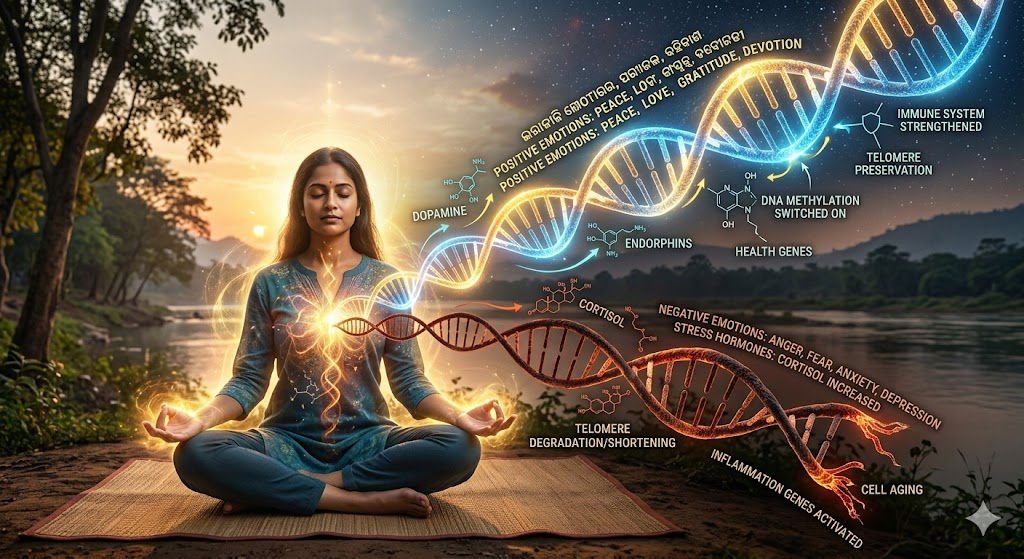
According to new research in science, specifically in the field of ‘Epigenetics’, human emotions and thoughts are not limited to the mental level; they also have a profound impact on the body’s biological structure or DNA.
The scientific analysis of this is provided below –
……………………………………………………………..
The Impact of Negative Emotions:
……………………………………………………………..
When a person constantly lives amidst various bad thoughts (such as thinking of harming others, greed, looting, grabbing, exploitation), work, anger, fear, anxiety, or depression, the level of stress hormones like ‘Cortisol’ increases in the body.
…….
Impact on Telomeres – According to scientists, due to such negative emotions, excessive mental stress quickly degrades the ‘Telomeres’, the protective shield at the end of the DNA.
……
The shortening of telomeres due to degradation means that cells age quickly and the immune system weakens.
…….
Gene Expression – Negative emotions activate genes that create inflammation in the body, which increases the risk of chronic diseases.
……
The Impact of Positive Emotions:
……………………………………………………………..
Positive emotions like peace, love, gratitude, joy, philanthropy, and especially devotion to the Divine, stimulate the secretion of positive chemicals like ‘Dopamine’ and ‘Endorphins’ in the body.
……..
DNA Repair: Research suggests that positive thinking and deep meditation (Samadhi or mental stability) accelerate the body’s DNA repair process.
……
Immune System: It makes the genes associated with the body’s immune system more active and powerful.
…….
The Role of Epigenetics:
……………………………………………………………..
Our DNA’s core code (Genetic Code) does not change, but our emotions act like a ‘chemical switch’ upon it. This is called DNA Methylation.
……..
Meaning, a person’s emotions determine which of their genes will be active (Switch On) and which will remain inactive (Switch Off).
………
Conclusion:
……………………………………………………………..
Human thoughts are like a biological signal. Through positive emotions, we can improve our genetic potential, which is helpful not only for health but also in increasing longevity.
Additional Scientific Perspectives
To further analysis, here are a few pertinent scientific concepts –
Heart-Brain Coherence- Research from the HeartMath Institute indicates that when we experience positive emotions like appreciation, our heart rhythm becomes “coherent.” This physiological state sends signals to the brain that can reduce cortisol and improve cognitive function, effectively altering the biochemical environment in which our DNA resides.
The Mind-Body Bridge – Scientific studies on mindfulness-based stress reduction (MBSR) have shown that regular meditation can actually downregulate the expression of pro-inflammatory genes. This serves as a practical, observable example of how subjective mental states translate into tangible, microscopic biological changes.
Transgenerational Epigenetics – While our personal thoughts impact our own gene expression, emerging evidence suggests that certain epigenetic markers—influenced by chronic stress or trauma—can potentially be passed down to offspring, highlighting the profound responsibility of maintaining a healthy emotional state for future generations.
…………………………………………………………..
What says Indian philosophy ?
…………………………………………………………….
Indian philosophy, especially the Vedas, the Upanishads, and the Srimad Bhagavad Gita, has repeatedly emphasized the importance of controlling the mind and fostering noble thoughts (Sadvichar). The mind is often compared to a horse or a chariot, which, if not controlled in the right direction, is driven toward an unrighteous path.
Below are some foundational verses regarding the control of the mind and noble thoughts:
1. Srimad Bhagavad Gita (Chapter 6, Verse 5)
This verse states that the mind is a person’s friend or enemy. A person who has conquered their mind finds a friend in it, but where the mind is unconquered (uncontrolled), it acts like an enemy.
Uddhared atmanatmanam natmanam avasadayet |
Atmaiva hyatmano bandhur atmaiva ripur atmanah ||
(Meaning: Elevate yourself by your own self; do not degrade yourself. Because this mind is the friend of the living entity, and this mind is the enemy of the living entity.)
2. Psychology and Noble Thoughts (Katha Upanishad)
In the Katha Upanishad, human life is compared to a chariot, where intellect (Buddhi) is the charioteer and the mind is the reins.
Atmanam rathinam viddhi shariram ratham eva tu |
Buddhim tu sarathim viddhi manah pragraham eva cha ||
(Meaning: Know the soul as the master of the chariot, the body as the chariot, the intellect as the charioteer, and the mind as the reins.) If the mind, in the form of reins, is not controlled by noble thoughts, the senses, like horses, will run toward unrighteous paths.
3. Patanjali Yoga Sutra
To remove unrighteous thoughts or ‘afflictions’ (Kleshas) from the mind, Yoga suggests ‘Pratipaksha Bhavana’ (practicing the opposite of unrighteous thoughts).
Vitarka-badhane pratipaksha-bhavanam
(Meaning: When an evil or unrighteous thought arises in the mind, one should immediately cultivate the exact opposite noble thought.)
These verses make it clear that noble thoughts are not just a piece of advice but a practice. By keeping the mind constantly alert through knowledge and positive thinking, unrighteous thoughts do not get the opportunity to enter.
About the Author