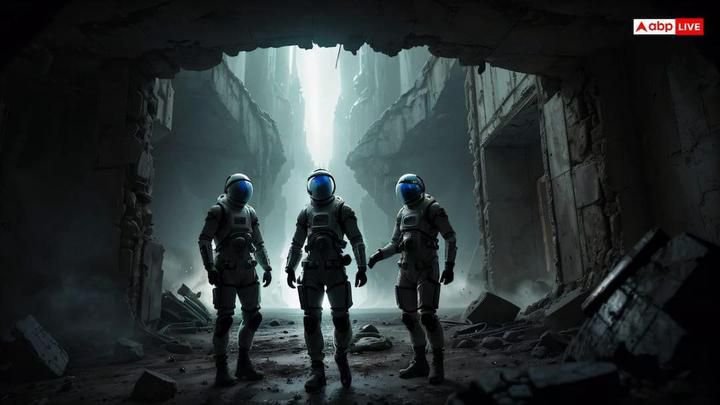
Highlights – According to research, alien spies or their technology could be present in our solar system. Scientists state that we do not possess the advanced technology required to detect them.
………………………………………………………
For many years, many major claims have been made regarding the existence of aliens in this solar system. Although this remains an unresolved question. No evidence of any aliens or Unidentified Flying Objects (UFOs) has been found in the solar system yet, but scientists believe that life could exist in our solar system. Astronomer T. Joseph W. Lazio has conducted a study on this. He says that it cannot be said with certainty whether any other civilization has sent its spy robots into our solar system or not.
…………….
According to astronomer T. Joseph W. Lazio, humans do not yet have the advanced technology to monitor the solar system. He said that humans have so far observed only a very small part of their solar system closely. He added that spies sent by another civilization could be anywhere around us; we just haven’t been able to find them.
…………………
Are there aliens in our solar system?
………………………………………………………………
According to media reports, astronomer T. Joseph stated that this idea about alien spies is not as strange or fictional as it sounds. He said, ‘Humans themselves have so far sent five spacecraft that will eventually exit our solar system. Their names are Pioneer 10 and 11, Voyager 1 and 2, and New Horizons. This proves that if a civilization is technologically advanced, it can send such spacecraft into space that can travel from one solar system to another.’
…………………
According to the research, alien spies or their technology could be present in our solar system in four ways. First—probes simply floating in space without any signals. Second—active spacecraft that are still operational and collecting data. Third—old machines that have crashed or landed on the surfaces of planets or moons. Fourth—automatic bases built on the surfaces of planets.
……………….
Why is it difficult to distinguish between real and fake ?
………………………………………………………
The biggest challenge for scientists is to distinguish between an asteroid and an alien machine in space. In the year 2020, scientists saw a mysterious object in space. Initially, it was considered an asteroid (rock), but later it was discovered to be debris from an old rocket launched by NASA in 1966. Something similar happened in 2017 when an object named ‘Oumuamua’ entered our solar system. Scientists are debating whether it was a strange natural rock or an exploratory craft of aliens.
Analysis
………………
According to research, alien spies or their technology could be present in our solar system. Scientists state that we do not possess the advanced technology required to detect them.
The provided article highlights a compelling intersection between astrobiology, space exploration, and the limitations of modern human technology. The central thesis—that our solar system could potentially host alien reconnaissance technology—shifts the search for extraterrestrial intelligence (SETI) from looking for active biological life to looking for persistent, automated “technosignatures.”
The analysis of the text reveals three key points regarding this scientific discourse:
Technological Asymmetry: The primary hurdle mentioned is the vastness of the solar system compared to our limited observational reach. Because human space exploration has only physically reached a small fraction of the solar system, the “darkness” mentioned in the headline refers to our lack of visibility rather than an intentional cloaking by external forces.
The Precedent of Human Probes: Dr. Lazio’s argument effectively bridges the gap between science fiction and reality by pointing to the Pioneer and Voyager missions. By acknowledging that humanity is already capable of sending autonomous craft beyond our solar system, the study establishes that such an endeavor is technologically plausible for any sufficiently advanced civilization.
The Identification Dilemma: The mention of ‘Oumuamua and the 1966 rocket debris underscores the “false positive” problem in space observation. As space becomes more crowded with human-made debris, distinguishing between natural phenomena (asteroids), human detritus (space junk), and potential alien artifacts becomes increasingly complex. This necessitates a more sophisticated classification system for interstellar objects.
In conclusion, while there is no definitive proof of an “alien army,” the research serves as a theoretical framework for potential discovery, reminding us that our current methods are likely tuned to recognize only what we already understand, potentially leaving us blind to more advanced, non-traditional surveillance technologies
About the Author