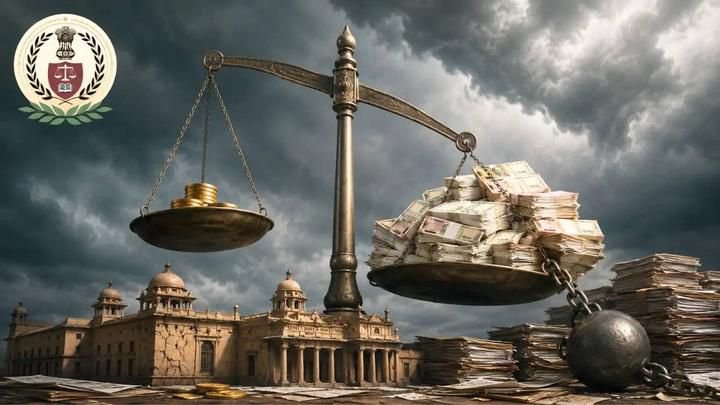
Highlights – CAG’s ‘State Finances Report’ raises alarms! The total debt on the country’s 28 states has crossed 90.51 lakh crore. Know the complete mathematics of deficits and expenditures.
…………………………………………………………
Are the states of our country stepping beyond their means? Has the earnings of the states become negligible compared to their expenses? The latest report by the Comptroller and Auditor General (CAG) of India has placed such bitter and shocking truths before the country. This report by the CAG has exposed the economic health of the states. According to this report, there is hardly any state left in the country that is not trapped in a quagmire of debt. Due to low income and high expenditure, the total debt of all 28 states of the country has now crossed the figure of 90.51 lakh crore rupees. The most worrying part is that 15 states in the country are running in massive deficits. Let us understand why the financial condition of our states is becoming so fragile.
………….
What is the ‘State Finances Report’ and who issued this warning ?
…………………………………………………………
The new Comptroller and Auditor General (CAG) of the country, K. Sanjay Murthy, released the ‘State Finances 2024-25 Report’ on Tuesday. This is no ordinary government document; rather, it is a complete balance sheet of the profits and losses of all 28 states in the country. While presenting this report, the CAG chief expressed hope that these figures would prove to be an eye-opener for governments, policymakers, and the general public. This will help states improve their financial condition and make correct decisions. However, the figures hidden within the report indicate that the promises and targets set by the states remain miles away from reality.
………………
The Mathematics of Income and Expenditure
…………………………………………………………
According to this report, at the beginning of the year 2024-25, 18 states in the country claimed that they would remain in ‘Revenue Surplus’. To put it simply, the goal of these 18 states was to spend less than their total income and save money. Three states had already acknowledged a deficit, and 7 states had set a target of ‘zero deficit’.
……………
But when the year ended, the result was completely the opposite. Out of the 18 states that set targets, only 9 states could meet their savings target. Overall, 15 states went completely into the abyss of deficit, while only 13 states were able to record some savings. The earnings of fortunate states like Uttar Pradesh, Gujarat, Jharkhand, and Manipur were higher than their expenses, but the remaining 15 states spent more than their capacity. To compensate for this additional expenditure, these states had to borrow heavily from the market.
…………….
Who benefited and who drowned in massive deficits?
…………………………………………………………
The CAG report provides a separate account for every state. Assam, Bihar, Chhattisgarh, Haryana, Himachal Pradesh, Karnataka, Maharashtra, Mizoram, and Telangana are included in the list of states that suffered a major blow and remained in total deficit.
……………..
On the other hand, out of the seven states that resolved to have zero deficit—Goa, Jharkhand, Punjab, Rajasthan, Tamil Nadu, Tripura, and Uttar Pradesh—only Uttar Pradesh, Goa, Jharkhand, and Tripura managed to save their reputation and remained in profit. Large states like Punjab, Rajasthan, and Tamil Nadu sank into a quagmire of heavy losses by the end of the year. In this difficult time, states like Himachal Pradesh, Mizoram, Punjab, and West Bengal were saved from drowning by the special grants received from the Finance Commission, i.e., the Revenue Deficit Grant.
…………..
The Increasing Burden of GSDP
…………………………………………………………
The Finance Commission has made a strict rule for all states in the country. The rule is that the fiscal deficit of any state should not exceed 3 percent of its Gross State Domestic Product (GSDP). But the CAG report states that 18 states of the country have crossed this Lakshman Rekha.
……………..
The total revenue deficit of these 15 states facing a deficit has reached 3,46,385 crore rupees, which amounts to 1.5 percent of their total economy. If we weigh all 28 states of the country on the same scale, the total net deficit was 2,19,041 crore rupees. This figure clearly states that the treasury received about 2.25 lakh crore rupees less than what the states expected to earn.
…………..
Where is the states’ money going ?
…………………………………………………………
Now the question arises, where is the income of the states coming from and where is this money going? According to the report, the importance of income from the states’ own taxes has increased significantly. In the year 2024-25, the total income of the states was 40.52 lakh crore rupees, out of which half—50 percent—was earned by the states themselves through tax collection. The biggest role in this tax income was played by the State GST (SGST), which is more than 43 percent of the total tax revenue.
……..
On the other hand, the total budget expenditure of the states reached 51.20 lakh crore rupees. If we look at the trend of the last ten years, a large part of the states’ income is being consumed not in development works, but in three things: salaries of government employees, pensions for the elderly, and paying interest on old debts. In the year 2024-25, more than 43 percent of the total expenditure went into just these three tasks. In Nagaland, the situation is so dire that 74 percent of its income is going into this, while in Maharashtra, this figure is around 29 percent.
……………….
When will this cycle of debt stop ?
…………………………………………………………
This CAG report is an eye-opener because it reveals that by March 21, 2025, the total mountain of debt on all 28 states of the country had increased to 90.51 lakh crore rupees. In the entire decade from 2015-16 to 2024-25, our states have been struggling with this disease of constant deficit. The COVID-19 pandemic in 2020-21 acted as fuel to the fire of this deficit, completely disrupting the economic balance.
………
The worrying thing is that even after the pandemic passed, a tremendous increase in the fiscal deficit of states considered prosperous, such as Andhra Pradesh, Gujarat, Karnataka, Kerala, Madhya Pradesh, Maharashtra, Odisha, and Uttarakhand, has been recorded. If the states do not curb free schemes and reckless spending in time, this debt trap could stop the economic pace of the entire country in the coming time.
About the Author