A.I ‘ s analysis is given below
Highlights –
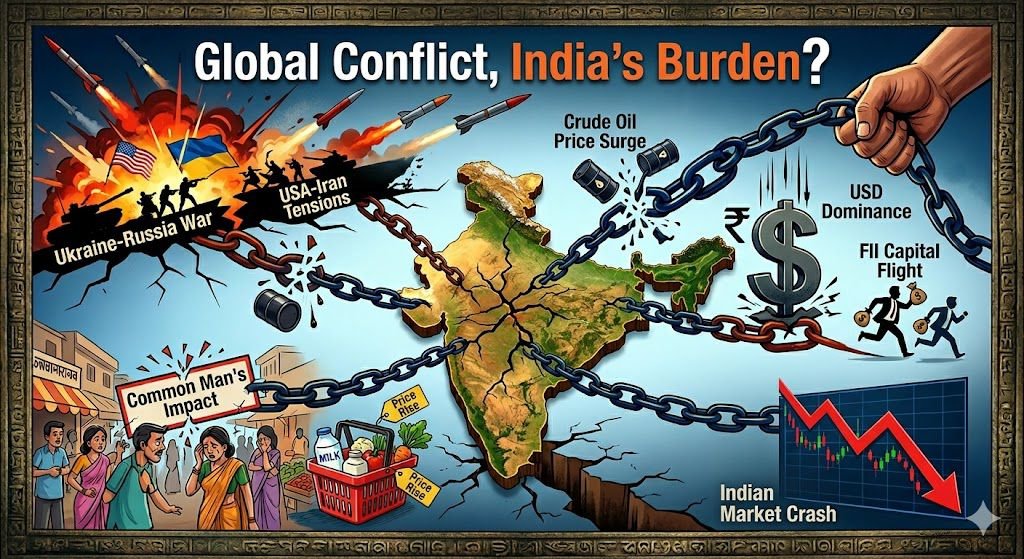
Why India ultimately pays the bill for every war in the world ?
The real reasons behind this situation.
The path to emerging from this ‘chakravyuh’ (complex trap).
India is navigating a period of economic crisis. The reasons are well-known: tensions in the Middle East. The situation is such that the people of India first check updates on crude oil and global conflicts upon waking up.
In fact, whether a missile is launched in some corner of the world, two nations clash, or a major power imposes sanctions on a weaker nation, the direct impact is felt on India’s wallet. It is a system where some create the conflict, and others (India) pay the price—a recurring scenario that troubles every Indian.
Whether it is the Russia-Ukraine war or the current conflict involving the United States and Iran, the devastation is clearly visible in the Indian stock market. While the U.S. stock market hovers near record highs, India’s market isn’t just battered; the pace of its GDP is poised to slow down.
The question now arises: Why must India pay the bill for every war in the world? What are the true reasons behind this? And how can India find its way out of this trap? This isn’t the first time this is happening; it’s not a coincidence. Four primary reasons are currently apparent.
1. Crude Oil (India’s Compulsion)
India imports approximately 85% of its crude oil requirements. In essence, India’s economy is sustained by oil. Whenever tensions arise in West Asia, and crises emerge on sea routes like the Strait of Hormuz, oil prices skyrocket, and India is left helpless.
In contrast, the U.S. calculates differently. The United States is no longer just a buyer of oil; it is the world’s largest oil producer. When oil becomes expensive, American companies benefit. This means that even in such crises, America faces no significant economic loss. India, meanwhile, bleeds dollars like water. In economic terms, this is called ‘imported inflation’—inflation caused by foreign decisions.
2. The Dollar’s Dominance
The global system dictates that India must pay for crude oil purchases in US Dollars. As uncertainty increases globally, global investors rush to buy dollars to keep their money secure. This strengthens the dollar and weakens the Indian Rupee. This has been happening for nearly the past two months. A weaker rupee directly means that oil purchased for $70-75 per barrel two months ago now requires a payment exceeding $100. The dual blow of rising crude oil prices and a weakening rupee impacts the Indian economy severely, putting direct pressure on foreign exchange reserves.
3. Stock Market Calculations
During times of global tension, the Indian stock market always witnesses a significant drop, with Foreign Institutional Investors (FIIs) as the primary cause. America, during such crises, remains insulated because it is considered the world’s ‘Safe Haven.’ As soon as war-like situations develop globally, foreign investors withdraw their profits from ’emerging markets’ like India and reinvest that money in U.S. government bonds or the American stock market. The result: India’s market crashes while America’s market remains robust.
4. The Direct Impact of Tension on Exports
India exports numerous products, including engineering goods, textiles, and chemicals. But when war shadows sea routes, exports are disrupted, or ships must navigate longer alternate routes. This can cause ship insurance premiums to increase by three to four times. Products imported into foreign markets thus become significantly more expensive, leading to reduced sales. Consequently, exports may stall, reducing the inflow of foreign currency.
The Cumulative Impact and Domestic Consequences
When all these crises converge, the nation’s growth rate—its GDP pace—slows down. India often can do little, as there may be no actual crisis on the domestic front. Just one factor, expensive oil, makes freight transport costlier. This increases the prices of everything from vegetables, milk, and rations. Then, to control inflation, the Reserve Bank of India (RBI) must raise interest rates. As interest rates rise, home loans, car loans, and business loans become more expensive.
When loans are expensive and people have less money in their pockets, the average citizen cannot afford to buy a new house, car, or phone, even if they wish to. If people do not buy, factories do not produce. If factories do not produce, new jobs are not created. This naturally slows down the GDP pace.
Analysis of the Provided Text
……………………………………………………………..
The provided text offers a detailed description of the economic ‘Chakravyuh’ (a classical Indian term for an inescapable trap) that India finds itself in whenever geopolitical conflicts erupt globally. The core argument is powerful: India is disproportionately punished for conflicts it did not start. The analysis correctly identifies four critical structural dependencies that render the Indian economy vulnerable to global shocks.
Evaluation of the 4 Reasons
The reasons cited are economically accurate and paint a clear picture:
Crude Oil Dependence (85% Import): This is a profound and long-standing strategic vulnerability. The text accurately describes ‘Imported Inflation.’ Because India must import this essential resource, price spikes in the Middle East immediately inflate domestic transport and manufacturing costs, spreading across the economy.
Dollar Dominance- The ‘Petrodollar’ system means India must maintain immense U.S. dollar reserves just to purchase energy. The phenomenon described—investors fleeing to ‘Safe Haven’ currencies (primarily USD) in times of panic—inevitably devalues the Indian Rupee. The text highlights the ‘dual blow’: paying a higher price (in dollars) while simultaneously suffering an exchange rate loss (weak rupee).
Stock Market Math (FII Flight) – The distinction made between India as an ‘Emerging Market’ and the US as a ‘Safe Haven’ is spot-on. Foreign Institutional Investors treat India as a source of high returns in good times but are quick to pull capital back to the stability of U.S. government bonds when global risk increases. This causes acute stress in India’s financial markets.
Export Disruption (Supply Chain Strain) – War in maritime corridors (like the Suez Canal or Strait of Hormuz) doesn’t just stop oil; it increases the cost and risk of all trade. The text highlights how increased freight and insurance costs destroy the competitiveness of Indian exports, leading to a wider trade deficit.
Domestic Policy Analysis
The second half of the text effectively traces the domino effect of a global oil price shock: Imported Oil Shock → High Domestic Inflation (Freight/Commodities) → RBI Policy Tightening (Higher Rates) → Slower Credit Growth → Reduced Consumer Spending (Demand) → Slowdown in Industrial Production (Supply) → Unemployment → Lower GDP. This analysis provides a sophisticated view of the monetary and real-economy trade-offs policy-makers face.
Analysis of Solutions/What Must India Do?
The text implicitly suggests the path forward by defining the trap. To escape this chakravyuh, India must:
Accelerate Energy Independence: This is the most critical strategic shift. India must dramatically scale up renewable energy (solar, wind) and green hydrogen production while modernizing its electrical grid. Success in the EV transition is also paramount to reduce oil consumption.
Internationalize the Rupee – To break dollar dependence, India must push for trade settled in Indian Rupees. This is a difficult, multi-decade process that requires deep financial market reforms, a stronger manufacturing base, and extensive bilateral agreements, particularly with major oil exporters.
Deepen Domestic Markets – To reduce vulnerability to FII flight, India needs a much deeper domestic investor base (mutual funds, insurance, pensions). This provides stability when foreign capital exits.
Enhance Strategic Autonomy – While navigating geopolitical tensions, India must continue to maintain balanced relationships that secure its strategic interests—such as continuing to purchase energy at non-dollar rates when feasible (e.g., in Russian roubles or Indian Rupees), despite diplomatic pressure.
About the Author