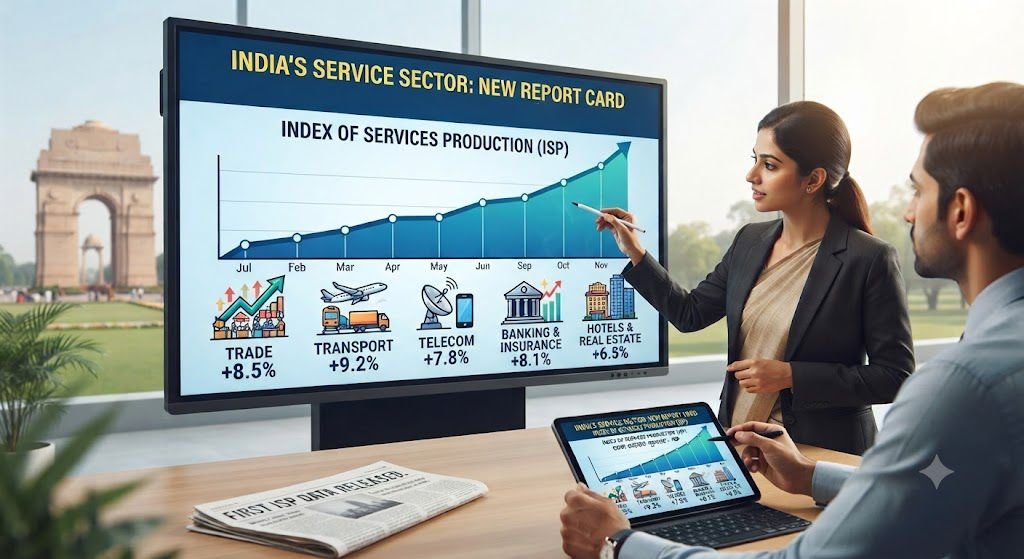

The government is taking a major step toward measuring India’s economy more effectively. From July 14, the Index of Services Production (ISP) will be released in the country for the first time. This will be a monthly indicator that will reveal how rapidly the country’s service sector is growing or if it is experiencing a slowdown. Until now, the government had the Index of Industrial Production (IIP) to measure industrial activities, but there was no such monthly index for the service sector. Given that the service sector currently makes the largest contribution to India’s economy, the ISP is being considered a major shift for the Indian economy.
……………….
What is the ISP ?
…………………………………………………………….
ISP stands for Index of Services Production. It will be a monthly economic indicator that will show whether activities in different service sectors of the country are increasing or decreasing. It can also be called the “IIP” of the service sector. Just as the IIP indicates the condition of the factory and manufacturing sectors, the ISP will indicate the health of the service sector.
……………..
Why was it needed ?
…………………………………………………………….
There has been a major change in India’s economy over the last few years. Earlier, manufacturing and agriculture had a higher contribution, but now the service sector accounts for more than 50% of the country’s GVA (Gross Value Added). Despite this, the government did not have a monthly indicator for the service sector. Consequently, the complete picture of economic activity remained obscured. The new ISP will bridge this gap.
……………..
Which sectors have been included ?
…………………………………………………………….
Several major service sectors have been included in the new index. Trade, transport, telecommunications, hotels and accommodation, entertainment, real estate, banking, and insurance represent about two-thirds of the service sector’s GVA. Therefore, all these sectors have been included in this index.
…………….
Why were health and education left out ?
…………………………………………………………………….
Currently, health and education will not be part of this index because reliable and regular data for these sectors is not yet available. The government plans to include these sectors in the index following the upcoming Annual Survey of Incorporated Services Sector Enterprises (ASISSE). Additionally, the informal service sector, public administration, defense, social services, and activities related to the central bank will also remain excluded for now.
…………….
Where will this data come from ?
…………………………………………………………….
Several government and administrative sources will be used to prepare the ISP. The primary source will be the data from GSTN (GST Network). In addition, administrative data from the railway, aviation, banking, and insurance sectors will also be utilized. This means the index will be prepared based on actual economic activities.
……………
How will this benefit the government ?
…………………………………………………………………..
Now, the government will be able to know every month whether the service sector is experiencing a boom or a slowdown. If a decline is observed in any sector, policy decisions can be made in a timely manner. This will make economic policy-making much easier.
………………
Why is it important for investors ?
…………………………………………………………….
Foreign investors, rating agencies, and market experts keep a close watch on the economic indicators of any country. Now, they will also receive monthly updates on the service sector. This will enable a more precise assessment of India’s economy and facilitate investment-related decision-making.
……………….
What will be its impact on the common man ?
…………………………………………………………….
The ISP will not put money directly into your pocket, but through it, the government and the industry will receive timely signals about the direction the economy is heading. If the service sector remains strong, the potential for growth in employment, investment, business, and income will also strengthen. Conversely, if any sector shows weakness, the government will be able to take corrective steps in time.
………
The digital economy will also be monitored
………………………………………………………………………
A Niti Aayog committee is also developing a separate framework to measure India’s rapidly growing digital economy. In the near future, the contribution of digital services will also be measurable separately.
About the Author