China’s ‘LianShine
supercomputer has pushed America’s ‘El Capitan’ to the second position. It is being said that LianShine is twenty percent faster than El Capitan. In such a situation, it is natural for the question to arise: where does our country stand in the field of supercomputers? While China built its first supercomputer in 1983, India did so in 1991. Our first supercomputer was named ‘PARAM 8000’.
……………..
There is a challenging story behind the construction of India’s first supercomputer. In fact, for accurate weather forecasting and advanced scientific research, India had requested America to provide its powerful ‘Cray’ supercomputer. Initially, America refused outright. A few days later, they said that if American experts kept an eye on the room where the computer was housed, they would be ready to provide it. This was certainly an extremely insulting condition. The then Prime Minister Rajiv Gandhi entrusted the responsibility of building an indigenous supercomputer to a team led by scientist Dr. Vijay Bhatkar.
…………………..
For this purpose, the ‘Centre for Development of Advanced Computing’ (C-DAC) was established in Pune. Within just three years, Indian scientists performed a miracle. If we look at the global assessment, America’s hold on the list of top 500 supercomputers is very strong. According to available data, it has 161 supercomputers, while Japan has 44 and Germany has 41. China has 40 supercomputers on the list, but it is a widely accepted assumption about China that it does not provide accurate information.
…………
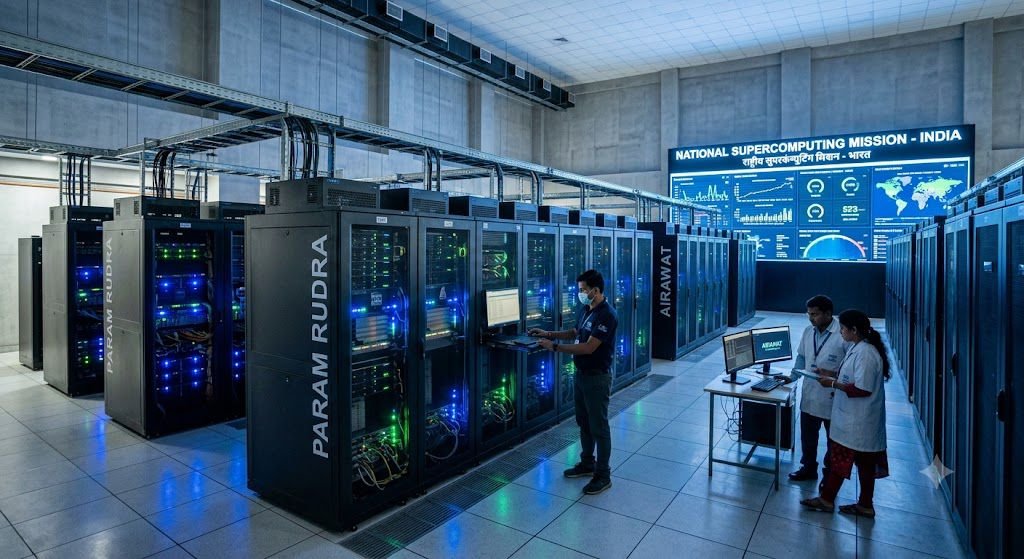
Possibly, it may have more or fewer supercomputers. As far as India is concerned, our position has been improving continuously. Our supercomputer named ‘AIRAWAT’, which is installed in Pune, is included in the top 100. In India, new supercomputers are being developed rapidly under the ‘National Supercomputing Mission’ (NSM).
……………..
More than 40 supercomputers have already been installed in the country under this mission. However, there is no denying that due to a lack of funds, we have not yet reached the position where we should be. The good thing is that the current government has also kept supercomputers as a priority. In September 2024, Prime Minister Narendra Modi unveiled a series of ‘PARAM Rudra’ supercomputers. These supercomputers are working for GMRT in Pune, the Inter-University Accelerator Centre in Delhi, and the S.N. Bose National Centre for Basic Sciences in Kolkata.
……………
Certainly, the country needs more supercomputers not only in terms of numbers but also needs to reach the top 10 in terms of quality. India has created much history in the recent past. Let us hope that we will write a new history in the world of supercomputers as well.
……………………
Analysis: – India’s Supercomputing Journey
……………………………………………………………………………………………………….
India’s supercomputing journey is a symbol of self-respect. Starting with PARAM 8000 in 1991, this journey has reached ‘PARAM Rudra’ and ‘AIRAWAT’ today. We can analyze this development as follows:
……………………………..
Approach to Independence
……………………………………………………………………………………………………….
America’s technological obstacles and conditions were a blessing in disguise for India. It inspired Indian scientists to become self-reliant, which resulted in the creation of C-DAC.
…………………..
Qualitative Growth
……………………………………………………………….
Through current government efforts and the ‘National Supercomputing Mission’, India is not only increasing the numbers but also providing high-quality computing capacity for scientific research and educational institutions.
………….
Upcoming Challenges
………………………………………………….
To reach the top 10 in the world, we will have to invest continuously not just in money, but in state-of-the-art chip technology and software ecosystems.
……………….
It is extremely important to understand that a supercomputer is not just a calculation machine; it is the backbone of the country’s scientific capability and national security. If India’s current pace continues, then in the coming days, we will definitely be at par with the world’s leading nations.
About the Author