India is currently trying to end its dependence on crude oil imported from abroad. To achieve this, the production of biofuels, especially ethanol, is being promoted very rapidly in the energy sector. But a very big challenge is also emerging with this entire process, and that is the excessive consumption of water.
……
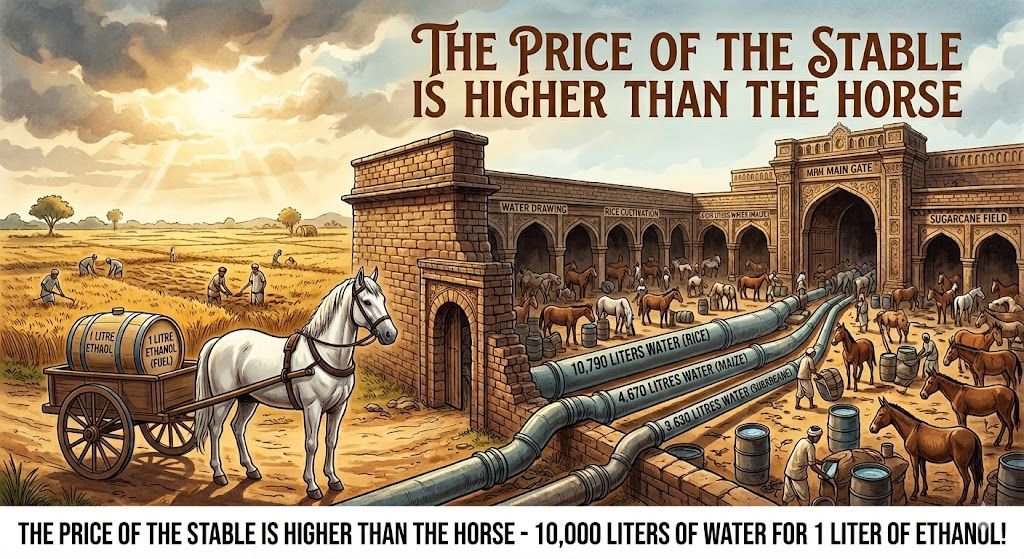
It might sound like only a few liters of water are used inside the factory while making ethanol, but the truth is far from it. Its real ‘water footprint’ is huge because the actual cost is incurred in growing the crops from which this fuel is prepared. Producing one liter of ethanol can consume between 2,800 to 10,790 liters of water, which depends entirely on which raw material is used.
……..
Water requirements are decided according to the crop
………………………………………………………
If we talk about raw materials, making ethanol from rice proves to be the most expensive deal, at least from the perspective of water. About two and a half to three kilos of rice are needed to prepare just one liter of ethanol, and growing this rice takes about 10,790 liters of water.
……….
On the other hand, maize is also being seen as an important alternative in the Government of India’s ethanol blending program. However, if we look at the entire journey from maize cultivation to ethanol production, about 4,670 liters of water are consumed in it. It is definitely slightly better than rice, but the water cost is still quite high.
…….
Apart from this, sugarcane has also been used traditionally. Depending on the variety of sugarcane and the weather of the region, it takes 2,860 to 3,630 liters of water to make one liter of fuel from it, which is a slightly more relieving figure compared to rice and maize.
……..
More water is consumed in the fields than in the factories
………………………………………………………………
Often people have a misconception that ethanol-producing factories waste a lot of water. The ground reality is completely the opposite. Inside the distillery plant, barely three to five liters of water are used in the processing of one liter of ethanol.
……………
Most of the water that is consumed is already used in the fields long before the crop reaches the factory. To understand this whole process, it is important to know the concept of ‘virtual water’. The water used in preparing any specific crop, such as irrigation, soil moisture, and rainwater, is called virtual water.
…….
This is why the real water footprint of ethanol is not limited to machinery or industrial work, but the entire process of cultivation is its actual scale.
………
Continuously falling groundwater level and future concerns
……………………………………………………….
This heavy consumption of water is not a small problem. Many major policy-making institutions, including NITI Aayog, and environmental experts have expressed deep concern about this. They believe that if water-intensive crops continue to be cultivated on a large scale for ethanol production, it will put terrible pressure on the water reserves present under our land.
………….
In many states of the country, the groundwater level is already moving towards the danger mark. In such a situation, continuing to depend on crops like rice and sugarcane can create a major crisis for our environment and water security in the long run.
About the Author