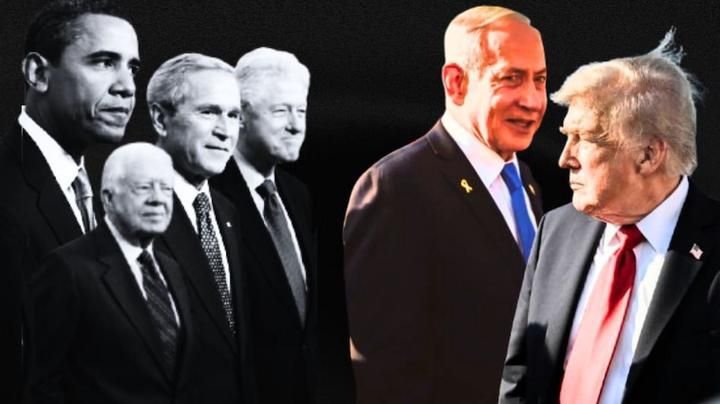
In American politics, the issue of Israel is not just about foreign policy, but also a major question of domestic politics. History shows that presidents who have tried to pressure or clash with Israel have had to pay a heavy political price. Some lost elections, some saw their popularity decline, and others could not reach the White House again.
…………………..
There is an old saying in American politics: “The Third Rail of American Politics.” This term is generally used for issues that are considered tantamount to political suicide. If there is any “Third Rail” in American politics whose impact is felt inside the White House, it is Israel. Whenever an American president tries to exert excessive pressure on Israel, his decisions are viewed not only through the lens of West Asia but are also scrutinized through the prism of American domestic politics.
………………
Today, when news of tensions between American President Donald Trump and Israeli PM Benjamin Netanyahu is in the headlines, some old chapters of American history have come into discussion again. This is because in the last 50 years, there have been many American presidents who clashed with Israel and later had to suffer political losses. However, it would be wrong to say that Israel was the sole reason for their defeat, but history suggests that the conflict with Israel certainly increased their difficulties.
…………..
The world considers America to be Israel’s greatest supporter. This perception is not wrong either. America gives billions of dollars in military and economic aid to Israel every year. From the United Nations and allegations of Palestinian genocide to international forums, America has always stood by Israel’s side. But the story of American politics is not just this. There is another side to it as well.
……………..
A side where many American leaders have tried to question Israel’s policies, sometimes spoken about Palestinian rights, and at other times tried to prioritize American interests. But after doing so, they had to pay a political price.
…………….
Jimmy Carter: The Hero of the Peace Accords, But Clashing with Israel Proved Costly
…………….
When Jimmy Carter became the President of America in 1977, West Asia was struggling with constant conflicts. Carter achieved the greatest success of his term in the form of the 1978 Camp David Accords. Through his mediation, a historic peace treaty was signed between Egypt and Israel. At that time, the world saw him as a peacemaker. But in later years, Carter began to openly question some of Israel’s policies.
………………..
Jimmy Carter even termed the Israeli settlements being built in the West Bank and Gaza as illegal under international law. Furthermore, he stated that lasting peace could not be achieved by ignoring the rights of Palestinians. His statement was viewed as anti-Israel. This stance angered many pro-Israel groups.
………………….
The statistics also show this shift. In the 1976 election, Carter received approximately 71 percent of the support of American Jewish voters. But by 1980, this support had dropped to about 45 percent. That same year, Carter faced defeat at the hands of Republican candidate Ronald Reagan. Of course, there were major reasons behind his defeat, such as the Iran hostage crisis and a weak economy. But many political analysts believe that his stance regarding Israel also became a political burden for him
………….
Later, when Carter wrote his controversial book, “Palestine: Peace Not Apartheid,” the controversy escalated further. Critics launched fierce attacks on him, and gradually he was almost isolated from mainstream American politics.
……………..
George W. Bush: When the President Felt Lonely
……………………………………………………………
After winning the Gulf War in 1991, the popularity of American President George W. Bush was soaring. His approval rating had reached nearly 90 percent. It seemed that his re-election was certain. However, the situation changed when he started pressuring Israel regarding peace talks. Many members of Congress came out openly in support of Israel. In a press conference in September 1991, Bush described himself as “One Lonely Little Guy.” He was signaling that he was facing an extremely influential lobbying network.
…………………….
A year later, the 1992 election was held, and Bush lost to Bill Clinton. Again, it would not be accurate to say that Israel was the sole reason for the defeat. Economic recession and domestic issues were also important. But many political analysts believe that the conflict over Israel had further increased his political difficulties.
……………….
Netanyahu vs. American Presidents
……………………………………………………………
During the era of Benjamin Netanyahu, this power struggle between America and Israel became even more visible. In 1996, the relationship between President Bill Clinton and Netanyahu remained tense. Clinton often felt that the Israeli leadership was not taking American pressure and advice seriously. But the biggest clash occurred during the era of Barack Obama.
………..
The Obama administration was moving towards a nuclear deal with Iran. Netanyahu was openly opposing it. In 2015, he went to the US Congress and directly criticized Obama’s policy. This was a highly extraordinary event in American politics. It is rare to see a foreign leader challenge an American president’s foreign policy from the floor of Congress. Interestingly, despite all the tension, the Obama administration signed a $38 billion military-economic package with Israel in 2016, which was the largest military package of that time.
………..
Charles Percy: The Senator Who Was Made an Example
……………………………………………………………
If there is any leader’s defeat in American politics that is considered the most famous example of the power of the Israel lobby, it is the name of Charles Percy. Percy was the chairman of the US Senate Committee on Foreign Relations and was counted among the influential faces of foreign policy. He questioned why America gives such large economic and military aid to Israel without any conditions. He also advocated for a balanced approach to Palestinian issues.
………………..
This did not go down well with several influential groups. In the 1984 election, a massive political campaign was launched against him. Heavy funding was provided in support of his opponents, and the electoral machinery became active. Eventually, Percy lost the election. In Washington, his defeat is still remembered as a political warning, a message to other leaders that public disagreement on issues related to Israel can be costly.
………..
Where Does Israel Get So Much Power?
……………………………………………………………
This question is often asked. Elections in America are extremely expensive. From the President to members of Congress, everyone has to raise millions of dollars to contest elections. This is where the role of political funding and lobbying begins. Pro-Israel groups, Political Action Committees (PACs), and their associated Super PACs play a major role in election campaigns.
……………….
Political analysts say that instead of attacking a leader directly, often the opponent is strengthened. That is, the opposing candidate gets more resources, more campaigning, and more support. The result is that many leaders become weak in their own party’s primary elections.
…………….
Is Israel the Cause of Every Defeat?
……………………………………………..
It would not be entirely correct to say that Israel is the only reason behind the political losses of leaders. Jimmy Carter did not lose just because of Israel. Economic recession was a major reason for the defeat of George Bush Sr. There were many local political reasons behind the defeat of Charles Percy as well. But there are many such examples in history where leaders who disagreed with Israel’s policies had to face political damage.
…………………
Even though there have been multiple reasons behind every electoral defeat, it is equally true that Israel and its associated lobbies have been influential in American politics for a long time. Perhaps this is why the perception persists in America even today that a clash with Israel is not just a matter of foreign policy. Sometimes it also becomes a question of a leader’s political future.
About the Author