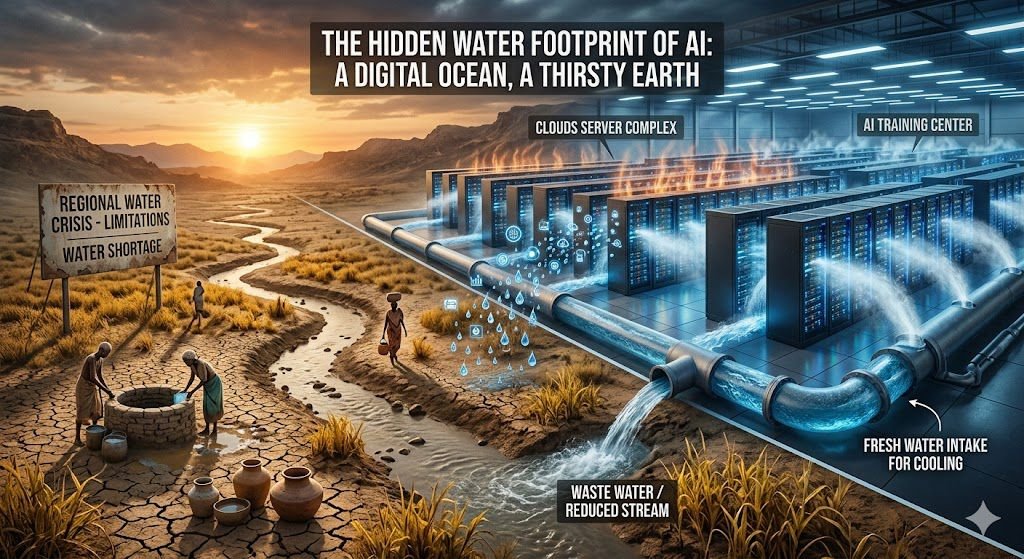
An AI ‘ s analysis is given below
…………………………………………………………………
Artificial Intelligence is being considered the greatest technological revolution of the 21st century. The increasing use of AI in almost every sector, including health, education, agriculture, finance, defense, and administration, has created new possibilities for development. Major global economies and technology companies view AI as the economic power of the future. Countries like America, China, Europe, and India are investing billions of dollars to achieve leadership in this field. However, amidst this technological race, there is an aspect that is being discussed relatively less, and that is the increasing water consumption of AI. In recent years, various international studies and United Nations-backed assessments have warned that the rapid expansion of AI-based data centers could lead to a massive increase in global water demand in the coming years. It is estimated that by 2030, the water needs of the AI and data center industry could grow to be equivalent to the annual water requirements of more than a billion people. This is not just an environmental issue, but a serious question linked to development, resource management, and human existence.
…………………………………………………………….
In reality, AI is generally considered a digital technology, and people feel its connection is only with computers, the internet, and software. But the reality is that the infrastructure working behind AI is extremely resource-intensive. When a person uses an AI chatbot, a company performs large-scale data analysis, or an institution trains a large language model, thousands of powerful servers remain active behind it. These servers generate massive amounts of heat, and if not controlled, the entire system can be affected. For this reason, large-scale cooling systems are used in data centers, in which water plays a significant role. Millions of liters of water are needed to keep the servers cool. As AI models become more complex and powerful, their energy and water requirements are also increasing.
…………………………………………………………….
With the expansion of the AI industry, the construction of new data centers is happening rapidly across the world. Large technology companies are developing vast data infrastructure to meet the growing digital demand. But the establishment of these data centers does not just mean higher electricity consumption, but also additional pressure on local water resources. In many countries, examples have emerged where local communities have expressed concern over the increasing water use of data centers. Especially in areas where a water crisis already exists, the presence of data centers is creating new challenges regarding the sharing of resources.
…………………………………………………………….
In fact, this concern becomes even more serious because the world is already facing a water crisis. According to the United Nations, billions of people do not have access to safe and sufficient water. Climate change, irregular rainfall, over-extraction of groundwater, and a growing population have made the situation more complex. At such a time, if the AI industry rapidly increases the demand for water, competition for water resources could intensify. On one hand, there is the agricultural sector, which depends on water for food security, and on the other, there are growing cities that need more resources for drinking water and sanitation. Industrial needs are also constantly increasing. Now, amidst all this, data centers are emerging as a new and fast-growing water consumer. In the future, the question may become even more important: for whom should the primary use of limited water resources be prioritized ?
…………………………………………………………….
The relationship between AI and the water crisis is not limited to water alone. Data centers also use massive amounts of electricity. If this electricity is generated from fossil fuels like coal, oil, or gas, carbon emissions increase. Increased carbon emissions accelerate climate change, and climate change makes the water crisis even more severe. Thus, a cycle forms between AI, energy, and water resources that can multiply environmental challenges. Therefore, the impact of AI cannot be assessed solely on the basis of its technical achievements or economic contribution. Its environmental footprint must also be understood with equal seriousness.
…………………………………………………………….
In the context of India, this issue becomes even more important. India is moving rapidly towards a digital economy, and AI is being made a significant part of the national development strategy. But along with this, the country is also facing serious water challenges. Many cities are heading towards a groundwater crisis, pressure on the water sector is constantly increasing, and climate change is increasing the uncertainty of the monsoon. If there is a large-scale expansion of data centers in the future, additional pressure on water resources is natural. Therefore, it is necessary for India to integrate the development of AI infrastructure with a comprehensive strategy for water management.
…………………………………………………………….
This does not mean that the development of AI should be stopped. AI can bring revolutionary changes in science, medicine, education, and economic productivity. The challenge is not to stop AI, but to make it sustainable. Steps such as using water-efficient technologies in data centers, using recycled water, expanding renewable energy-based infrastructure, and establishing data centers while keeping water availability in mind can be important in this direction. At the same time, technology companies will also have to show more transparency regarding their water use and environmental impact.
…………………………………………………………….
…History is witness that every technological revolution brings with it both new possibilities and new challenges. The Industrial Revolution increased production but also created problems of pollution and resource depletion. The digital revolution connected the world but brought challenges like energy consumption and electronic waste. The AI revolution is no different. If its expansion is not managed while keeping the limits of natural resources in mind, the cost of its success may have to be paid in terms of the environment and water security.
…………………………………………………………….
However, the question is not how powerful AI will become, but how responsible it will become. In the coming years, the real test of the world will be whether it can establish harmony between technological progress and environmental balance. If AI is a medium to make the future of humanity better, then it must also protect the resources on which human life itself depends. Therefore, the future of AI is not just a question of algorithms and data, but also of water, energy, and sustainable development. This approach can make this technological revolution truly human-centric and sustainable.
…………………………………………………………….
Analysis
……………………..
This passage beautifully illustrates the need to strike a balance between the progress of AI and its impact on the environment. Here are the key aspects of this analysis:
Resource Scarcity and AI Requirements-
The essay clearly demonstrates that AI is not merely software, but is dependent on physical resources such as electricity and water. In particular, the water resources used to cool servers could create a major crisis in the coming days.
………
Development vs. Environment – It is not suggested here that AI should be stopped entirely; rather, emphasis has been placed on making it ‘green’ or ‘sustainable’. Transparency and water recycling must become a moral responsibility for technology companies.
……….
A Warning for India – For a country like India, where water scarcity is a complex issue, it is imperative to include water management policies in the mainstream during the expansion of the digital economy.
………
Responsible AI –
Finally, this essay provides us with a profound thought: if this technology, created for human welfare, jeopardizes the fundamental basis of human life (water), then it will not be true development.
.
.
Conclusion
……………………..
In summary, this writing clarifies that in the coming days, the benchmark of success will not just be ‘AI capability’, but ‘environmental responsibility’.
About the Author