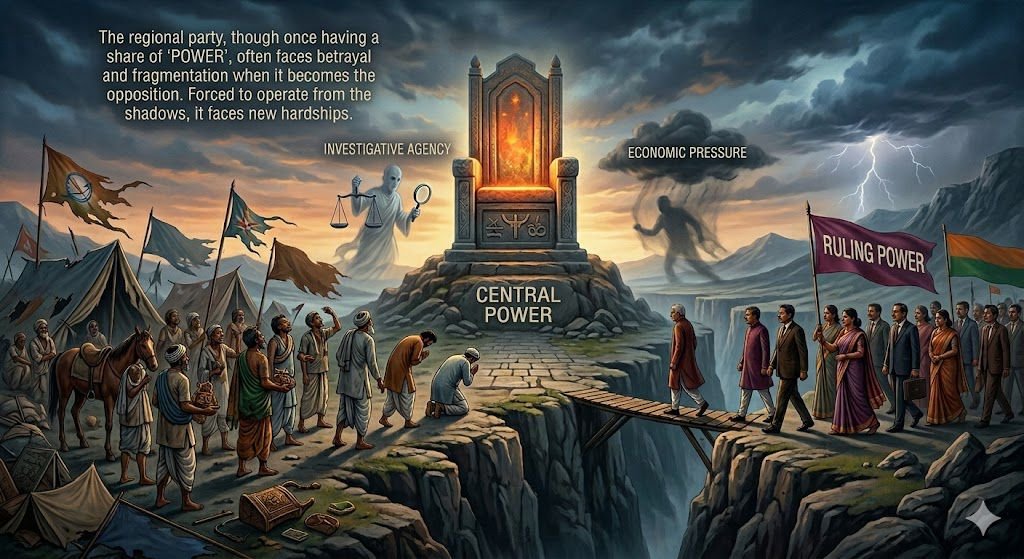
Summary – Since independence, the Indian political system has evolved in such a way that resources and decision-making power have always remained centralized. Even during the past Congress regimes, there were instances of attracting opposition leaders or destabilizing regional governments. This proves that ‘the center of power’ has always acted like a magnet in our political culture.
…………………………………………………………
Power and the Disintegration of the Opposition – A Deep Crisis in Indian Democracy
…………………………………………………………….
It has remained a long-standing and serious question in Indian politics as to why any political party feels so helpless the moment it is ousted from power. Conversely, why does the ruling party find it so easy to make other parties their allies or succeed in breaking them apart? If we analyze the Indian political history spanning decades, this trend is not just limited to one party or one period; rather, it has become a defining part of our system.
…………………………………………………………
Organizational Weakness and Ideological Void
…………………………………………………………….
The first and primary reason for the disintegration of Indian parties is organizational weakness. Most of the country’s regional and opposition parties are built not on deep ideological commitment, but on the personal charisma of a single leader. As long as that leader remains in power, the organization stays united. But the moment governance is lost, discontent arises among various factions within the party. This is because, here, ‘convenience’ rather than ‘service’ serves as the foundation of politics.
…………………………………………………………
Dependence of Workers and Local Leadership
…………………………………………………………
The formation process of Indian political parties is controlled from the top down. Everything from ticket distribution to appointments remains in the hands of the central leadership. In such a situation, when the main party loses power and moves to the sidelines, grassroots workers and local leaders are forced to look toward the ruling party to secure their social standing and future. This is not just betrayal, but a struggle to survive their existence within the system.
…………………………………………………………
Equations of Caste, Community, and Vote Bank
…………………………………………………………
Most regional parties depend on the vote bank of a specific caste or community. While in power, they keep this vote bank satisfied through various government schemes. However, after defeat in an election, when they come to sit in the opposition, that same vote bank also tries to connect with the ruling party for its own interests. The pressure from this vote bank shakes the foundation of the party, which becomes the main cause of division.
…………………………………………………………
Economy and the Pressure of Investigative Agencies
…………………………………………………………
In modern politics, financial power plays a decisive role. Electoral expenditure has increased to such an extent that for parties outside of power, running their organization becomes a major challenge. On the other hand, the growing influence of central investigative agencies is creating a ‘legal fear’ for opposition leaders. History tells us that whichever party has been in power at the Center has not hesitated to use the Constitution and administrative agencies for its own convenience. Due to this pressure, leaders feel it is safer to take refuge in the ruling party to survive.
…………………………………………………………
Constructive Strategy: Victory Before Election
…………………………………………………………
A new rule of politics is now emerging. Even before the election results are announced, the ruling party lures potential opposition members with promises of seats and positions. As a result, the possibility of the opposition uniting is destroyed right from the beginning. The turn of events in Maharashtra and West Bengal is a glaring example of this. There, taking advantage of technical loopholes in the anti-defection law, breaking a party or bringing it to one’s side has become a common process.
…………………………………………………………
Economic Imbalance and the Impact of Funding
…………………………………………………………
The unimaginable amount of money that has come to the ruling party through various funding schemes prevalent in the past (e.g., Electoral Bonds) has pushed the opposition into a corner, both mentally and financially. Where the country’s major economic resources remain concentrated in one place, fighting on an equal footing becomes impossible for the opposition.
…………………………………………………………
Conclusion – Where is the Future of Democracy Headed ?
…………………………………………………………
Looking at all these circumstances, it seems that a major void has now been created in our democracy. The kind of strong opposition parties we witnessed in the eighties and nineties is not seen today. This is not just the failure of any one party, but a decline of the entire system. Small and regional parties are surrendering to the pressure of the ruling power to save their own existence.
………
For a healthy democracy, a strong, determined and ideological opposition party is more essential than the ruling party. But when politics becomes merely a game of ‘power’ and ‘self-defence,’ the interests of the common citizen are left behind. History will prove that wherever the opposition party becomes weak, the power there becomes absolute.
……….
Therefore, the need of the hour is a new political reform that steers parties away from the personal ambitions of leaders and builds them upon a strong ideological foundation for the benefit of the country.