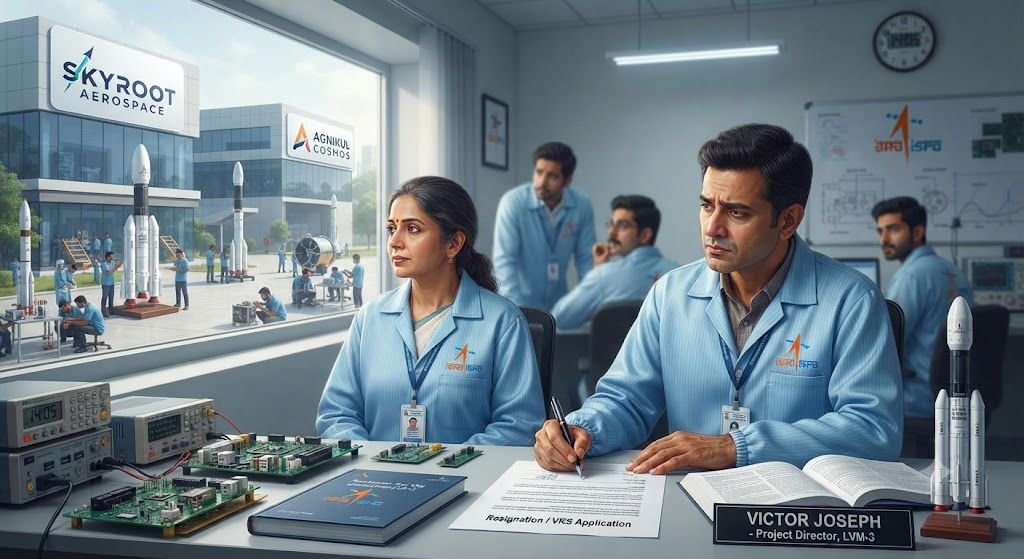
In the last few months, between 100 and 120 scientists have resigned from ISRO. Following this, the Central Government has had to intervene in the matter. In this regard, the Department of Space issued a memorandum on July 14 to curb these resignations.
………………….
News of a large number of scientists and technical experts resigning from the Indian Space Research Organisation (ISRO) has come to light over the past few days. Consequently, the Central Government has had to intervene. According to sources, about 100 to 120 scientists have left the organization in the last few months, many of whom were associated with key missions like Gaganyaan. In view of this, the Department of Space issued a memorandum on July 14, directing that strict measures be taken to prevent these resignations. Additionally, instructions have been given to further tighten the rules regarding Voluntary Retirement (VRS) and resignations for scientists.
……………………………………………………………………………………………………….
According to the information, the highest number of resignations has come from the U.R. Rao Satellite Centre (URSC), where approximately 80 employees have left the organization. Alongside this, information has emerged that about 20 scientists have resigned from the Vikram Sarabhai Space Centre (VSSC). Apart from these, many other resignations are currently under evaluation.
………………….
It is worth noting that approximately 14,600 personnel work at ISRO. Meanwhile, a matter of concern is that many of those who have resigned were associated with important and strategic projects.
……………………..
Many key personnel have resigned
……………………………………………………………………………………………………….
According to information received from sources, those who have resigned include Victor Joseph, the Project Director of the LVM-3 rocket program associated with VSSC. Besides this, the Project Director of the SPADEX mission at URSC has also resigned. It is also being said that Aditya Ravapalli, a young scientist associated with the Chandrayaan-3 mission, has left the organization. He was the Project Manager for this mission.
……………………..
Department of Space has changed its rules
……………………………………………………………………………………………………….
In view of the consistently increasing number of resignations, the Department of Space has made significant changes to the rules implemented in 2020. Previously, ISRO Centre Directors could approve the resignations or VRS of Group ‘A’ scientists and technical staff working under them, but that will no longer be the case. Especially if scientists associated with Gaganyaan and other major missions resign, the Centre Directors cannot approve it directly. They must send the entire matter, along with their recommendations, to the Department of Space (DoS) for final approval.
……………………
ISRO Chief confirms the resignations
……………………………………………………………………………………………………….
ISRO Chief V. Narayanan has confirmed these resignations. Meanwhile, he stated, “The organization is prepared to handle this situation.” However, according to some former officials, rather than just issuing orders to try and stop resignations, there is a need to understand the root causes and address them. It is being said that the better opportunities available in the rapidly growing private space sector in the country could also be a major reason for these resignations.
…………………….
Why did the resignations increase suddenly ?
……………………………………………………………………………………………………….
Regarding the sudden resignation of scientists from ISRO, it is claimed that India’s space sector has grown rapidly due to government efforts over the past few years. Many private companies are now involved in this race, attracting scientists with lucrative offers. A major reason for this is also that private sector companies are providing scientists with remuneration according to their demands. In such a situation, the number of resignations has increased.
…………………..
Ultimately, why are scientists leaving ISRO?
……………………………………………………………………………………………………….
The Department of Space or ISRO has not officially given any specific reason for these resignations, but according to a report by media organization WION, the rapid expansion of India’s private space ecosystem is considered to be the biggest reason. As the space sector has been opened up for private entities, many new startups and aerospace companies are attracting experienced ISRO scientists for leadership and technical roles. Government policies for involving the industry in satellite projects and the transfer of launch vehicle technology have also significantly increased the demand for skilled professionals outside.
………………
What are private companies offering ?
……………………………………………………………………………………………………….
If the reports are to be believed, apart from better facilities and high salaries, the thing that attracts scientists the most is that they do not have to wait for the government budget to do their work, and the resources required for the work are also made available quickly. Apart from all this, another big factor is that one does not have to run to ten different people for work approval.
………………………
What is ISRO doing to stop the scientists ?
……………………………………………………………………………………………………….
For this reason, the Department of Space issued a new internal memorandum on July 14, which has made the rules for Voluntary Retirement (VRS) and resignation for scientists associated with Gaganyaan and other national missions quite strict. With this new policy change, new administrative procedures have been implemented in the space sector.
……………………
Centralization of the resignation process: Approval will no longer be easy
……………………………………………………………………………………………………….
According to the instructions of the new memorandum, applications for resignation or VRS from Group ‘A’ scientists and technical staff working on Gaganyaan and other critical missions will no longer be treated as a routine administrative process. Previously, the Directors of various ISRO centres had the authority to approve these applications, but now under the new rules, this power has been withdrawn from them. Henceforth, all cases of resignations and voluntary retirements of scientists involved in major programs will be thoroughly scrutinized and final approval will only be granted at the Department of Space level.
About the Author