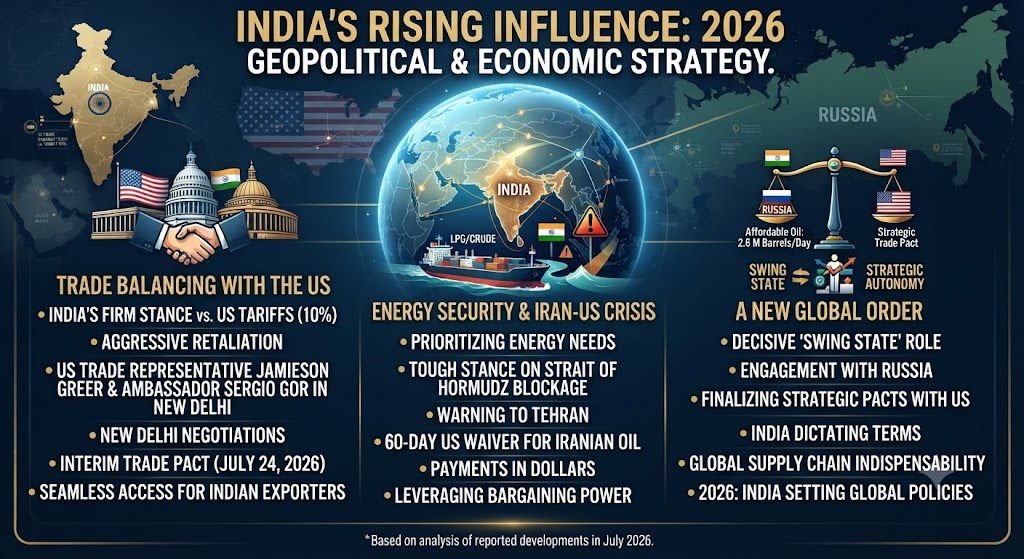
The growing economic power of India on the global stage has forced America to change its policies. In the last 24 hours (July 10-11), very big news in favor of India is emerging from the ongoing India-US trade talks in New Delhi. Rattled by the aggressive retaliatory stance taken by India in response to the temporary 10% import tariffs imposed by the US administration, US Trade Representative Jamieson Greer and Ambassador Sergio Gor have had to come to New Delhi to sit at the negotiating table. India’s Commerce Minister Piyush Goyal has told US officials point-blank that no compromise on India’s interests will be accepted.
…
The result of this aggressive bargaining by India is that America is now pleading to finalize a major Interim Trade Pact before July 24, 2026. India has agreed to provide concessions on American agricultural products, dry fruits, and soybean oil only if America provides Indian exporters seamless entry into American markets. India has made it clear that the India of 2026 is not one that will be afraid of threats from Western countries. If America wages a tariff war, India has its domestic market and other global partners available. US officials have well understood that to counter China and keep the global supply chain intact, they must accept every legitimate condition of India. This news has brought tremendous enthusiasm to the Indian market and the business world.
…
On the other hand, amidst the fierce war breaking out between Iran and America, India has proven its diplomatic and economic sovereignty. In a high-level strategic review held between Washington and New Delhi in the last 24 hours, India has made it clear that the ongoing conflict in the Gulf countries should not affect India’s energy security. India has adopted a very tough stance on Iran’s actions to obstruct the Strait of Hormuz. India has warned Iran in strong terms that stopping India’s LPG and crude oil vessels will cost Tehran dearly. India will not tolerate any country’s bullying for its energy needs.
…
Meanwhile, understanding India’s strategic importance, America has also given India a special 60-day waiver for the purchase of Iranian crude oil in July 2026. The most significant part is that this time, America has approved India to make payments directly in dollars. This is a massive diplomatic victory for India. India has clearly told America that it will only talk about oil from Iran on its own terms and upon receiving heavy discounts; otherwise, India has reliable alternatives like Russia, which is providing India a record 2.6 million barrels of oil per day. India has hit Iran where it hurts—if Iran wants India’s money, it must provide a discount of more than $8 per barrel compared to Brent crude and provide a safe passage for Indian ships. India’s aggressive and calculated stance has proven that in today’s era, India does not come under any geopolitical pressure, but instead sets global policies on its own terms.
……
Analysis – India’s Rising Influence and Strategic Autonomy
……
1. Trade Balancing with the United States-
For a long time, tensions between India and the US regarding tariffs and trade barriers have been a point of contention. The firm stance India has adopted in response to the US administration’s investigative measures and tariff impositions demonstrates that India is no longer prepared to yield under external pressure. For the United States, India’s cooperation in the global supply chain has become indispensable, which has provided India with a strong position at the negotiating table.
…….
2. Energy Security and the Iran-US Crisis –
Despite the tensions at the Strait of Hormuz, India has successfully prioritized its energy security. Securing a 60-day waiver from the US is a notable diplomatic victory for India. Most importantly, India has not only received approval for direct dollar-denominated payments but has also paved the way to negotiate Iranian oil purchases on its own terms, leveraging its bargaining power.
3. A New Global Order –
These events indicate that India is now operating as a decisive “swing state” in global affairs. By maintaining its engagement with Russia for affordable energy while simultaneously finalizing strategic trade pacts with the US, India is demonstrating the effectiveness of its “strategic autonomy.”
Conclusion –
India’s aggressive and calculated trade diplomacy proves that in 2026, the nation is not merely protecting its own economic interests but is fully capable of dictating terms in the global market. For the United States, India’s market and its strategic geographic position have now become key factors that necessitate a mutually respectful and flexible partnership.
About the Author