America possesses the largest economy in the world, with a GDP exceeding 20 trillion. It holds the largest military force globally. From Apple to Microsoft, the world’s biggest companies are American. The list of such achievements is so extensive that it is easy to believe America is indeed the most powerful country in the world.
…….
If you examine history, global power has resided in different countries and even continents at various times. Looking at the ancient era, China, Rome, and India were among the most powerful parts of the world. Until 1800, the entire global economy revolved around India and China, from where goods were exported on a large scale to Europe.
…….
However, when the modern world began and industrialization arrived in Europe, Europe brought these major powers under its control—whether it was Hindustan, China, or the Middle East, which remained under the control of Ottoman Sultans. But by the end of the Second World War, leaving behind India, China, England, and France, America emerged as the most powerful nation in the world.
…….
The History from the Discovery of America to the Establishment of 13 British Colonies
………………………………………………………………
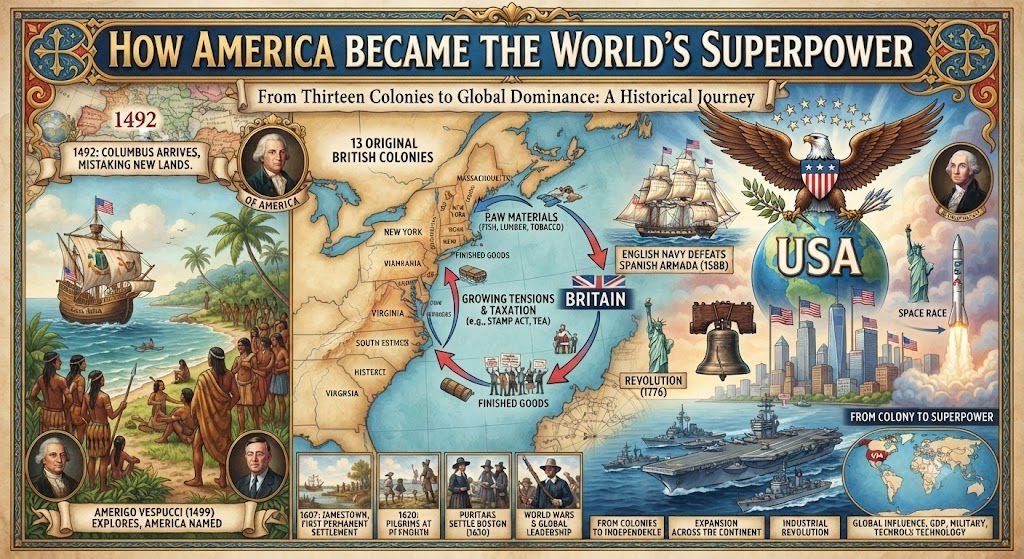
In 1453, Turks captured Constantinople, which closed the trade routes from Europe to Eastern countries, prompting European sailors to begin searching for new sea routes to facilitate trade with the East. In search of a new sea route to India, the Spanish sailor Columbus wandered across the Atlantic Ocean and reached an entirely new world in 1492. Mistaking this new continent for India, Columbus called the native people ‘Red Indians’.
……..
Subsequently, in 1499, Italian traveler Amerigo Vespucci reached this continent, and it was named ‘America’ after him. This continent was filled with mineral resources, and its land was extremely fertile, leading to a race among European countries to make it their colony. Initially, the Spanish tried to enslave the native people of America to perform farming, but the locals did not accept it. Therefore, people from Africa were brought to America and enslaved to perform agricultural labor.
……….
Thus, Spain established colonies in some parts of America. Then came the year 1588, when a fierce battle took place between the Spanish navy and the English navy, resulting in a victory for the English, which gave England the opportunity to establish its own colonies in America. England established its first colony in North America during the time of James I in 1607, which was named Jamestown.
……….
Later, the work of establishing colonies gained momentum during the time of Charles I. In 1630, a group of Puritans settled in Boston, North America, after which Europeans began settling in America in large numbers. By 1707 to 1722, the British had established their 13 colonies in America. Colonies were a major means of acquiring property at that time, which is why Europeans kept migrating to America. Additionally, Europe had rigid policies regarding religion, which also contributed to Europeans settling in America.
……..
The Three Parts of the American Colonies
…………………………………………………………….
The American colonies could be divided into three parts. The Northern part included Massachusetts, New Hampshire, and Rhode Island; these were mountainous and snowy areas not suitable for farming. England obtained fish and timber from here. The Middle part included colonies like New York, New Jersey, and Maryland, where industries such as liquor and sugar operated. The Southern part included North Carolina, South Carolina, Georgia, and Virginia; the climate here was warm, so they primarily produced grains, sugarcane, tobacco, cotton, and plantation crops.
……….
England was using these colonies solely for its own benefit. Yes, England would take raw materials from these colonies, send them to industries back home, and then sell the produced goods back here at higher prices, which caused growing anger among the people. The actual rule here was exercised by the British Crown and the English Parliament from across the Atlantic Ocean. Although each colony had an elected assembly to advise the governor, the authority to make laws for the colonies still rested with the British Parliament. Officials from England were sent to occupy high administrative positions in the colonies, as the British government believed that the people in the colonies were not qualified for high administrative positions.
……….
About the Author