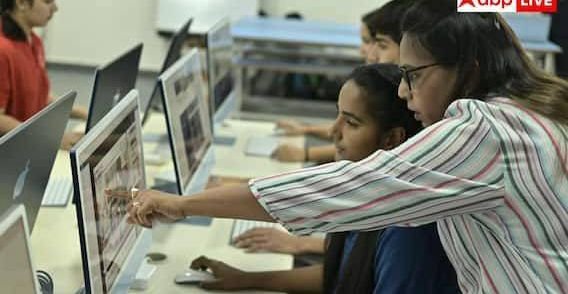
Highlights – Over the past few years, digital technology has expanded rapidly in India. Like banking, entertainment, and government services, education is now shifting rapidly to digital mediums.
…………………………………………………………………….
The landscape of education in India is changing rapidly; now, learning is no longer limited to blackboards, books, and classrooms. Smartphones, the internet, AI, and digital learning platforms have begun to completely transform the ways of learning. This is precisely why digital education and the EdTech sector are becoming an essential part of the country’s education system. Experts believe that in the coming years, a mixed model of online and offline learning—that is, hybrid education—could become the standard practice. In such a scenario, let us tell you whether the growing trend of digital education in schools will completely change the way of learning in the coming years.
…………….
Mobile and Internet Have Changed the Face of Learning
……………………………………………………………….
Over the past few years, digital technology has expanded rapidly in India. Like banking, entertainment, and government services, education is now shifting rapidly to digital mediums. The increasing accessibility of smartphones and the internet has made quality education accessible to students in small towns and rural areas, alongside cities. During the COVID-19 pandemic, when schools were closed, online learning played a major role in sustaining the education system. The use of digital learning platforms is continuously increasing, and today, millions of students are studying online regularly.
…………………..
Getting Learning Facilities through AI
……………………………………………………………….
AI is rapidly making its place in the field of education. AI-based learning systems are now analyzing students’ studies and providing study material according to their needs. This is providing extra assistance to weak students, while advanced-level study material is being made available to high-performing students. Through AI, answering students’ questions, test analysis, performance evaluation, and providing personalized suggestions have become much easier than before. Due to this, learning is becoming more effective and tailored to the needs of the students.
…………………
New Education Policy Has Also Emphasized Digital Learning
……………………………………………………………….
The National Education Policy (NEP) 2020 has given special importance to the use of technology in education. The government is already providing free study material to students and teachers through digital platforms like DIKSHA, SWAYAM, and e-Pathshala. Apart from this, the government has launched several initiatives aimed at strengthening digital infrastructure, developing a National Digital Library, and integrating modern technology with education.
………………….
AI and Computational Thinking Will Be Taught in Schools
……………………………………………………………….
Preparations are underway to provide foundational education in Artificial Intelligence and Computational Thinking to students from classes 3 to 8 in schools across the country. The purpose of this initiative is to familiarize children with new technologies from an early stage and to develop their logical thinking and problem-solving abilities. For this, new teaching material is being prepared, and teachers will also be given special training so that they can impart information on these subjects to students in a simple manner.
………………….
Will Education Change Completely in the Coming Years ?
……………………………………………………………….
Education experts believe that in the future, a hybrid model—combining both—will prove to be more effective than just online or just offline learning. Along with studying in the classroom, students will be able to access extra study-related material, recorded lectures, online tests, and personalized guidance through digital platforms. Additionally, the use of new technologies like Virtual Reality, Augmented Reality, gamification, and micro-credentials is slowly becoming a part of education, which can make learning more interactive and practical. However, despite the expansion of digital education, many challenges remain. Internet connectivity is still not sufficient in the rural areas of the country. Not all students have access to facilities like smartphones, tablets, or laptops.
About the Author