

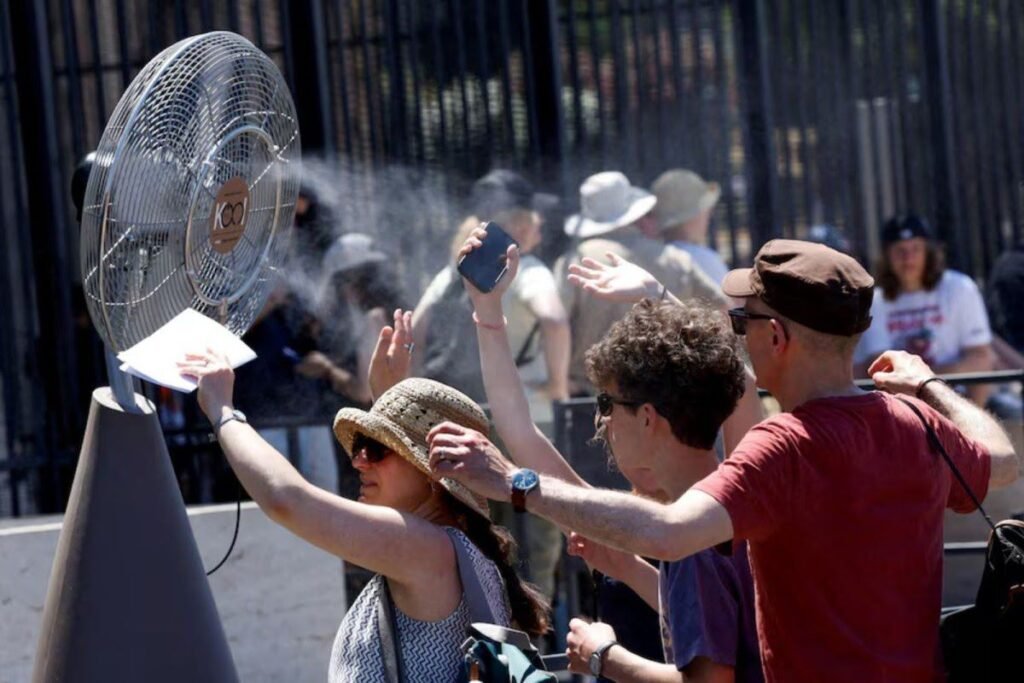
Europe is currently in the grip of a severe heatwave, and the situation is becoming increasingly critical in several countries. The 40-degree Celsius temperature, which is considered normal during summers in India, is taking a heavy toll on lives in Europe. Reports indicate that over a thousand people have died due to the heat in France alone. Apart from this, heatwaves have severely impacted life in several other European nations, including Germany, the UK, and Sweden.
…………………………………………………………….
The situation has become so dire that schools in many places are being closed ahead of schedule. Parents are being urged to take their children home early. Work in offices is also being affected, and options for people to find relief are extremely limited. Local residents state that while the temperature may be recorded at 40 degrees, the actual impact feels significantly higher.
…………………
Why is heat becoming a ‘silent killer’ in Europe?
…………………………………………………………….
The biggest question is why the same temperature that millions of Indians live with every year is causing such a major tragedy in Europe. According to experts, a major reason for this is the construction of houses and the infrastructure designed according to the local climate. Most houses in Europe are built to retain heat inside during winter to minimize the impact of the cold.
…………………………………………………………….
Usually, temperatures do not reach extreme levels there during summer, so the design of the buildings is prepared accordingly. But when the temperature hits 40 degrees Celsius, these same houses trap the heat inside. Consequently, the temperature inside the houses often feels like it is around 50 degrees, making it extremely difficult for people to find relief.
……………..
Stone houses and lack of air conditioners are increasing the difficulty
……………………………………………………………..
Most old houses in Europe are made of stone. Stones heat up slowly during the day, but once heated, they take a long time to cool down. In such a situation, the day’s heat remains inside the houses until night, preventing people from getting any rest. This is why the situation becomes even more severe during prolonged heatwaves.
……………
The second major reason is the limited use of air conditioners. Air conditioning facilities are available in only about 7 percent of homes in Europe. Since there is less need for it under normal circumstances, most people do not install ACs. However, due to the sudden spike in heat this time, the demand for air conditioners and cooling appliances has increased rapidly. Shortages are also being witnessed in many places.
……………..
Houses built for cold weather, not prepared for heat
…………………………………………………………….
Ravi Ranjan, who has lived in Europe for a long time, explains that the entire structure of houses there is designed with the objective of protecting against the cold. People wear heavy woolens outside, but take them off as soon as they enter the house because the interior environment is already kept warm. The walls and construction style of the houses are such that the impact of the cold is minimized.
……………….
In such a situation, when the outside temperature reaches 40 degrees, the heat inside the houses feels even more intense. He mentioned that unlike India, almost every house in Europe does not have an AC, cooler, or fan. Even the trend of using table fans has only gradually increased over the last few years. Therefore, the sudden arrival of extreme heat is proving to be unusual and extremely difficult for the people there.
……………….
Genetic adaptation is also considered a reason
…………………………………………………………….
Experts believe that it is not just the structure of buildings, but biological adaptation that may also play a role in this situation. People in Europe have evolved over thousands of years to live in cold weather. Their bodies have adapted better to cold climates, while they have relatively little experience living in extremely hot environments.
…………….
This is why the impact of the sudden, intense heat is felt more heavily by their bodies. When high temperatures, hot houses, limited cooling facilities, and persistent heatwaves combine, the situation turns into a serious health crisis for many. Experts say that considering the changing climate landscape, Europe must now make comprehensive changes to its basic infrastructure and public health systems to cope with the heat.
…………………………………………………………….
About the Author