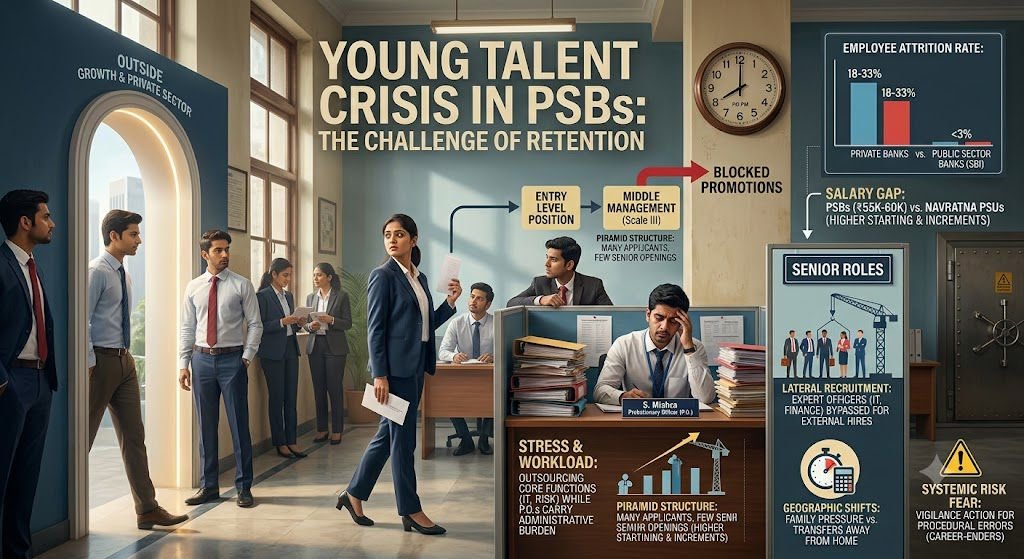
The employee attrition rate in major private banks is approximately 18% to 33%. In contrast, the attrition rate in Public Sector Banks (PSBs) is significantly lower. The annual attrition rate for employees at the State Bank of India consistently remains below 2%, while in other banks, this rate ranges between 3% and 8%.
…………………
From the 1980s to the early 1990s, a career in the banking sector was considered almost equivalent to civil services in terms of appeal. During this time, the salary of an entry-level officer was on par with that of a directly recruited Class-I government officer. Currently, according to the 12th Bipartite Wage Settlement, a Probationary Officer joining a PSB receives a basic salary of approximately ₹36,000 per month. For a banker posted in a metro city, including dearness allowance, house rent allowance, and special allowances, the total take-home salary can range from ₹55,000 to ₹60,000.
……………
On the other hand, a new employee joining a Navratna Public Sector Undertaking (PSU) receives a significantly higher salary compared to a private bank, which includes regular salary increments and other benefits that are not available in Public Sector Banks. At the middle management level, this disparity increases even further. Salary growth has not kept pace with the nature of work and the level of pressure involved.
…………………..
The organizational structure in PSBs has become like a vertical pyramid, where the number of officers in the first and second levels (Scale-1 and Scale-2) is very high, while the number of vacant positions at the third level and above has been continuously decreasing. What was once a systematic, merit-based promotional path has now become a bottleneck, where many highly qualified candidates are competing for very few opportunities.
……………
One of the major causes of discontent in recent years is the growing trend of lateral recruitment for senior positions. Many PSBs are bypassing internal promotion processes to hire officers directly at the third and fourth levels from private companies and consulting firms.
………………..
For officers like Suresh, who have spent years mastering banking operations, complying with regulatory requirements, and understanding the complex internal culture of PSBs, it is disheartening to see an outsider—who has no banking background but similar years of experience—taking over responsibilities two levels above them. Since these external employees take time to understand the ground reality of PSBs, the senior officers often have to work for longer hours during the adjustment period.
……………….
Outsourcing core banking functions to external agencies is making the situation even more severe. These are tasks for which many banks train their own officers. Some banks are paying large sums of money to major IT consulting firms for this purpose. Risk management frameworks are being prepared by multinational management consulting firms, and human resource processes are being redefined by external agencies.
………………….
Every year, thousands of IT graduates join PSBs through specialist officer posts, yet banks are paying outsiders to perform the very tasks for which these professionals were hired.
……………..
Apart from this, there are many other reasons. Many young officers between the ages of 20 and 35 are dealing with the responsibilities of aging parents, small families, or marital life. Not getting a posting near their home state is a major issue for them. Transfer policies in PSBs are based on seniority and administrative requirements. For this reason, junior officers are often posted far away from their relatives for several years. This is a constant source of personal and familial stress and is one of the most common reasons for young officers leaving.
………….
Furthermore, there is a constant fear of severe consequences for management errors. Officers in PSBs work in an environment where any irregularity in transactions, even those committed unintentionally, can lead to vigilance actions, which have a profound impact on their careers. The professional lives of many talented officers, who performed well even in difficult situations, have been disrupted due to minor procedural errors.
……………..
This disparity is clear. Private sector banks operate in a performance-driven culture where corrective actions are mostly internal. Conversely, PSBs operate under a vigilance system where even errors made in good faith can leave a stain on a career. For this reason, officers are often hesitant to take initiatives and approve proposals that are valid but appear suspicious.
………………..
The talent crisis today is partly the result of decisions made two decades ago. From the mid-1990s to 2010, there was a significant lack of recruitment in PSBs. It was a 15-year period of stagnation that created a structural void in the workforce. When the recruitment process resumed in the last decade, it happened at a rapid pace, and officers were promoted quickly to fill positions vacated by mass retirements.
…………….
The combined assets of the 12 PSBs are approximately ₹1.70 lakh crore, and their market share is around 55 percent. These banks are the primary instruments for financial inclusion, rural credit, lending to MSMEs, and providing financial support to the infrastructure sector.
……………….
The foundation of PSBs has been built by professionals who have dedicated decades to mastering the banking sector and passing on that knowledge to lower-level senior officers. This chain of institutional knowledge transfer is currently under severe strain. It is in need of change.
About the Author