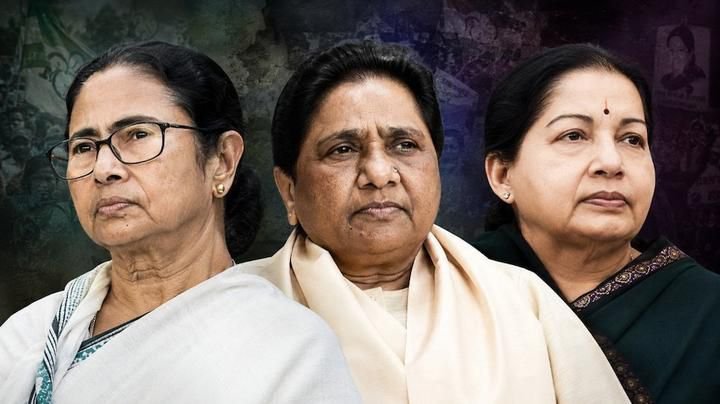
Highlight – Three of the most sharp-witted leaders in Indian politics—Mamata Banerjee, Mayawati, and J. Jayalalithaa. Their astute politics gave a new direction to the national discourse in the new century. However, the legacy of all three now appears to be struggling, with their leadership bearing a significant portion of the blame.
……………………………………………………………….
. When India stepped onto the threshold of the 21st century, a revolutionary change was taking shape in the nation’s politics. Dominating the landscape of male-dominated Indian polity, three female leaders shone with full intensity: J. Jayalalithaa in the South, Mayawati in the North, and Mamata Banerjee in the East.
There was a remarkable aggression in the political temperament of these three, a unique confluence of ideological bitterness and mass appeal. They each possessed a dedicated voter base in their respective states that had the power to change the political atmosphere with a single gesture.
During the Atal Bihari Vajpayee government era, they were referred to as the ‘three goddesses’ of Indian politics. This was not an exaggeration, but the reality of power during that period. Who would sit on the throne of Delhi, whose government would be saved, and whose would fall—the remote control for these outcomes was, to a large extent, in the hands of these three leaders. Jayalalithaa once brought down a central government over a cup of tea, Mayawati changed the course of history by making an unexpected shift, and not even a leaf in the Ministry of Railways would move without Mamata Banerjee’s consent.
However, as the 21st century completes its first silver jubilee, the wheel of time has turned completely. The political parties that were once the greatest symbols of regional identity and the empowerment of the marginalized are today either shrinking into the pages of history or fighting a final battle for their very existence. What exactly happened that the empires of these ‘one-woman armies’ crumbled ? Why are the parties of these three leaders now heading toward a political abyss?
‘One-Woman Army,’ But Lacking Internal Democracy
……………….. ………………………………………………..
The greatest strength and, later, the greatest weakness of these three leaders was that they were the ‘supremos’ in their parties. They had achieved this stature solely through their own resilience, without the crutch of any established political dynasty. Jayalalithaa fought a long battle against both friends and foes to carry forward the legacy of MGR. She treated the indignity she faced on the streets of Tamil Nadu as a challenge and transformed the AIADMK into the state’s strongest cadre-based machinery.
In Uttar Pradesh, Mayawati took Kanshi Ram’s ‘Bahujan Movement’ to the pinnacle of power. A Dalit daughter reaching the Chief Minister’s chair was one of the most revolutionary events in Indian democracy. She gave a new direction to the bureaucracy and built an organization where the order of ‘Behenji’ was the final law.
Meanwhile, in West Bengal, Mamata Banerjee achieved what was considered impossible in contemporary politics. She uprooted 34 years of invincible and organizationally ruthless Leftist rule, driven by the movements in Singur and Nandigram.
All three leaders formed governments with absolute majorities in their respective states and ran them with tight control.
But a major flaw kept growing behind this success. The party became synonymous with only ‘one face’—the party supremo. As long as the magical influence of these leaders remained, the parties ran smoothly, but as soon as the leadership faced a crisis, the entire organization began to crumble like a house of cards.
Power Centers, but Stained by Allegations
……………………………………………………………….
When these leaders were at the peak of their politics, they gradually became surrounded by allegations of corruption, misgovernance, and centralization of power. During Jayalalithaa’s tenure, cases of disproportionate assets grabbed headlines at the national level. The interference of her aide Sasikala and her family in government affairs grew to such an extent that it sent a negative message to the public. Judicial proceedings and imprisonment left Jayalalithaa’s final years politically very weak.
In Uttar Pradesh, Mayawati was also accused of straying from her ideology. Whether it was the Taj Corridor scam or the controversy over the installation of statues in monuments, all these established Mayawati’s image not as a ‘missionary leader’ but as a ‘lavish ruler.’ Allegations of the alleged sale and purchase of party tickets disappointed the dedicated cadre who had once worked selflessly for ideological commitment.
Mamata Banerjee’s story is even more paradoxical. She had resolved to end the misgovernance of the Left, but after coming to power, the Trinamool Congress (TMC) was accused of adopting the same violent political model and ‘syndicate raj.’ The Saradha chit fund, Narada sting, and recent teacher recruitment scams caused serious damage to the party’s credibility. Incidents like Sandeshkhali shook Mamata Banerjee’s strongest base—the female voter. When the state government appeared to be defending its leaders caught in these cases, the public became disillusioned.
The Crisis of Succession – Familial Interference
………………………………………………………………..
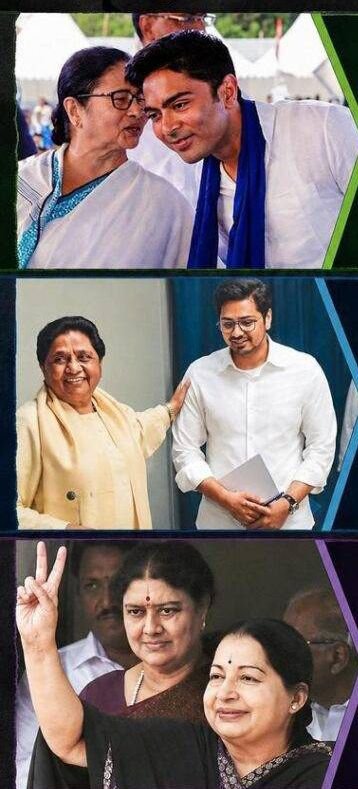
There was another similarity in the political lives of these three leaders. All three remained unmarried and dedicated their lives entirely to politics. However, a consequence of this was that no natural successor could be prepared within these parties. Since the size of the organization had become very vast, they had to rely on some ‘Number 2’ or troubleshooter. The irony was that whoever was trusted, instead of loyalty, only conflict and internal discord emerged.
Where is the Legacy Heading ?
………………………………………………………………..
The way the AIADMK split into factions after the death of Jayalalithaa disillusioned the public with the party. Today, the situation is such that about a decade after Jayalalithaa’s death, the party has slipped to third place in Tamil Nadu. And the cycle of party fragmentation has not stopped. The political ground of the AIADMK now appears to be divided between the new party ‘TVK’ of Tamil cinema actor Vijay and the traditional rival, the DMK.
In Uttar Pradesh, the Bahujan Samaj Party has been on the margins continuously since 2012. The BJP, through its skillful ‘social engineering,’ brought non-Jatav Dalits into its fold, while the remaining Dalit votes are now being captured by the Samajwadi Party and Chandrashekhar Azad’s ‘Azad Samaj Party.’ Consequently, the BSP is heading towards a deep political vacuum, where the party, confined around a brother and a nephew, is failing to provide any concrete ideological direction to its cadre.
In West Bengal, the walls of the TMC have begun to crack as the Mamata Banerjee government loses its grip. Due to the dominance of Abhishek Banerjee, there is intense dissatisfaction among the party’s old and loyal leaders. The BJP has greatly exploited the anti-incumbency wave and internal strife, making significant dents in the TMC’s traditional support base in rural and border areas. Surrounded by serious allegations and investigations, the Trinamool is becoming isolated today.
The Two Fundamental Mistakes of the Three Parties
………………………………………………………………..
First, instead of making their parties democratic institutions, they turned them into ‘person-centric cults.’ Second, fearing the loss of their influence, they never allowed a strong second-line leadership to emerge. Furthermore, these parties also failed to read the aspirations of the 21st-century voter, who now votes not just in the name of identity or emotion, but on the basis of good governance, employment, and transparency.
History is a witness that time never forgives political parties that fail to recognize the pulse of the era. Female leaders are also not granted any exemption. The fate of these three goddesses and their parties serves as a serious warning to all other regional parties in the country: if they do not restore internal democracy and honesty in time, their destiny will be to shrink into the footnotes of history.
About the Author