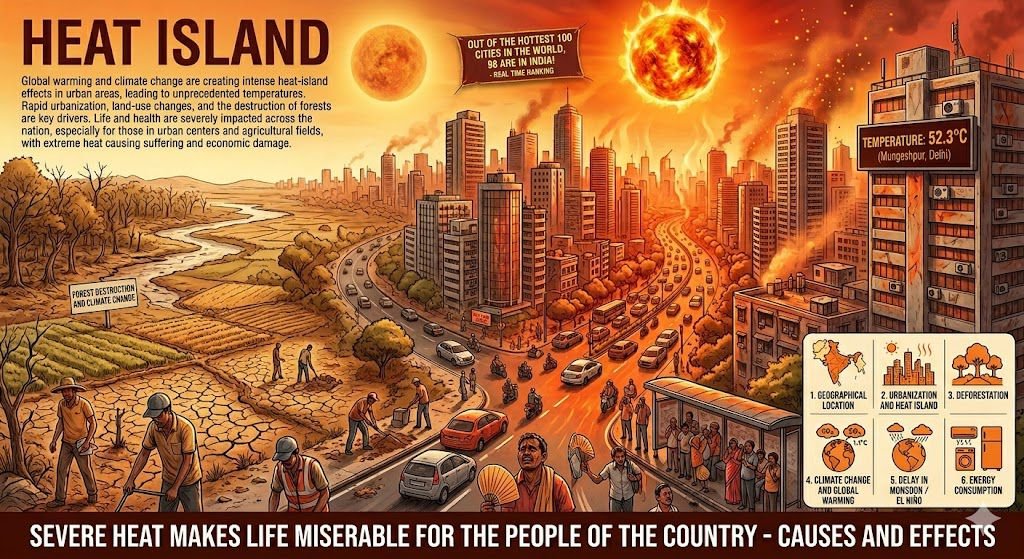
The heat has made life difficult for the common people of the country at this time. The situation has become so serious that India has currently become the hottest country on the entire planet. According to alarming data from real-time global temperature rankings, 95 to 98 out of the top 100 hottest cities in the world are solely in India.
On the other hand, in the live rankings of Aqi.in, only Indian cities have been placed in the list of all 100 cities in the world in terms of extreme heat. Talking about the geographical conditions of the country, the situation is continuously worsening due to this scorching heat, especially in Uttar Pradesh, the Vidarbha region of Maharashtra, Rajasthan, Telangana, Odisha, and Chhattisgarh.
Increasing Intensity of Heatwaves over Two Decades
According to a recent scientific research published in the journal ‘Nature’, a significant increase in the intensity and duration of heatwaves (loo) has been observed within India over the last two decades (20 years). This research has found that heat hotspots are now spreading rapidly into new areas of the country. Along with this, seasonal and global events like ‘El Niño’ are working to make this situation even worse.
This is the reason why this deadly heat starts troubling people every year as soon as April and early May begin. If we look at old data, from 1961 to 2021, an increase of about 2.5 days has been recorded during heatwave days. According to meteorologists, the number of days of heatwaves may increase by 12 to 18 more days in the coming few years. Apart from this, a record-breaking increase is also being seen in the maximum temperature of the country. In the 2024 season, the maximum temperature in Delhi’s Mungeshpur area reached a terrifying level of 52.3 degrees Celsius.
Why is the Heat Continuously Increasing in India? Know These 6 Main Reasons
1. The Country’s Specific Geographical Location.
The main reason for the continuous increase in heat in India is considered to be its geographical location. Actually, our country is located in the Tropical Zone. The part falling between the Tropic of Cancer and the Tropic of Capricorn is called the tropical zone, where the sun’s direct rays fall more. Because of this, the temperature here remains higher than normal, and the weather remains cool for a very short time. Additionally, the Thar Desert spread across northwest India (especially Rajasthan, Haryana, and Punjab) gets fiercely hot in the summer, and the dry hot winds rising from here turn into a ‘Loo’ and scorch the whole of India.
2. Indiscriminate Urbanization and Heat Island Effect
The pace of urbanization is increasing very rapidly in all the states of India, due to which green areas (trees and plants) are constantly decreasing. This has created a serious problem of ‘Heat Island Effect’ in cities. Skyscrapers, concrete structures, and asphalt (tar) roads built in urban areas absorb the sun’s heat all day and retain it in the atmosphere even at night. This is the reason why the temperature in urban areas is many times higher than in rural areas. Large cities like Delhi, Nagpur, and Ahmedabad are regularly recording temperatures several degrees higher than their surrounding rural areas. Actually, because of concrete, the heat gets trapped inside and cannot rise into the upper atmosphere, making the air even hotter.
3. Rapid Decline of Forests and Green Areas
Trees are considered the Earth’s natural air conditioner, but the felling of forests in the name of infrastructure development in India has completely broken this natural shield. According to a report by the ‘Climate Impact Tracker’, large-scale deforestation has occurred in India due to the expansion of agricultural land and heavy industrialization. With the destruction of forests, the balance of nature that trees maintained has been completely lost. According to the State of Forest Reports, urban green cover has decreased very rapidly in many of the country’s metropolitan cities due to the expansion of infrastructure, which is playing the biggest role in increasing surface temperature.
4. The Fury of Climate Change and Global Warming
Climate change and global warming occurring at the global level are also a very big reason for India’s boiling. The period between 2014 and 2023 was seen by India as the hottest decade in its history. During this time, the level of carbon dioxide in the atmosphere reached a new and worrying height of 425 ppm. According to the Intergovernmental Panel on Climate Change (IPCC), the global average temperature has already increased by about 1.1°C above pre-industrial levels. Meanwhile, in 2024, the heat of the oceans reached its highest level in the last 65 years. The World Meteorological Organization’s report says that the rate of warming of the oceans in the last two decades has more than doubled compared to 1960 to 2005, which is having a direct impact on India’s weather.
5. Constant Delay in Monsoon and the Effect of El Niño.
Due to the monsoon not arriving on time, i.e., its delayed arrival in the states of eastern and central India, conditions of severe heatwave prevail for a long time. This delay in the monsoon creates drought-like conditions in many parts of the country, which absorbs soil moisture and further increases the heat. Historical data clearly shows that whenever El Niño conditions develop in the Pacific Ocean, there is a heavy decrease in monsoon rainfall in India. History is witness that due to the ‘Super El Niño’ that came in 1877, there was a terrible drought in India and millions of people had to lose their lives.
6. Heavy Industrialization and Reckless Consumption of Energy
Along with development in the country, industrialization is also spreading very rapidly, due to which the greenhouse gases emitted are constantly accumulating in the environment. Along with this, the demand for electricity for cooling in the summer season reaches a record high. People use ACs and fridges indiscriminately in their homes to avoid the heat. But these air conditioners, fridges, and cars running on the roads provide cooling inside, but in return, they increase the temperature of the outside environment many times more. That is, the more we try to avoid the heat, the faster the heat of the outside world is increasing.
Serious Impacts of Excessive Heat on General Public Life
This increasing outbreak of severe heat and loo does not just trouble people, but it also proves to be very deadly. According to a detailed report by ‘Research Gate’, between 1992 and 2015, more than 24,000 deaths were recorded in India due to heatstroke alone. Seeing the seriousness of the situation, an international group of experts has recently made an official demand to the World Health Organization (WHO) that this growing climate crisis should now be declared a ‘Global Health Emergency’. The continuously increasing heatwaves and deaths caused by heat have been made the biggest basis behind this demand.
Apart from health, this excessive temperature is having a direct and very bad effect on the country’s agriculture and the wage-earning class. According to various reports, due to excessive heat and water scarcity, the country’s total agricultural production is continuously decreasing, the common public’s expenditure on health is increasing, and a huge decline is being recorded in the daily income of businesses and laborers dependent on outdoor activities (under the sun and open sky).
About the Author