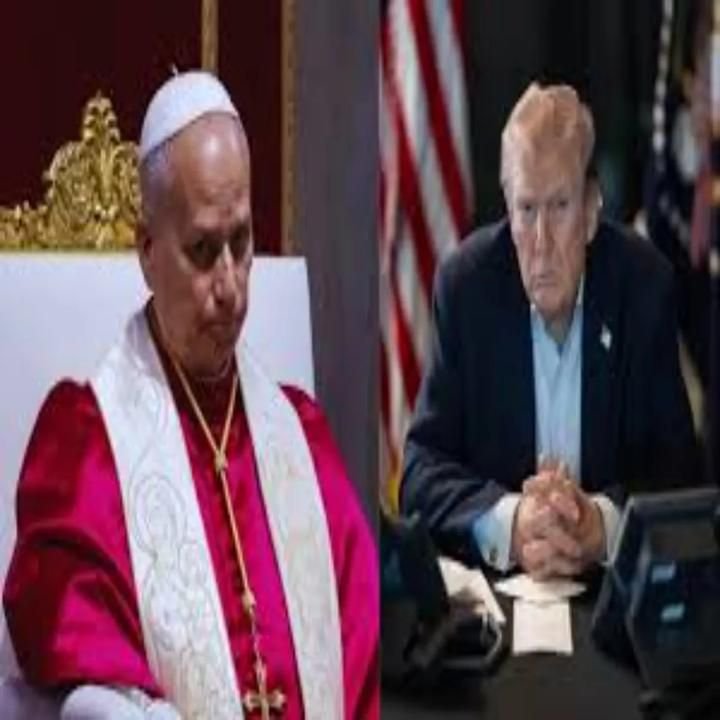
The sharp rhetoric in recent days between U.S. President Donald Trump and the head of the Catholic Church, Pope Leo XIV, has garnered international attention. Amid ongoing tensions in West Asia, this dispute is not limited to just two leaders; its impact is spreading across religious communities, global politics, and diplomatic relations. Statements from both sides are further deepening this confrontation.
The Selection of the New Pope and Global Identity
Following the passing of Pope Francis, Cardinal Robert Francis Prevost, of American origin, was elected as the new Pope during the Vatican Conclave in May 2025. He adopted the name Pope Leo XIV and became the first American-born Pope in history. His inclination is considered to be towards social justice, assistance to the poor, and peace initiatives. Internationally, his image has been that of a balanced leader who emphasizes dialogue.
Dispute Ignited by the Iran Issue
This confrontation began around Easter when President Trump issued harsh statements regarding Iran. He publicly adopted an extremely stern stance, issuing sharp warnings against Iran. In response, Pope Leo XIV, in his religious message, opposed war and violence, stating that the prayers of those who promote conflict are not accepted. His statement was seen as a direct reaction to Trump’s remarks.
Reaction from Trump and Allies
Following the Pope’s statement, President Trump openly expressed disagreement. Responding on his social media platform, he stated that a religious leader should not interfere in political matters in this manner. He also indicated that he considers his decisions justified based on public support. Meanwhile, Vice President JD Vance also questioned the Pope’s comments and spoke about exercising caution regarding religious subjects.
Historical Context as a Factor
This dispute did not emerge suddenly; rather, pre-existing differences have also been a cause. Before becoming Pope, Robert Prevost had criticized certain U.S. policies, especially decisions related to immigration. Even then, his views were a topic of discussion in political circles. Although Trump congratulated him upon his election as Pope, his statement included political undertones.
The Pope’s Balanced Stance
Despite the recent rhetoric, Pope Leo XIV has tried to avoid direct public confrontation. During his visit to Africa, he refrained from making detailed comments on this dispute and kept his message limited to religious values. He signaled that his objective is solely to promote peace, compassion, and dialogue, rather than engaging in any political debate.
Social Media and the Expansion of the Conflict
Social media has also played a significant role in this entire sequence of events. Certain posts and photos shared by Trump further escalated the controversy. Despite deleting one post and later offering a clarification, the discussion did not subside. Additionally, the sharing of an AI-generated image drew criticism, further intensifying the debate.
The Challenge of Balancing Religion and Politics
This dispute underscores how difficult it becomes to maintain a balance when religion and politics come close to one another. On one hand, the Pope speaks of moral and human values, while on the other, political leadership views its decisions through the lens of national interest. It will be important to see in which direction this confrontation moves in the coming time.
Fact-Based Analysis by A.I.
This conflict represents a historic shift in Vatican-U.S. relations, primarily due to the unique background of Pope Leo XIV (Robert Prevost). Here is an analysis of the key dynamics at play:
The “First American Pope” Paradox: Historically, there was a quiet consensus that an American Pope might be “too political” due to the U.S.’s superpower status. Now that it has happened, the friction with a populist U.S. administration was almost inevitable. Pope Leo XIV’s American roots mean he understands the nuances of U.S. domestic policy (like immigration) better than his predecessors, making his critiques feel more “personal” to the White House.
The Just War vs. Moral Diplomacy: The clash over Iran highlights the fundamental gap between Realpolitik (Trump’s focus on national security and deterrence) and Moral Authority (the Vatican’s stance against preemptive conflict). By stating that the “prayers of conflict-promoters are not accepted,” the Pope is utilizing the Papacy’s strongest tool—moral delegitimization—which directly challenges Trump’s appeal to his religious voter base.
The Role of Digital Misinformation: The mention of AI-generated images and social media volatility is a modern twist. In the past, diplomatic rifts between the Holy See and Washington were handled through Nuncios and State Department cables. Today, they are fought in real-time on social media, leaving little room for the “quiet diplomacy” the Vatican traditionally prefers.
Internal Religious Polarity: This isn’t just a fight between two men; it reflects a divide within the Catholic Church in America. Conservative Catholics often align with Trump’s policies, while the new Pope represents the more liberal, social-justice-oriented wing of the Church. This creates a complex “Three-Way Tug-of-War” between the Vatican, the U.S. Government, and the American Catholic electorate.
Conclusion:
While Pope Leo XIV is attempting to pivot back to a “pastoral” role (as seen in his Africa trip), the precedent is set. As long as the administration pursues “National Interest First” and the Vatican pursues “Global Humanity First,” their paths will continue to cross—and collide.
About the Author