Highlights-
The US has now disrupted the discounted oil game.
China was the biggest beneficiary.
The US weakened Russia’s power in the oil market with various bans.
Discounted oil has become a costly and risky proposition for China.
…………………………………………………………………..
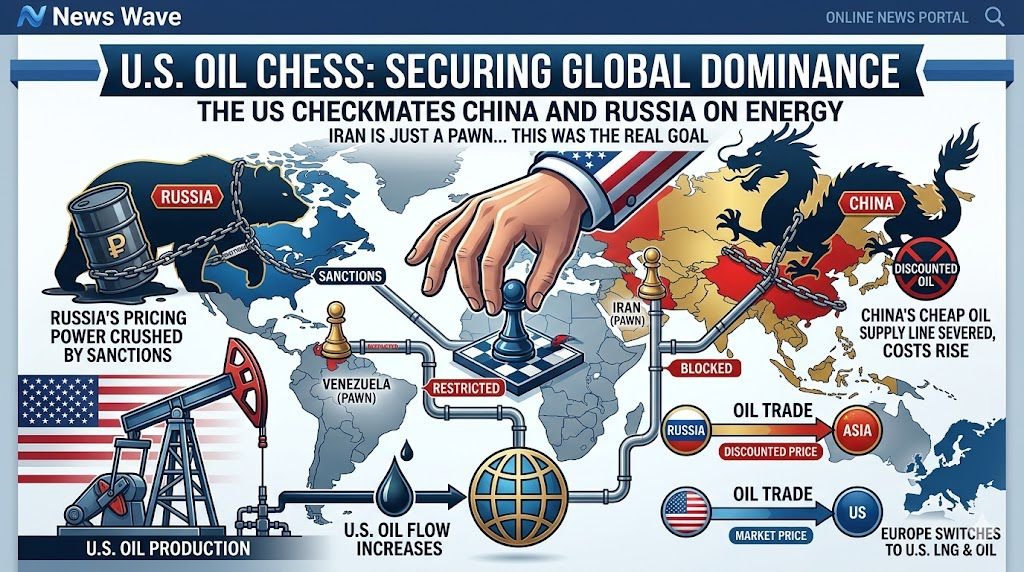
The US now wants to end the conflict with Iran, as the purpose for which President Donald Trump entered this conflict is largely fulfilled. In the battle for dominance over oil, the United States has simultaneously pushed Russia and China onto the backfoot. First, the US engineered a regime change in Venezuela to secure its oil reserves. Now, it has restricted Iran within limited bounds by exerting all-around pressure.
This is not a coincidence, but a part of a well-thought-out strategy. Currently, the US has adopted a policy of ‘Energy Dominance’. Its objective is not just to meet its own needs but to control the global oil supply and prices. The US had an ulterior motive against China, as China was heavily benefiting from discounted oil.
China is the world’s largest oil importer. Iran and Venezuela have been its primary sources of cheap oil. The US first imposed strict sanctions on Venezuelan oil companies, preventing their oil from reaching China. After that, the US is trying to divert Venezuelan oil back towards its own refineries.
China’s energy supply has been disrupted by the US sanctions on these countries, forcing it to buy oil from other countries at much higher prices. China has been the biggest beneficiary of discounted oil. It was getting oil from Iran and Venezuela at a huge discount of around $8 to $15 per barrel.
The Game of Discounted Oil is Over
Not only this, the US has started tracking and seizing the shadow vessels used by countries like China to get cheap oil. This has made cheap oil a costly and risky proposition for China. About 20% of China’s oil supply came from these two sanctioned countries. Meanwhile, the US, by pressuring Iran, has made the Strait of Hormuz and Kharg Island points of contention. China was benefiting the most from this route.
When these cheap options are reduced, China is forced to buy oil from Saudi Arabia or the US itself at market prices, increasing its production cost. The US has directly harmed China and Russia economically by imposing strict sanctions on Venezuela and Iran. Russia has been a major investor in the Venezuelan oil sector. The US sanctions have put these Russian investments at risk and attempted to isolate it in the global market.
China has been trying for a long time to trade oil in its currency, the ‘Yuan’, to reduce its dependence on the Dollar. Iran and Venezuela were key partners in this plan. By destabilizing the oil economies of these two countries, the US has indirectly struck a blow to China’s financial system that sought to challenge the Dollar.
Conspiracy to Control China
However, after the supply was cut off from Iran and Venezuela, China has become even more dependent on Russian oil. In view of the US pressure, China has started filling its strategic oil reserves to a record level, so that it can survive in the event of a war or full blockade.
In fact, the US has used energy diplomacy as a weapon. The US has not only shocked Russia and China simultaneously but has also changed the entire chemistry of the global oil market. It is worth noting that after the Ukraine war, the US has completely cut off Europe from Russian gas and oil. Earlier, Europe was also dependent on Russia for fuel. But now it has become the biggest buyer of US oil and LNG.
Meanwhile, Russia is now unable to find oil buyers, due to which it has been forced to sell its oil to Asia (India and China) at discounted prices. This has eliminated its ‘pricing power’. While China’s biggest economic strength has been the cheap oil obtained from Iran, Russia, and Venezuela. On the one hand, China now has to pay higher prices for oil, and on the other hand, the US, by increasing its oil exports, has established a psychological control over China’s supply line.
Looking at the global situation, as of today, the US has the oil market under its control. The US is now the world’s number-one oil producer. Global oil trade is conducted in Dollars; the US can decide through sanctions which country can sell oil and which cannot.