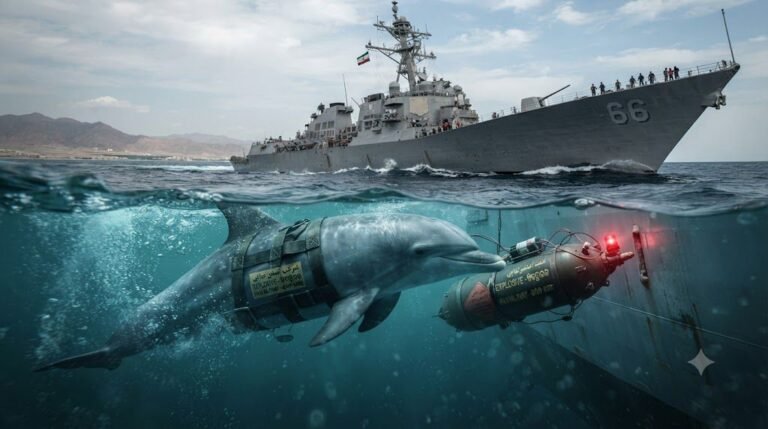
( Analysis is given below)

The Vice President of the United States has expressed apprehension amidst the ongoing conflict that Iran could develop a “jacket nuclear bomb,” through which it could easily attack any city.
The U.S. is also fearful of the concept of this bomb because it could be used to easily carry out an attack within its own borders.
Amidst the war, Iran could develop a jacket nuclear bomb. U.S. Vice President JD Vance has expressed this concern. Vance stated that Iran is moving forward very tactfully. It aims to create a weapon that could cause havoc in America.
Iran intends to prepare a “suicide nuclear bomber” on the lines of a suicide bomber. For this, it could develop a nuclear-equipped jacket.
Vance also indicated that this jacket nuclear bomb could be designed keeping the smallest nuclear bomb in mind. The U.S. possesses the world’s smallest nuclear bomb, which can carry a 23 kg warhead. Its total capacity is 10 tons of TNT.
Why the apprehension regarding the jacket nuclear bomb ?
An editorial in the IRGC-backed Tasnim News Agency of Iran has mentioned withdrawing from the NPT (Non-Proliferation Treaty). Tasnim argues that when other countries of the world are not following rules and laws, why should they? The NPT is a nuclear treaty proposal.
Iran possesses 440 kg of uranium enriched up to 60 percent. To create one nuclear bomb, uranium enriched up to 90 percent is required. From 440 kg of uranium, 11 nuclear weapons can be prepared.
Why is this dangerous for America ?
Currently, Iran does not possess any jet or missile that can reach America. This means that even after creating nuclear weapons, Iran cannot attack the U.S. directly. On the other hand, if Iran develops a jacket nuclear bomb, it could use it to attack America as well. This is why the U.S. is fearful of this bomb.
Sleeper cells linked to the Islamic Republic of Iran are active in America as well. These sleeper cells can easily cause havoc in the U.S. There is a fear that if a nuclear jacket bomb is created, it could be very difficult to stop, as preventing Iranian sleeper cells from entering or operating within the U.S. is a very difficult task.
While a jacket nuclear bomb may not cause large-scale destruction, it could prove effective for small-scale usage. According to JD Vance, if thousands of people are killed simultaneously and a specific area of a city is destroyed, it could cause an outcry across the entire world.
It is worth noting that this type of weapon is highly secretive and its exact design is not publicly available. These weapons are so small that a person can easily hide them in a jacket or bag, which makes them very dangerous.
Analysis
………………………………
The prospect of a “jacket” or “suitcase” nuclear weapon represents a shift from traditional strategic deterrence to asymmetric terror. While large missiles are designed to prevent war through the threat of mutual destruction, these miniaturized devices are designed to bypass those very defences.
Based on the news and current strategic climate in 2026, here is an analysis of the implications –
1. The Erosion of “Nuclear Threshold”
Traditional nuclear weapons are “strategic”—they are so large that using one almost certainly triggers a global world war. However, a “jacket bomb” is tactical.
Perceived Usability: Because the yield is lower (around 10 tons of TNT, as mentioned, compared to the 15,000 tons of the Hiroshima bomb), some military thinkers might wrongly view them as “usable” weapons that won’t necessarily end the world.
Lowering the Bar: This makes the transition from conventional to nuclear warfare much more likely and unpredictable.
2. Bypassing National Missile Defence
The U.S. and its allies have spent trillions on “Golden Dome” and Aegis missile defence systems to shoot down incoming ICBMs.
The “Trojan Horse” Strategy: A jacket bomb doesn’t fly through space; it travels in a suitcase, a shipping container, or on a person.
Intelligence over Interception: This shifts the burden of defense from the Air Force and Space Command to the FBI, CIA, and border security. As JD Vance noted, the threat isn’t a missile launch, but a “sleeper cell” already inside the country.
3. The Collapse of the NPT Framework
The mention of Iran’s potential withdrawal from the Non-Proliferation Treaty (NPT) is a critical red flag.
Global Domino Effect: If Iran successfully miniaturizes a warhead and exits the NPT, neighbors like Saudi Arabia or Turkey may feel forced to develop their own “equalizers” to maintain a balance of power.
The “Third Nuclear Era”: Analysts suggest we are entering an era where nuclear restraint is no longer a given rule, but a temporary choice.
4. Psychological Warfare and “Trāhimām” (Chaos)
As the report highlights, the goal of such a weapon isn’t necessarily to destroy a country’s military, but to shatter its psychological resolve.
Urban Vulnerability: A 10-ton TNT equivalent explosion in a major financial district or a crowded stadium would cause “Trāhimām” (an outcry of extreme distress). It creates a permanent state of fear where any person with a heavy jacket becomes a potential existential threat.
About the Author