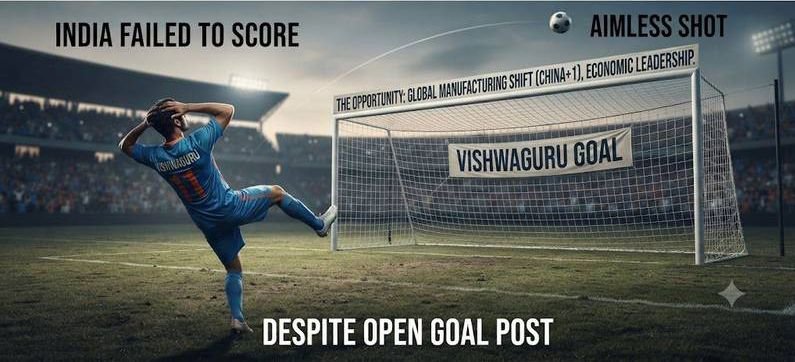

At a time when there was an illusory environment of joy of becoming a ‘Vishwaguru’ in the country, the Government of India has actually failed to formulate any actionable strategy to capitalize on the opportunities. Two major think tanks have reached this conclusion.
…………………………………………………………………………………………………………
Two think tanks have reached the same conclusion that due tomorrow the rapid changes that began in global equations since 2018, India failed to take advantage of the opportunities thus created. In fact, this is the story of the time when crores of countrymen believed in the narratives of India becoming a ‘Vishwaguru’. However, at a time when there was such an illusory environment, the Government of India had actually failed to formulate a workable strategy to capitalize on the opportunities. New York-based think tank ‘Rhodium Group’, in its latest report titled ‘Can India Finally Achieve its Manufacturing Ambitions’, stated that when the trade war between the US and China began in 2018, a general perception was created that since companies would move their operations out of China to other countries, India would benefit the most from it. But that did not happen.
…………………..
Vietnam and Mexico have performed very well in this matter. They have effectively filled the void created by the decline in China’s exports to the US. This has added more value to the manufacturing sector of these countries, whereas India has lagged far behind in this matter. Similarly, Australian think tank ‘Lowy Institute’ has reached a similar conclusion on strategic matters. According to its ‘Asia Power Index’, despite its massive potential and resources, India is not becoming an influential power or a regional “anchor” (a primary power providing stability) in Asia.
…………………
According to the institute, compared to the capacity, population, and resources India possesses, its actual regional and international influence is quite low. India’s influence in regional defense alliances and commercial partnerships is limited compared to other major powers, as a result of which it has not been able to make full use of its potential. Given the competition from Western countries against China, if foreign institutions sympathetic to India reach such conclusions, the people of India should pay attention to this. When the issue of accountability arises, the question of who is responsible for these failures must also be asked.
…………………………………………………………………………………………………………
Analysis and Justification
…………………………………………………………..
The given news is based on the assessments of two major global research organizations—New York’s Rhodium Group and Australia’s Lowy Institute. A neutral and intellectual analysis regarding the extent of truth in this news is presented below:
…………….
1. Manufacturing and the Reality of the ‘China Plus One’ Strategy
Analysis- Ever since the trade war started between the US and China from the year 2018 and later during the Covid pandemic, major global companies wanted to establish their manufacturing centers in countries other than China (which is called the ‘China Plus One’ policy).
Truth – Vietnam and Mexico have achieved far more success than India in this domain. Due to Vietnam’s flexible labor policies, easy business processes, and Mexico’s border proximity advantage with the US, they were able to quickly capture China’s space in the US market. On the other hand, despite the launch of ‘Make in India’ and the ‘PLI Scheme’ in India, desired foreign direct investment could not be attracted due to complex bureaucracy, land acquisition hurdles, and tax system complexities.
…………………..
2. India’s Potential and International Influence (Lowy Institute Report)
Analysis -According to the Lowy Institute’s ‘Asia Power Index’, despite having massive population and military might, India has not emerged as a single ‘anchor’ or decisive power in the Asian continent at economic and diplomatic levels.
Truth: There is validity in this point as well; due to India’s economic size (GDP per capita) and non-participation in regional free trade agreements (such as staying out of RCEP), India’s influence in Asian trade has remained limited. China’s economic and infrastructural influence in other Asian countries has remained much higher compared to India.
…………………..
3. The “Vishwaguru” Narrative and Public Perception
Analysis – India is a fast-growing economy and has achieved major successes in the field of science (such as the space mission Chandrayaan). However, considering only diplomatic success or macroeconomic numbers as ‘Vishwaguru’ while ignoring the ground realities of employment, poverty alleviation, and the manufacturing sector creates a sense of complacency or ‘khush-femi’.
……………
Conclusion-
The above facts are not entirely baseless. They are based on international economics and analytical data. Although the Government of India has taken many positive steps to elevate the nation’s economy, it must be conceded that India has fallen somewhat short in making optimal use of the golden opportunities created in global manufacturing and export markets. This should not be taken as criticism, but rather considered as a self-reflection for the future.
About the Author