By – Jawahar Mishra
…………………………………………………………..
For eight decades, Japan’s security policy rested on three sacred rules: first, no significant use of military force; second, no export of weapons; and third, minimal defense spending. These restrictions were not just policies, but the foundation of Japan’s post-war identity.
………..
Between the 1890s and 1945, Japan’s imperial expansion caused occupation of East and Southeast Asia, mass violence, forced labor, sexual slavery, and wartime atrocities. These experiences are embedded in national history, education, museums, and family memories in China, Korea, the Philippines, and elsewhere.
………..
After World War II, Japan embraced pacifism not only to limit Tokyo’s options, but also to reassure neighbors that imperial aggression would not happen again.
………..
Post-war institutions, the diplomacy of apologies, and restrictions on military bases and weapons became part of a regional social contract. But over the past decade, Tokyo has gradually weakened these post-war constraints.
……….
Defense budgets are rising, military capabilities are being rebuilt, arms sales have begun, a central intelligence agency is being recreated, and most shockingly, Japan is no longer shying away from debating the role of nuclear weapons in national security.
…….
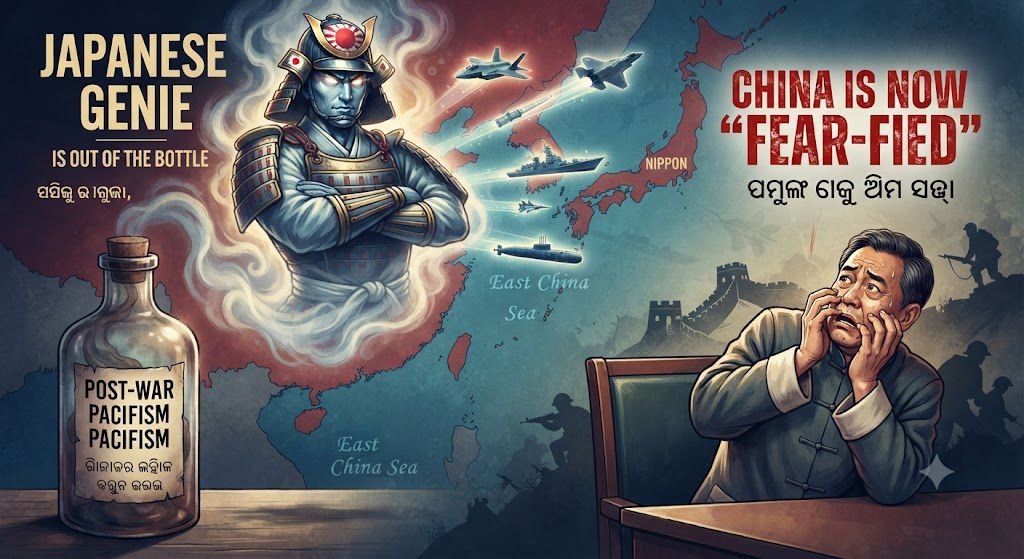
China sees changes in Japan’s policy as a historic provocation
For China, this is not just a policy shift; it is a historic provocation that revives painful memories of the imperial militarist era.
……..
A technologically advanced ally of the United States that once kept itself constrained is now transforming into a military power whose reach and influence extend across Asia and beyond.
………
Beijing feels its strategic scope is shrinking as its mortal enemy displays its strength once again.
……….
Why is China worried?
………………………………………………………………
China’s concern over changes in Japan’s defense policy stems from three reasons: first, history; second, hard power; third, alliances.
…….
The first reason is history, which plays a crucial role in China’s domestic and foreign policy. Memories of wartime atrocities committed by Japan reinforce the Communist Party’s claim that it saved the country, and whenever Tokyo appears to cross its boundaries, these memories are invoked.
…………….
Beijing can frame any move by Japan as a return to “imperial militarist mindset,” even if its purpose is solely “deterrence.” This perspective finds support in South Korea and parts of Southeast Asia, making Japan’s diplomacy difficult.
…….
The second reason is “hard power”; China views this shift by Japan as a detrimental change to the regional balance. Japan’s target of spending 2% of GDP on defense, counter-strike capabilities, modern SDF (Japan’s military), and a strong defense-industrial base together massively increase its military capability on China’s eastern border.
…………
This makes it necessary for the PLA to worry about strong Japanese retaliation before projecting power in the Taiwan Strait or the South China Sea. Furthermore, potential exports of weapons by Japan to Southeast Asia (such as patrol vessels, radar systems, or coastal defense missiles) further reduce China’s dominance over smaller neighboring countries.
…………….
The third reason is alliance dynamics, which further amplify these concerns. Japan’s reforms come with deeper integration into US-led partnerships, such as trilateral cooperation with the US and South Korea, closer ties with Australia and the UK, and engagement with other minilateral groups in the Indo-Pacific region.
……….
As Tokyo’s capabilities grow, US contingency plans could incorporate Japanese assets in maritime surveillance, anti-submarine warfare, missile defense, and logistics. For China, this means that during any crisis in the region, rather than being a contest between just two countries, it could take the form of an alliance where Japan’s strength plays a leading role.
About the Author