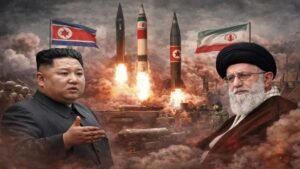
Where did Iran get such powerful missiles? This is the question that has cost the sleep of everyone from the Pentagon to the Israeli Defense Force (IDF). Iran’s recent attacks have proved that even the world’s most modern American and Israeli air defense systems are proving ineffective against its missiles. Now the veil has been lifted from this mystery, and the strings are being connected to the world’s most mysterious country—North Korea.
Secret Arms Deal: The Alliance of Kim Jong and Iran
A sensational report by the American news agency ‘News Digital’ has caused a stir. Defense expert Bruce Bechtol claims that a large part of Iran’s ballistic missile stockpile has either been purchased directly from North Korea or uses North Korean technology. According to Bechtol, the missile with which Iran attacked the Diego Garcia military base was actually a North Korean ‘Musudan’ missile. Iran had purchased 19 such missiles from North Korea back in 2005, which are capable of precision strikes over long distances.
Decades-Old Friendship and Indigenous Technology
According to the book ‘Rogue Allies’ by Bruce Bechtol and Anthony Soles, the military alliance between Iran and North Korea is decades old. In the 1990s, North Korea provided a large number of ‘No Dong’ missiles to Iran. After this, Iran did not give up and developed its own technology to produce missiles like ‘Emad’ and ‘Ghadr’. Reports suggest that Iran currently possesses a stockpile of missiles with ranges from 1,000 km to 3,000 km, making even American bases unsafe.
Why are Israel-US Air Defenses Failing ?
Experts believe that these missiles with North Korean technology often go undetected due to their speed and specific trajectory. This is why multi-billion dollar air defense systems have not been fully successful in stopping them. However, according to ‘The Wall Street Journal’, one of the Musudan missiles used in the Diego Garcia attack failed and another was intercepted, but the threat is far from over.
Carnage in the Middle East and ElBaradei’s Warning
February 28, 2026, has been recorded in black letters in the history of the Middle East. America and Israel are raining explosives on Iran under the name ‘Operation Epic Fury’. According to Iran’s Health Ministry, more than 2,000 people have been killed in these attacks, while human rights organizations claim the figure has crossed 3,500, including 250 innocent children.
Mohamed ElBaradei, former head of the International Atomic Energy Agency (IAEA), has warned the entire world from Vienna. Terming Trump’s decisions as ‘madness’, he said that if this is not stopped, the entire Middle East will turn into a fireball. Now the question is, will Trump and Netanyahu stop this destruction, or will the world witness another catastrophic war?
America supplied weapons to Iranian protesters
Tensions between Iran and America in West Asia have now reached their peak. Meanwhile, US President Donald Trump has made a statement that has sent shockwaves across the globe. During an interview on Sunday (April 5, 2026), Trump admitted for the first time that the US had supplied weapons to people protesting against the government in Iran. Trump’s claim is not only provocative to Iran but has also intensified fears of the war flames spreading further.
Guns were sent through the Kurds
In an exclusive interview with Fox News, President Trump spoke candidly. He said, “We used the Kurds to send a large number of guns and weapons to the Iranian protesters.” However, Trump added a twist to this. He further stated, “I think the Kurds, through whom we sent these weapons, kept those weapons for themselves.” Trump’s hint was toward the community that has been fighting for its rights for a long time.
Who are the Kurds mentioned by Trump ?
Following Donald Trump’s claim, the ‘Kurdish’ community is in the spotlight once again. The Kurds are one of the world’s largest ethnic groups without a country of their own. Their total population is about 30 million, spread across different parts of Turkey, Iran, Iraq, and Syria. They have their own languages and dialects, and most of them are Sunni Muslims. Since the Iranian government has declared several Kurdish organizations as terrorist entities, Trump’s statement is like rubbing salt into Iran’s wounds.