By – Jawahar Mishra
Highlights – How much contradiction is there in Rahul Gandhi’s statements: Is Narendra Modi a ‘dictator’ or a ‘weak PM’ ?
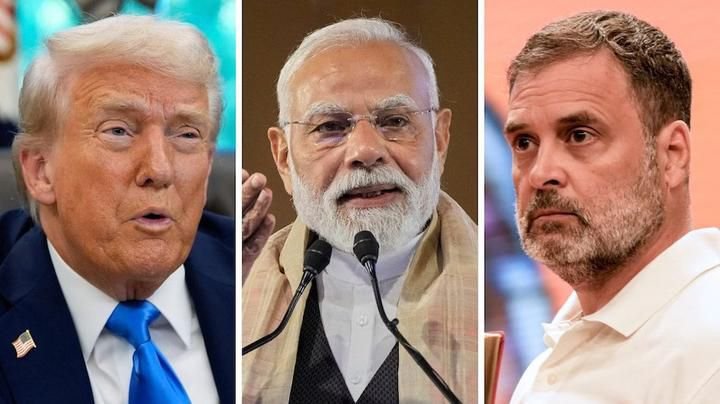
Rahul Gandhi has once again taunted Prime Minister Narendra Modi by calling him a weak PM. But what will the public react to when someone who repeatedly calls Modi a dictator and destroys constitutional institutions calls him weak ?
…………………………………………………………………….
Congress leader and Leader of the Opposition in the Lok Sabha, Rahul Gandhi, has described Prime Minister Narendra Modi’s silence in the face of US President Donald Trump on the H-1B visa fee hike ($1,700-$4,500) as a “weak” Prime Minister. Rahul Gandhi retweeted a July 5, 2017, post on the social media site X, which stated that Modi was scared of Trump.
Retweeting this on September 20, Rahul Gandhi wrote, “I reiterate that India has a weak Prime Minister.” Rahul again linked the H-1B visa fee hike of $100,000 (Rs 8.8 million) to “weak leadership.” Mallikarjun Kharge called it “Trump’s birthday gift.” Rahul argues that Modi has failed to protect India’s interests (in the IT sector, where 71% of H-1B workers are Indians) on the global stage. He also described his silence on Trump’s decisions, such as the lifting of sanctions on the Chabahar port and the 50% tariff, as “weakness.”
1- Confusion in Rahul Gandhi’s Statements
In his statements, Rahul Gandhi has sometimes called Narendra Modi a dictator and sometimes mocked him by calling him a “weak PM.” In reality, no person can simultaneously be a dictator and a weak PM of a country. Clearly, these two statements by Rahul Gandhi lead one to believe that his views on Narendra Modi are either contradictory or that he himself is unable to understand the Prime Minister’s personality.
On the one hand, Rahul Gandhi has repeatedly claimed that Modi weakened constitutional institutions (such as the CBI, ED, and the Election Commission) due to his authoritarian attitude. On the other hand, he called Modi a “weak PM” in 2017 and again on September 20, 2025, over the H-1B visa fee hike. This contradiction seems superficial, but if we look deeper, it could be part of the Congress’s strategy. Because a dictator can never be weak. And more importantly, can a weak Prime Minister bring about major constitutional changes in the country between 2017 and 2025? Can a weak Prime Minister win three consecutive elections? Can a weak PM take decisions like demonetization and the reduction in GST?
2-Contradiction or Strategy?
Rahul Gandhi’s statements about Modi are a strategy, not a contradiction. It’s possible that Rahul Gandhi wants to shatter Modi’s image of a “strong leader” with a double blow. The opposition, especially young and urban voters, wants to convey that Modi is destroying democracy. Similarly, the educated, NRIs and professionals want to convey that Modi has failed to strengthen India on the global stage.
While the terms “dictator” and “weak” appear to be contradictory, Rahul Gandhi’s statements address two distinct dimensions. To portray Modi as a “dictator,” Rahul Gandhi cites examples of alleged misuse of institutions and suppression of the opposition. He claims that Modi has used power to benefit the RSS and his “friendly capitalists” (Adani and Ambani). Conversely, to portray Modi as weak, Rahul Gandhi claims that he has adopted a “soft stance” on foreign policy toward countries like the US and China. In 2023, Rahul called China’s incursion at the LAC “Modi’s weakness.” In 2025, he described his silence on H-1B as a weakness.
3- Can a weak PM do all this?
Modi’s achievements—electoral victories, major legislation, economic reforms, and global stature—refute Rahul Gandhi’s claims. Modi led the BJP to historic victories in 2014 (282 seats), 2019 (303 seats), and 2024 (240 seats, NDA 293). His third consecutive victory in Maharashtra, Haryana, and the Delhi Assembly elections demonstrate that Narendra Modi’s charisma remains intact, despite a slight weakening in 2024.
A user on X writes that Modi has kept the coalition united, something no weak leader could do. Rahul Gandhi’s “Constitution in danger” narrative has been nearly destroyed by Modi’s “development versus corruption” narrative. By abolishing Article 370 (2019), implementing GST (2017), and implementing the CAA-NRC (2019-20), the Modi government has demonstrated that it was never a weak leader.
4- The Weak PM Narrative Could Cost Rahul Gandhi
Rahul Gandhi’s dual narratives of “dictator” and “weak” create confusion among the public. A user on X writes, “Let Rahul decide, dictator or weak?” The BJP retorts by calling this “negative politics.” A year ago, The Hindu wrote that such a narrative by Rahul could lose credibility.
Rahul’s “weak PM” statement may be beneficial in the short term. While such statements could potentially mobilize young people and opposition supporters who are angry with the BJP, Rahul Gandhi could prove risky in the long run, as Modi’s achievements and the BJP’s organizational strength would likely neutralize them.
This controversy may increase the vote share slightly in the Bihar Assembly elections, but it is insufficient to defeat the NDA. Because when anti-Modi forces unite, there will inevitably be a reaction to action, and those recently disgruntled with the Modi government may return, whose vote share will be significantly higher than the Congress’s increased vote share.