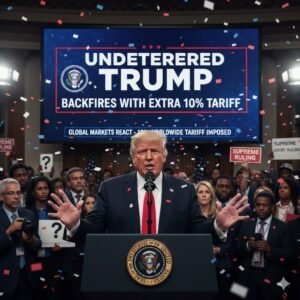
American President Donald Trump, in a major counter-strike following Friday’s U.S. Supreme Court decision, announced the imposition of a 10 percent additional global tariff on all countries. Trump stated that he would sign a new order under Section 122, which will levy an additional 10% charge over existing tariffs. This tariff will come into effect immediately and will remain effective for approximately five months.
In a press conference, Trump clarified that despite this decision, he would not back down from his trade agenda. He said, “Foreign countries are very happy, but their happiness will not last long. We will now take steps in a stronger direction and adopt a tough stance in trade policy.” He signaled that all options are on the table and other robust methods of imposing tariffs are already under consideration.
Trump clearly stated that he would sign an order today, under which an extra 10% fee would be collected on top of current tariffs. During the press conference, Trump went as far as to say, “We will make more money from tariffs.” This means the baseline tariffs already in place will continue, and an additional 10% will be added on top of them. This ensures that imports are set to become more expensive.
‘President lacks the authority to impose tariffs’
Earlier late Friday (Indian time), the U.S. Supreme Court, in a 6-3 majority, declared Trump’s previous global tariffs illegal and struck them down. The court stated in its decision that according to the Constitution, the authority to impose taxes and tariffs rests with Congress, not the President.
What will happen to the $134 billion already collected ?
While the Supreme Court declared the tariffs illegal, it left a major question unanswered. The government has already collected approximately $134 billion in revenue from importers. The court did not clarify what should be done with this massive sum. According to Customs and Border Protection data, more than 300,000 importers have deposited this money. Now, the matter of refunding this amount will go to lower courts. Justice Kavanaugh wrote in his note that the process of returning billions of dollars could become a massive ordeal. There are also fears that this could adversely affect the American economy.
Why was there a controversy over ‘Liberation Day’ tariffs ?
Trump had imposed heavy import duties on countries like China, Mexico, Canada, and India. In the case of China, this tax had reached up to 145 percent. Trump’s argument was that tariffs would make America a rich country, and without them, it would become poor. On the other hand, small businessmen termed it a tax collected without congressional approval. They described it as a “suffocating” display of presidential power. Trump had relied on a 1970s-era emergency law that does not even mention the word ‘tariff.’ The court caught this technical flaw and rejected Trump’s claims.
Does Trump have a backup plan ready ?
Despite the defeat, Trump does not seem in the mood to back down. According to sources, he has told Governors that he has a secret backup plan. The President possesses certain other powers through which he can impose tariffs. However, those laws are tied to time limits and other conditions. For instance, one law allows him to impose a 15 percent tax for only 150 days. Taxes can also be imposed on specific industries in the name of national security. Now, it remains to be seen what new path Trump adopts to bypass this court order.
What will be the impact of this decision on the business world?
This decision has brought major relief to thousands of companies troubled by expensive tariffs. Large companies like Costco had already raised a front against this tax. Traders say this will end uncertainty in the market and could lead to a reduction in prices. However, it is a headache for the government as the refund process is going to be very complex. The administration has already warned that returning the money will be a long and tedious task. Currently, the eyes of the entire world are on Trump’s next move because he is known for his persistence.