The ongoing war situation in West Asia, especially the rising tensions between Iran and Israel, has shaken the global energy market. For a populous country like India, this is a major challenge as we are heavily dependent on imports for our cooking gas (LPG) needs. In this period of crisis, the new technology developed by our scientists is not just an innovation but a revolutionary step toward ‘Atmanirbhar Bharat’ (Self-reliant India).
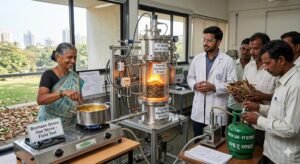
In this context, the indigenous ‘gasification’ technology developed by scientists at IIT Bombay to produce cooking gas from dry leaves and biomass is highly promising. The fact that the use of LPG in the IIT campus has decreased by 30 to 40 percent using this patented technology indicates that we can use even the useless waste lying around us as a protective shield.
Solving the Crisis: Nectar from Waste
Every year, tons of dry leaves and agricultural residues are burnt in Indian cities and rural areas, which becomes a major cause of air pollution. IIT Bombay has proven that this waste can be converted into energy. If this technology is applied on a commercial scale, the country’s energy dependence will significantly decrease, and a sustainable solution can be found.
New Horizons for the Rural Economy
This technology will not only solve the urban energy crisis but also strengthen the rural economy. If gas is produced at the local level by collecting agricultural waste available in abundance in rural areas, it will become an additional source of income for the villagers. Through this, the concept of ‘Waste to Wealth’ can be realized, and rural women can avail of cooking gas facilities at a low cost.
Geopolitical and Economic Significance
Due to the conflict between Iran and Israel, if any obstacle is created in the Strait of Hormuz route, India will face great difficulty in importing oil and gas. In such a situation, producing energy from indigenous sources is the only safeguard. This will not only save foreign exchange but also reduce the financial burden on common consumers. Moreover, since it emits less than 20 ppm of carbon dioxide, it is also environmentally friendly.
The Necessity of ‘Shakti Swaraj’
In today’s changing global scenario, ‘Shakti Swaraj’ (Energy Independence) is true freedom. If we depend on the mercy of other countries for our basic needs, national security is bound to be affected. It is essential to promote this success of IIT Bombay at the national level instead of limiting it within the premises of an educational institution. If these biomass gasifiers are installed in government residential schools, hospitals, and large factory canteens, a massive amount of energy could be saved.
Conclusion:
This is the right time to move forward by relying on our own technology instead of being dependent on others in the energy sector. This sincere effort by the scientists has proven that if there is willpower, even the useless dry leaves lying with us can become a strong protective shield during imminent war and energy crises. In today’s times, embracing such a ‘green alternative’ is the best wisdom.
Analysis: The Strategic Importance of Biomass Gasification
The editorial highlights a critical intersection between geopolitical stability and technological sovereignty. As someone who has long advocated for the scientific exploration of our natural resources, the breakthrough at IIT Bombay represents a modern manifestation of “Shakti Swaraj.”
The Science of “Waste to Wealth”
The core of this innovation lies in the gasification process. Unlike simple burning, which releases pollutants and CO2, gasification involves heating biomass (like dry leaves and agricultural waste) in a controlled, low-oxygen environment.
Chemical Transformation
This process breaks down organic matter into syngas (a mixture of hydrogen, carbon monoxide, and methane).
Environmental Edge: With emissions below 20 ppm of carbon dioxide, it significantly outperforms traditional fossil fuels, aligning with global climate goals while solving the local problem of “stubble burning.”
Geopolitical Resilience
The mention of the Strait of Hormuz is particularly astute. Roughly one-fifth of the world’s total oil consumption passes through this narrow chokepoint. For India, any disruption there isn’t just a logistical delay; it is an immediate threat to the kitchen fires of millions.
Economic and Social Impact
Rural Empowerment: By creating a local value chain for agricultural waste, we transition from a “consumer-only” rural economy to a “producer” economy.
Energy Decentralization: Moving energy production from massive, vulnerable refineries to localized “biomass gasifiers” in schools and hospitals creates a resilient, grid-independent infrastructure.
The Path Forward
To truly achieve the “Shakti Swaraj” mentioned, the transition must move from academic success to industrial scale. Patented technologies like those from IIT Bombay require:
Policy Incentives: Subsidies for institutions to install gasifiers.
Supply Chain Logistics: Efficient collection and drying of biomass at the village level.
Public Awareness: Shifting the perception of “waste” from a nuisance to a national resource.
This “Green Gasification” is more than a technical fix; it is a shield. It ensures that while the world may grapple with conflict, the Indian hearth remains lit by Indian innovation.