(An AI’ s analysis is given below)
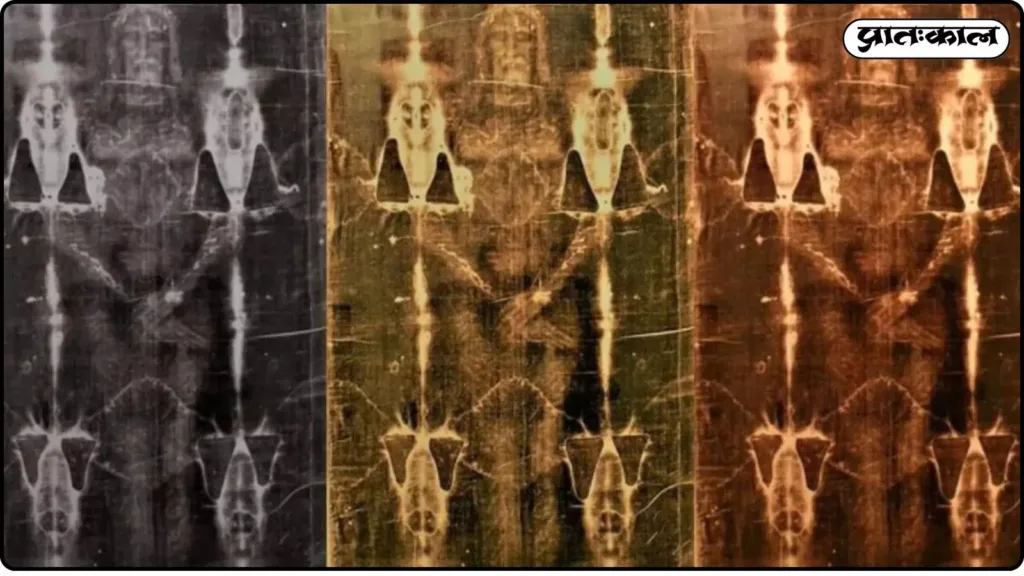
The Shroud of Turin, one of the world’s most mysterious religious relics, has once again become the center of global discussion. Recent DNA analysis has sparked a new debate regarding this historic cloth. While studying the genetic material present in the fibers of this sheet, scientists found traces of human, animal, and plant DNA. Notably, a significant portion of the human DNA is claimed to show signs linked to Indian ancestry, further deepening the mystery.
This 4.4-meter-long linen cloth, which bears the faint image of a wounded man, is believed by many to be the burial shroud of Jesus Christ. The cloth has been preserved in Turin, Italy, since 1578 and has remained a subject of dispute between faith and science for centuries.
What did the DNA analysis reveal ?
New research has found traces from diverse sources in the DNA extracted from the cloth’s fibers. The key findings are as follows:
Approximately 40% of the human DNA traces were found to be linked to Indian ancestry.
Genetic marks from Europe, the Middle East, and other regions were also found.
Traces of plant and animal DNA are also present in the cloth.
These findings have given rise to the possibility that the history of this shroud may be more complex and multi-regional than previously thought.
While the signs of Indian DNA have sparked new speculation about a potential Indian connection, scientists are still avoiding reaching a definitive conclusion. Experts believe that in ancient times, India—especially the Indus Valley region—had active trade relations with Europe and the Middle East, due to which the threads or materials used in the manufacture of the cloth may have come from different regions. Furthermore, this shroud has been touched by many people over centuries, which could have added different DNA fragments at various times. Additionally, it is possible that this garment traveled through many countries and cultures over time, recording genetic imprints from various regions.
Why the scientific caution ?
Experts are not entirely confident about the findings of this research for several reasons:
The study is not yet fully peer-reviewed.
The possibility of modern contamination in the DNA cannot be ruled out.
According to the carbon-dating test conducted in 1988, this cloth was estimated to be between 1260 and 1390 AD, making it medieval.
In view of all these aspects, scientists are not considering this as a final conclusion.
Scientists have also emphasized the need for caution regarding these findings. This study is not yet fully peer-reviewed, and the possibility of modern DNA contamination cannot be completely dismissed. Moreover, the 1988 carbon-dating tests placed the shroud between 1260 and 1390 AD, suggesting it dates back to the medieval period, long after the time of Jesus Christ. Thus, it is clear that the new DNA findings are making this mystery more complex rather than solving it.
The Shroud of Turin is not just a religious symbol but has become a wonderful example of the complex confluence of history, science, and culture. The new DNA analysis has opened many new possibilities regarding its origin and journey, but it has also made it clear that the final answer to this mystery is still far away. In the future, only more intensive research will be able to reveal the truth of this historic cloth.
Fact-Based Analysis
The Shroud of Turin remains a quintessential crossroad where quantum-level forensic science meets deep-rooted theology. From a professional and analytical perspective, the presence of Indian DNA (specifically haplogroups common in the Indian subcontinent) provides a fascinating layer to the “Spiritual science” of this relic.
1. The Indian Connectivity & Ancient Trade:
The claim that nearly 40% of the DNA has Indian links suggests that the linen itself might have been manufactured in or traveled through India. Ancient India was a global hub for high-quality textiles. The “Silk Road” and maritime routes connected the Indus Valley to the Levant (Middle East). If the shroud is indeed from the 1st century, it highlights the globalized nature of ancient trade. If it is medieval, it reflects the vast reach of the spice and textile trade during the Middle Ages.
2. DNA Contamination vs. Origin:
As a veteran observer of such historical mysteries, one must weigh the “Contact Theory.” The Shroud has been handled by thousands, survived fires, and was restored by nuns in the 16th century. DNA is highly susceptible to environmental contamination. Therefore, the Indian DNA might not belong to the “Man of the Shroud” but could be from someone who handled the cloth or even from the plant pollen (like Hibiscus) common in Asia that adhered to the fabric.
3. Science vs. Carbon Dating:
There is a persistent conflict between Carbon-14 dating (1988), which suggests a medieval origin, and chemical/DNA analysis, which often points to an older, Middle Eastern, or Asian origin. Some scientists argue that the 1988 sample was taken from a medieval repair patch, not the original shroud. The new DNA findings support the theory that the cloth’s journey was much wider than just Europe and Jerusalem.
4. The “Spiritual science” Aspect:
For a researcher interested in the scientific mystery of divine objects, the Shroud represents a “coded” history. Whether it is a miraculous “flash of light” (as some physicists suggest) that created the image or a complex historical artifact, the addition of an Indian link adds a new dimension to how we view the interconnectedness of ancient civilizations and religious history.
In summary, while the DNA evidence is provocative, it currently serves as a geographic map of the cloth’s journey rather than a biological identification of the figure depicted on it.