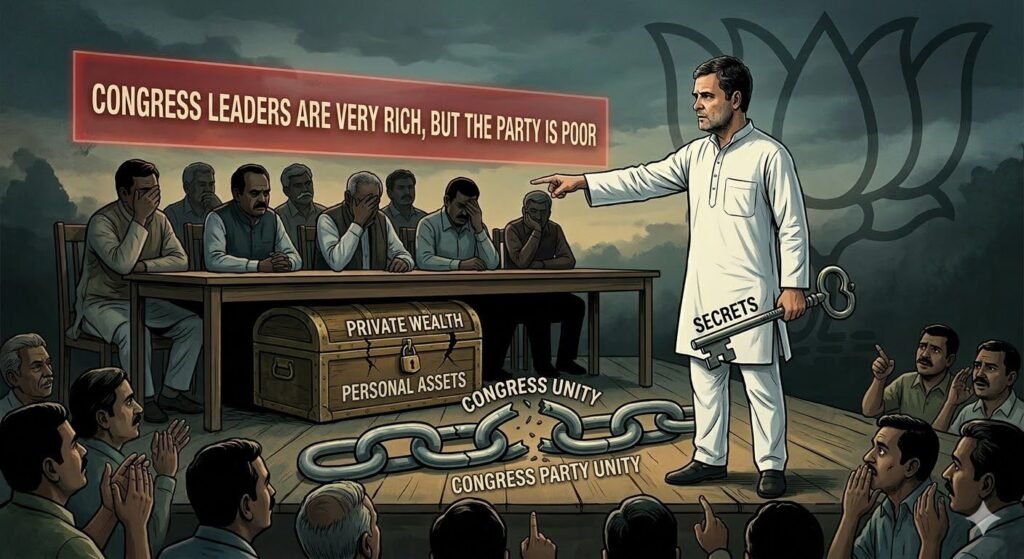
Rahul Gandhi keeps exposing the secrets of his own leaders, and that too in front of the public. This is when the BJP and other parties get an opportunity to attack Congress leaders.
Rahul Gandhi said among the public in Lucknow that Congress leaders are very rich, but Congress is a poor party. There was a lot of applause for this. People in the Congress ecosystem are also clapping on social media, saying that Rahul Gandhi is an amazing man.
The question is, what is so amazing about this? How did Congress leaders become rich? There are certainly some people who made money through their professional work, like Abhishek Singhvi, who has declared assets of three thousand crore rupees. But most people have become rich only while being in the government. So, if they have become rich, will the Congress governments be considered honest? BJP leaders say that Congress turns governments into ATMs, and Rahul Gandhi is also confirming that point. He is also indirectly saying that Congress leaders turn the government into an ATM but keep the money that comes out for themselves and do not give it to the party.
Similarly, when Rahul Gandhi went to Gujarat, he said there that many people in the party are in league with the BJP. What was achieved by saying this among the public? He had said that such people would be identified and expelled from the party, but even after a long time has passed, no one has been expelled.
On the contrary, after his statement, Congress lost badly in the by-elections, while the Aam Aadmi Party managed to save its seat. Conversely, AAP got an opportunity to tell people that Congress leaders are in league with the BJP and only AAP is fighting the BJP. Regardless, after Rahul’s statement, it is also being said that even if Congress is a poor party, it still spends crores in elections. In Bihar, it contested 60 seats and spent 35 crore rupees. The expenditure of the candidates is separate. In Bihar, one Congress MLA cost six crore rupees.
Key Arguments and Analysis
..The core of the recent discourse surrounding these statements centers on three critical observations:
Validation of Opposition Narratives: By publicly labeling party leaders as “rich” while the party itself is “poor,” there is an argument that this inadvertently confirms long-standing allegations from the BJP. It suggests that leaders may have prioritized personal wealth over the organization’s financial health during their time in power.
Tactical Risks in Regional Politics: In regions like Gujarat, labeling internal members as collaborators with the opposition has created a vacuum. This has allowed third-party players, like the Aam Aadmi Party (AAP), to claim they are the only “true” opposition, potentially contributing to poor electoral outcomes for the Congress in by-elections.
The Financial Paradox: There is a noted contradiction between the “poor party” rhetoric and actual election spending. For instance, in the Bihar elections, the party contested 60 seats with an estimated expenditure of 35 crore, leading to questions about the consistency of the party’s “poverty” narrative.
Political Implications
Internal Friction vs. Reform
This approach is seen by some as a necessary “shock therapy” to sideline the “Old Guard.” However, the immediate result is often internal demoralization. Publicly criticizing one’s own team can lead to a divide between the aggressive “New Guard” and veteran leaders who feel alienated.
The “Clean Outsider” Strategy
By distancing himself from the wealth of his own party’s leaders, Rahul Gandhi is attempting to position himself as a “clean” outsider fighting a corrupt system from within. This is a high-stakes gamble; while it may appeal to younger voters tired of traditional politics, it risks damaging the very party machinery required to win elections.
Campaign Ammunition for Rivals
The most significant implication is the creation of “ready-made” campaign material for rivals. When a high-ranking leader admits their colleagues are suspiciously wealthy, it reinforces the opposition’s narrative regarding corruption, making it difficult for the party to claim the moral high ground in future debates.