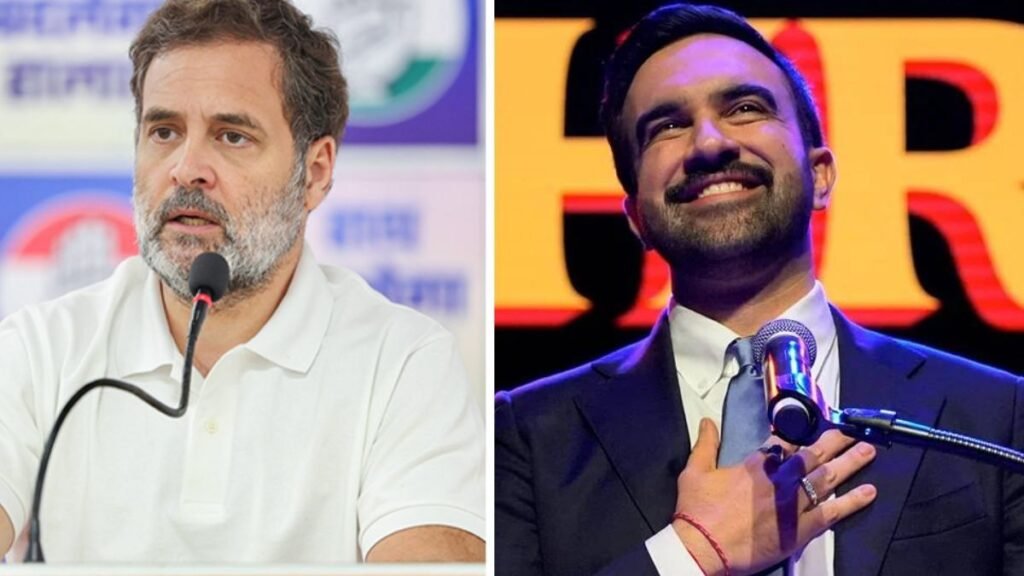
Ever since Zohran Mamdani won the New York mayoral election, he’s been more talked about in India than in the United States. India’s right-wing ecosystem, while some independent analysts, are jokingly pointing out that Mamdani also won the election by promising free sweets. They argue that there’s not much difference between the people of India and New York. Meanwhile, a Muslim female influencer is upset that Prime Minister Narendra Modi didn’t congratulate Mamdani on his victory. Whatever the reason, Mamdani is being widely discussed. The Indian media is hell-bent on portraying him as being of Indian origin, even though he has described himself as a Ugandan immigrant in the United States. Now, the question is: are Mamdani’s promises and India’s “free sweets” really the same thing? At first glance, they certainly appear similar, but there are some subtle differences.
Unfortunately, Indian parties and their leaders won’t attempt to understand this difference. They already assume that this is the Indian model, which also proved successful in New York. Mamdani’s victory in New York will further motivate him to make exaggerated promises. He needs inspiration. For example, Rahul Gandhi has been inspired by the Nepal incident. After the Nepal protests and coup, he has begun mentioning “Jen Ji” in every speech. Before the Nepal incident, I don’t remember him using the word “Jen Ji” even once. But after that, there hasn’t been a single speech in which he doesn’t use it. He has found inspiration from Nepal. Without understanding the caste, religious divisions, and ideological and cultural diversity in India, he is treating “Jen Ji” as a homogeneous citizenry and trying to inspire them to protest. Success in this is impossible. Similarly, the issue of freebies is also concerning. In India, the announcement of free services and goods is leading to electoral success, but there are many other factors at play. A thoughtless announcement of distributing “freebies” cannot lead to victory.
For example, during the Bihar Assembly elections, Tejashwi Yadav promised a government job for every family. This promise likely didn’t resonate with anyone, as it lacked any well-thought-out basis. Yes, he announced a monthly salary of ₹2,500 for women, and during the election, he announced that he would deposit ₹30,000 for the entire year into women’s accounts on January 14th. This appeals to women. Tejashwi’s ₹30,000 is being discussed, compared to Nitish Kumar’s government’s ₹10,000. This also demonstrates that promises should be trustworthy and targeted. Recall how the Congress and the opposition raised the issue of saving the Constitution and reservations during the last Lok Sabha elections, when BJP leaders were talking about changing the Constitution after winning 400 seats. However, the issue of depositing ₹1 lakh into accounts every year fell flat.
In fact, the difference between freebies and the Mamdani model in India is that there is a herd mentality. There are promises of bringing down the moon and the stars, whereas the Mamdani model is about announcing specific benefits for targeted groups, along with ideological and cultural commitment. Edward L. Barnes, known as the father of public relations, theorized that only if your actions are backed by policy preparation will you reap the benefits of your actions. He explained that if a leader caresses or kisses a small child in public, they must have a good childcare policy in place. This means that a random act without policy preparation creates optics but doesn’t garner votes. For example, in Bihar, Tejaswi Yadav starts batting with a cricket bat or a badminton racket anywhere. If he had a good sports policy to announce, then this behavior would be beneficial, otherwise it would be meaningless. Similarly, if Rahul Gandhi had announced a policy on fisheries and jumped into the pond to catch fish, it would probably have been more beneficial.
However, Mamdani’s campaign demonstrated that he announced freebies with targeted groups in mind, and they directly benefited from them. He carefully placed housing, transportation, and food at the center of his campaign promises. To achieve this, his and the Democratic Party’s team conducted extensive research. They were presented with data showing that the average rent, or housing cost, in New York has increased by 68 percent over the past few years. Similarly, the average cost of transportation and food has risen by 56 percent. The national average for these increases is 40 percent. Another reality in New York is that the number of people employed in the stock market, investment, or banking sectors has declined from 16 to 13 percent, while the number of people engaged in low-paying jobs like teaching, nursing, and childcare has increased from 30 to 40 percent. Similarly, the foreign-born population in New York has reached a quarter. This is precisely why Mamdani’s promise focused on housing, transportation, and food.
The benefit of this was that his promises generated enthusiasm among the targeted groups. They felt that these promises were relevant to their lives and lifestyle. This was reflected in the election results. Mamdani enjoyed a 10 to 20 percent lead in Brooklyn, Manhattan, and the Bronx, as these areas have a high population of low-wage workers and people dependent on government assistance. On the other hand, independent candidate Andrew Cuomo gained a 33 percent lead in the affluent neighborhood of Staten Island. Social profiling shows that Mamdani received the greatest support among Asians, Hispanics, and Blacks. This clearly demonstrates that while “freebies” are a winning mantra for elections, they must be used with a persuasive, convincing approach to the targeted groups, while also maintaining ideological and cultural values.