( An AI’ s analysis is given below)
A major turning point has emerged amidst the Iran-Israel war. While Pakistan is making failed attempts to project itself as a peace messenger, Israel has clearly stated that if anyone has the power to stop this great war, it is only India. The meetings held in Islamabad yielded no results; even Pakistan’s Foreign Minister, Ishaq Dar, had to return empty-handed. Now, the world’s eyes are fixed on New Delhi.
Israeli Special Envoy Expresses Confidence in India
Fleur Hassan-Nahoum, a special envoy of the Israeli Foreign Ministry, made a significant statement saying that India could play the biggest role in ending this fierce conflict in West Asia (Middle East). She stated in no uncertain terms that India could prove to be a much more reliable and strong mediator compared to Pakistan. According to her, India’s credibility and its better relations with all parties make it the most fit for this role.
Providing information on the war situation, Nahoum mentioned that this war has been fought on several fronts from the beginning. Hamas attacked from the south on October 7, and the very next day, Iran-backed groups opened a front from the north. However, she claimed that in the past month, Israel has gained a strategic lead. Israel says it has destroyed 80 percent of Iran’s rocket capability, caused heavy damage to its navy, and eliminated several of Iran’s major military and political figures.
Questions Raised on Pakistan’s Mediation
Taking a dig at Pakistani efforts, the Israeli envoy said that a country struggling with internal problems and economic crisis—how can it possibly stop the world’s war? The probability of Pakistan’s success is negligible. Meanwhile, Israel’s stance on Iran’s nuclear program remains strict. She clearly stated that no compromise is possible on the nuclear issue, as lethal weapons cannot be given to a country that openly talks about destruction. In such a situation, India is the only country that has Israel’s friendship and the stature to convey messages to others.
Will India Become the Troubleshooter ?
History is Witness
This is not the first time the world has looked toward India with hope. Turning the pages of history, India has worked to extinguish fires many times before. During the Korean War in the 1950s, it was India that opened the path for dialogue between America and China and played a key role in the 1953 peace agreement. Apart from this, whether it was the Geneva Agreement of 1954 or the Suez Crisis of 1956, India has always remained active.
However, experts believe that today’s challenges are different from the past. In that era, the Non-Aligned Movement (NAM) was dominant, but today’s diplomacy is more complex. If India criticizes one side harshly, its impartiality may be questioned. The example of Oman is before everyone, where attack preparations were made under the guise of talks. In such a situation, if India becomes a mediator, this step is as risky as it is big. Now it remains to be seen whether India steps forward to stop this great war or not.
Strategic Analysis:
The statements made by the Israeli envoy highlight a significant shift in the geopolitical landscape of the Middle East and India’s growing influence. Here is a breakdown of the situation:
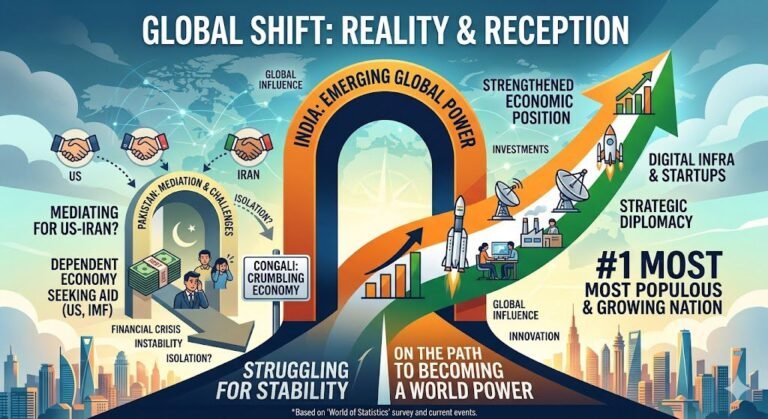
Credibility vs. Posturing: The contrast between India and Pakistan in this context is stark. While Pakistan attempts to mediate, its lack of economic stability and its perceived bias or lack of leverage with Israel renders its efforts ineffective. In contrast, India’s “Strategic Autonomy” allows it to maintain a robust defense partnership with Israel while simultaneously managing critical energy and strategic ties with Iran.
The “Middle Path”
Advantage: India is one of the few global powers that can talk to both Jerusalem and Tehran without being seen as a puppet of either side. This “all-alignment” policy is exactly what a mediator needs.
The Risk Factor: As the report suggests, mediation is a double-edged sword. In a conflict as deeply ideological and volatile as the one between Israel and Iran, any perceived tilt can damage India’s carefully cultivated relationships. The mention of the “Oman example” serves as a cautionary tale regarding the fragility of trust in Middle Eastern diplomacy.
Historical Legacy vs. Modern Realpolitik: While India’s history in the 1950s provides a template for mediation, the 21st century involves complex layers like nuclear proliferation and proxy warfare. India’s role might not be a formal “peace treaty” negotiator but rather a “back-channel communicator” to prevent a total regional collapse.
Conclusion:
Israel’s public endorsement of India as a potential peacemaker is a testament to India’s rising “Vishwa Mitra” (Friend of the World) status. However, New Delhi will likely tread carefully, ensuring that any mediatory role does not compromise its own national interests or its balanced standing in a volatile region.