Highlights – When the Election Commission announced the Special Intensive Revision (SIR) of the voter list, Mamata Banerjee stated categorically that she would not allow this to happen in Bengal. Now, she is saying that if even one person’s name is unnecessarily deleted, there will be no mercy. TMC workers have been instructed to accompany the BLOs.
……………………………………………………………………..
The “Special Intensive Revision” (SIR) of voter lists in 12 states began on November 4th and will continue for a month, until December 4th. However, the most uproar regarding this process was seen in West Bengal, where the TMC, under the leadership of Chief Minister Mamata Banerjee, launched a campaign against the Election Commission and the Modi government at the Centre. However, the fierceness with which the SIR protests began is gradually waning. Or, one might say, Mamata Banerjee is now backing away from confrontation. Let’s understand the reasons behind this shift in Mamata Banerjee’s gears.
When the Election Commission announced the “Special Intensive Revision” (SIR), Mamata Banerjee called it a “surgical strike on democracy.” Trinamool Congress workers were ordered to go door-to-door to protest against the Booth Level Officers (BLOs). The TMC feared that the names of over 10 million voters in Bengal could be deleted, especially in Muslim-majority areas like Murshidabad and Malda. The TMC threatened to approach the Supreme Court and announced a street protest. But just a week later, Mamata Banerjee abruptly changed gears. The TMC was instructed to cooperate with the BLO, add new voters, and file objections to incorrect deletions. The question arises: why this U-turn ?
Is there a fear of President’s rule?
BJP leader Suvendu Adhikari openly stated on October 30, 2024, “Mamata Banerjee’s anarchy is becoming a basis for imposing Article 356 (President’s Rule) in Bengal.” The central government already had the tools to pressure Bengal due to the deteriorating law and order situation there. However, this never happened. However, Mamata knows that if she stops a constitutional process like the SIR, the central government could take action against her under the pretext of contempt of a constitutional institution. And the threat of President’s rule before the 2026 assembly elections could directly challenge her power. Therefore, she transformed her opposition into “controlled cooperation.”
Is there also a fear of the Supreme Court’s strictness?
In July 2024, the Supreme Court rejected the RJD’s petition to stop the SIR in Bihar. The court clearly stated that the autonomy of the Election Commission cannot be interfered with. TMC legal advisors warned Mamata Banerjee that going to the SC prematurely would risk being labeled an “obstructionist.” The Mamata Banerjee government has been criticized in the Kolkata High Court and the Supreme Court before, and she has handled those challenges admirably. But now she understands that she cannot legally oppose actions like the SIR while sitting as Chief Minister. Therefore, she pushes her opposition politics to a certain point, and then stops short, where the central government, the Election Commission, and the Supreme Court are within her jurisdiction.
Protests are being held because the voter base also needs to be protected.
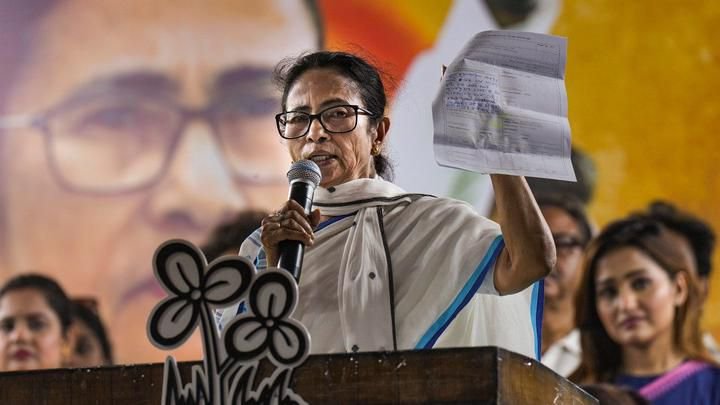
It is common knowledge that many people in Bengal have been issued fraudulent Aadhaar cards. The BJP calls these individuals “infiltrators” and accuses Mamata Banerjee of harboring them. She is accused of harboring Rohingya infiltrators. In retaliation, Mamata asks the BJP to ask Amit Shah to reveal how many Rohingyas are in Bengal? How many infiltrators are there? A similar debate has also erupted during the Bihar elections. However, Muslim votes have a significant influence in Bengal politics, serving as a solid vote bank for Mamata Banerjee. Mamata wants to retain this voter base. If there is fear among Muslims about the NRC, Mamata goes ahead and links the SIR to the NRC. And during her 4-kilometer march, she reiterates that if even a single person’s name is wrongly deleted from the voter list, she will topple the Modi government. Mamata Banerjee goes ahead and offers security guarantees to the Muslim vote bank.
Her activism regarding SIR isn’t solely due to her opposition to the BJP and the Election Commission. She doesn’t want to lose her grip on any issue that could potentially help the Congress and Left regain ground in Bengal. Rahul Gandhi is already attacking the Election Commission and raising issues of irregularities in the voter list. However, Mamata Banerjee doesn’t want to share the copyright of this issue in Bengal. By opposing SIR, she strikes an interesting balance, preserving her credibility while also ensuring the Election Commission’s work is done.