(An AI’ s analysis is given below)
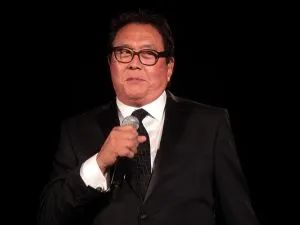
Highlights – Predicting a major economic crisis in 2026, Robert Kiyosaki has advised investing in real assets like gold, silver, and Bitcoin to become wealthy.
The market is experiencing daily fluctuations, and news of global uncertainty is widespread. In such an environment, Robert Kiyosaki, the author of the book ‘Rich Dad Poor Dad’ and a renowned investor, has once again expressed apprehension regarding a major financial crash in 2026.
In his recent post, he has emphasized that investors should prepare to avoid a stock market crash. He also stated that he is not just talking about scaring people, but rather suggesting that such a crash could become a huge opportunity for some people to make money, while many others could be severely affected by it.
Kiyosaki Apologized, But Remained Firm on His Previous Opinion
In an earlier post, Kiyosaki had mentioned that some people could become even wealthier during an economic recession. This faced significant criticism, for which he apologized. However, along with the apology, he reiterated his point even more strongly. He wrote that those who have been following his X (formerly Twitter) account for a long time would know that his plan has always been to buy and hold assets that the Federal Reserve, the US government, or banks cannot easily create by printing.
Kiyosaki clearly stated that real wealth is only created by things that governments, banks, or Wall Street cannot produce out of thin air. Turning his apology into an opportunity, he reminded investors that those who are prepared when a crash occurs can move ahead. He wrote, “If the 2026 crash comes true, I am absolutely certain that you and I will become richer… while millions of people will become poorer.” His emphasis was that a crash is not just a time of loss, but also an opportunity for wealth redistribution.
Trust in Real Assets, Away from Printable Products
Robert Kiyosaki explained his investment strategy very clearly. He says he stays away from financial products that the government or banks can easily “print.” Instead, he invests money in real and solid assets, such as oil, property, farming, gold, silver, and cryptos like Bitcoin and Ethereum.
He also shared the story of his beginnings. He mentioned that there was a time when he did not have much money. Despite that, he made small investments, held them for a long time, and avoided selling early. Once, he even invested all the money he had to buy just 6 Bitcoins.
Kiyosaki clearly says that if something can be easily created by a bank or Wall Street, he does not invest in it. According to him, real money is made only in those things that cannot be easily produced. Therefore, he likes assets such as oil, real estate, gold, silver, Bitcoin, Ethereum, and food production.
He also gave the example of Warren Buffett. According to him, Buffett is currently holding a large amount of cash and waiting for the right opportunity so that he can buy good assets cheaply when the market falls.
Prediction of Massive Surge in Gold, Silver, and Crypto After the Crash
Earlier this week, Kiyosaki made another big prediction regarding gold, silver, and crypto in a post. He stated that if a major financial crisis occurs in the world and the market bubble bursts, then within a year of that, gold could reach $35,000 per ounce. Silver could reach $200 per ounce, Bitcoin around $7.5 lakh ($750,000), and Ethereum could reach $95,000.
Kiyosaki has long been a supporter of assets that cannot be easily controlled or printed. He believes that things like gold, silver, and crypto help protect against inflation, currency devaluation, and systemic risks.
He also asked investors where they think the prices of these things could go if the next big financial crisis arrives.
Current Market Challenges and Kiyosaki’s Perspective
Currently, global markets are under various types of pressure, primarily due to geopolitical tensions, the threat of inflation, and changing economic policies. In such an environment, Kiyosaki is advising investors to understand risk and opportunity in a new way. He believes that a market crash does not just bring loss; it also changes the distribution of money. Those who are already invested in the right places can take advantage of it.
Kiyosaki’s entire focus is on the fact that real wealth is built only by starting with small amounts and maintaining investments over a long period. He clearly stated that he himself is investing in assets that no one can easily “print.” His goal is not to avoid the crash, but to take advantage of it with proper preparation.
AI’ s analysis
……………………………..
News Context
Predicting a major economic crisis in 2026, Robert Kiyosaki has advised investing in real assets like gold, silver, and Bitcoin to become wealthy. The market is experiencing daily fluctuations, and news of global uncertainty is widespread. In such an environment, Robert Kiyosaki, the author of the book ‘Rich Dad Poor Dad’ and a renowned investor, has once again expressed apprehension regarding a major financial crash in 2026.
In his recent post, he has emphasized that investors should prepare to avoid a stock market crash. He also stated that he is not just talking about scaring people, but rather suggesting that such a crash could become a huge opportunity for some people to make money, while many others could be severely affected by it.
Analysis: Evaluating the 2026 Financial Crash Warning
Robert Kiyosaki’s warnings often spark intense debate because they blend fundamental economic concerns with highly speculative price targets. To determine how much weight to give his 2026 prediction, we must look at the data from three angles: the macroeconomic reality, Kiyosaki’s track record, and the strategic merit of his advice.
1. The Macroeconomic Landscape: Is a Crash Likely ?
The year 2026 does present legitimate economic headwinds. Currently, we see:
Geopolitical Volatility: Ongoing tensions in the Middle East and the US-China “power race” have created energy shocks. As of March 2026, crude oil prices have seen significant volatility, which historically precedes market corrections.
The “Buffett Indicator” at Extremes: Kiyosaki correctly points out that Warren Buffett (via Berkshire Hathaway) has built a record cash pile—estimated at over $370 billion. While Buffett rarely predicts “crashes,” his move to hold cash and trim major holdings like Apple suggests he finds the current market overvalued.
Debt and Inflation: Global debt levels remain at historic highs. Institutions like J.P. Morgan place the probability of a U.S. recession in 2026 at roughly 35%. While not a certainty, it is a significant risk.
2. Accuracy vs. Alarmism: Kiyosaki’s Record
It is important to maintain a healthy skepticism regarding Kiyosaki’s specific price predictions ($35,000 gold or $750,000 Bitcoin).
The “Perma-Bear” Label: Kiyosaki has predicted “the biggest crash in history” multiple times (notably in 2011, 2015, and 2021) that did not materialize in the catastrophic way he described.
Exaggerated Targets: While gold has performed exceptionally well—trading above $5,000/oz in early 2026—his target of $35,000 is considered extreme by mainstream analysts (like Goldman Sachs), who project more modest growth toward $5,400.
3. The Strategy: “Real Assets” vs. “Printable Products”
Despite his alarmist tone, his underlying philosophy aligns with sound “spiritualisticoscience” principles of seeking intrinsic value.
Scarcity as Protection: His preference for gold, silver, and Bitcoin is based on their finite supply. In an era where central banks can expand the money supply (printing), these “hard assets” act as a hedge against currency devaluation.
Opportunity in Chaos: His most accurate point is that wealth is redistributed during crashes. For those with cash or “real” assets, a market dip allows for the purchase of productive assets (land, businesses, energy) at a discount.
Final Verdict
…………………………….
Is he right ? Partially. While a total “systemic collapse” is less likely than a standard market correction or recession, the vulnerabilities he highlights—debt, inflation, and overvaluation—are real.
The takeaway isn’t necessarily to expect the world to end in 2026, but to acknowledge that the cycle of expansion is stretched thin. Moving a portion of one’s portfolio into “real” assets is a classic defensive move that aligns with the caution currently shown by institutional giants like Berkshire Hathaway.
When the “physical” systems of man-made finance become too detached from “real” value, a correction is nature’s way of restoring balance.