The West Bengal chief minister Mamata Banerjee’s attempts to stop the Special Interactive Revision (SIR) seem to be reaching an end. The question arises: while SIR was conducted peacefully in 12 other states, why is there such a desperate attempt to stall it in Bengal? Opposition parties have opposed SIR, but Mamata Banerjee has crossed all limits in this opposition.
Why is Mamata so afraid of “SIR”?
The question is, why does she ultimately fear this process so much? In reality, her fear is justified from her perspective because once this process is completed, all of Mamata’s electoral mathematics are bound to crumble. Opposing SIR is not just her strategy, but a compulsion.
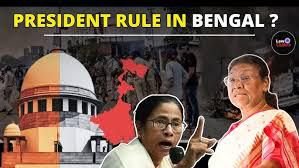
When SIR was underway in Bihar, Mamata Banerjee was aggressively opposing it even then. Now that SIR is being conducted in her own state, her opposition has crossed all boundaries. She has put all her might into stopping this process, but now these efforts are backfiring. She has opened a front against the Election Commission, calling it a “puppet” of the Central Government. The TMC moved the Calcutta High Court against SIR but faced disappointment there. Subsequently, the Mamata government reached the Supreme Court. To put pressure on the Supreme Court, Mamata Banerjee herself arrived there dressed in a lawyer’s robe to conduct the case. She felt that this would influence the Supreme Court, but it now seems the Honorable Judges have seen through her tactics. Mamata has been constantly alleging a conspiracy by the Modi government to impose President’s Rule in Bengal, but now the path for it has been opened by the Honorable Court itself.
PM Modi is determined not to impose President’s Rule in any state, as he considers it against the federal structure. Having been a Chief Minister himself, he remains opposed to imposing President’s Rule. From one perspective, this policy of his might not be ideal because the makers of the Constitution included this provision after much thought. When the constitutional machinery of a state breaks down, President’s Rule should be imposed. In Bengal, this should have happened much earlier, but now the Supreme Court is moving towards facilitating this. The question is, how did the situation reach this point?
Why is Mamata not cooperating with the Commission?
In fact, the Supreme Court has clearly told the Mamata Banerjee government that if the SIR process is not completed, elections will not be held. The Election Commission has placed all facts before the Supreme Court proving that Mamata Banerjee does not want SIR to happen in Bengal, which is why she is not cooperating with the Commission. On the contrary, she is creating obstacles in the Commission’s work. The Supreme Court understood from the Election Commission’s arguments and facts that Mamata Banerjee would not allow SIR to take place. The Honorable Court expressed strong displeasure over the state government’s non-cooperation with the Election Commission. The Supreme Court stated that a clean voter list is essential for fair elections, and no delay in this regard will be tolerated.
Mamata’s Tactics Fail
Mamata Banerjee’s entire effort was to ensure that the Election Commission could not complete its work on time, allowing elections to be held based on the old voter list. She made the same plea before the Supreme Court, stating that the Election Commission would not be able to complete the SIR process in time, so orders should be given to conduct elections using the old voter list. It appears Mamata Banerjee created circumstances where the Election Commission could not perform its duties, thereby forcing it to use the old list. The Election Commission has already removed 5.8 million names of deceased, absent, and shifted voters from the list.
A Massive Problem
The problem in Bengal is that 15 million voters have been found to be suspicious. A list of logical inconsistencies has been prepared by the Election Commission, out of which 4.5 million cases are still pending resolution. For this task, the Election Commission had asked the Mamata government for a list of Group-A officers to be assigned the responsibility, but the Mamata government asked the Commission to wait. Later, during the hearing in the Supreme Court, the Election Commission highlighted the state government’s failure to provide Group-A officers.
The Honorable Court ordered the Bengal government to provide an adequate number of required officers to assist the Commission in SIR. Despite the court’s order, the Mamata government did not provide these officers and later sent a list of Group-B officers. The Commission argued that since the cases of logical inconsistencies are complex, only Group-A officers are suitable, and Group-B officers cannot handle this work. In the hearing held on Friday, the Honorable Court expressed disappointment over the state government’s attitude and non-cooperation. The Supreme Court advised both parties to understand the sensitivity of the matter. Following this, the Supreme Court delivered a verdict never heard before. This decision proves that the Honorable Court not only lacks trust in the state government but has also lost faith in the state’s administrative system.
Supreme Court Lacks Faith in Mamata Government
The Honorable Court has sensed the state government’s pressure on state officials and feels they cannot work correctly. The Honorable Court has issued orders to appoint Judicial Officers to carry out the Election Commission’s work. The Supreme Court directed the Chief Justice of the Calcutta High Court to provide District Judges, Additional District Judges, and retired judges to resolve the Election Commission’s logical inconsistency cases. These judicial officers will resolve cases in all districts. The Supreme Court stated that there is a lack of trust between the state government and the Election Commission, and in such a situation, there is no option but to involve judicial officers and the court.
The bench of Justice Surya Kant, Justice Bagchi, and Justice Pancholi has delivered a historic verdict that will serve as a warning to other governments in the future.
The Election Commission does not have its own staff; it draws staff from the respective governments for all its work. This makes state governments feel that the Election Commission is entirely dependent on them. While state governments are constitutionally bound to cooperate with the Election Commission, they often create hurdles. This order proves that if any government obstructs constitutional work, the court can issue such orders. Judicial officers are not accountable to any government. The state government cannot take action against them or transfer them. While pressure can be exerted on officials provided by the state government, judicial officers are free from all such pressures.
All of Mamata Banerjee’s Moves Backfire
The Supreme Court has stripped all power from Mamata Banerjee’s hands, making it clear that she is not the “owner” of the state. The Constitution has empowered the Supreme Court to restrain her arbitrary actions at any time. Now, Mamata Banerjee has run out of cards. She can neither target the Election Commission nor accuse the Modi government of colluding with it. Mamata Banerjee thought no one could block her path and that her arbitrary rule would prevail in Bengal. Now, the entire matter has moved to the Calcutta High Court. The High Court has appointed 400 officers to complete the SIR work.
According to the Supreme Court’s order, the state’s DGP and Chief Secretary must cooperate in their work. If a law and order situation arises anywhere, both officers will face consequences. Following the Election Commission’s demand, the Home Ministry is going to deploy 500 companies of paramilitary forces in Bengal, meaning 60,000 central security personnel will remain in Bengal until the elections. This is a new problem for Mamata Banerjee that is set to trouble her.
Mamata Banerjee’s biggest problem is yet to come. It is difficult to resolve 4.5 million cases of logical inconsistencies in time, so the elections might be postponed. The Supreme Court has already stated that elections will only happen after SIR is completed. This means elections in Bengal are not going to be held on time. Now, there is a strong possibility that elections will be organized during President’s Rule. If this happens, it will be a major setback for Mamata Banerjee because she won’t even be able to play the ‘victim card’ then. Ultimately, the situation in Bengal has been created by Mamata Banerjee herself, and now she will have to face it.
Conclusion and Detailed Analysis:
A Constitutional Deadlock
For Mamata Banerjee, this is not just a legal defeat but a major ‘Political Checkmate.’ The process she was trying to stop using her administrative power has now gone beyond her control following the Supreme Court’s intervention.
Trapped in Her Own Strategy: Mamata Banerjee initially wanted to create a situation by non-cooperation where the SIR process would stop due to lack of time, and elections would be held on the old voter list. However, the Supreme Court’s order of “No SIR, No Election” has completely invalidated her ‘old list’ card. The judicial system she tried to use as a shield has now become an impenetrable barrier.
A Blow to Administrative Monopoly: In Indian democracy, state officials usually follow the Chief Minister’s directions. However, the appointment of Judicial Officers by the Supreme Court is a clear signal that:
The Court no longer trusts the state bureaucracy.
The TMC’s cadre-based administrative influence has been completely bypassed.
Judicial officers will not succumb to political pressure, ensuring a fair investigation of the 15 million suspicious voters.
Irrelevance of the ‘Victim Card’: Mamata Banerjee always gains public sympathy by calling central intervention an “attack on the federal structure.” But here, the action is being taken by the Supreme Court, not the Central Government. As a constitutional head, she cannot label the apex court as a “political enemy,” leaving her politically isolated.
Compulsion of President’s Rule: If the SIR process is delayed and the election deadline passes, a constitutional vacuum will be created. In such a case, even if PM Modi doesn’t want to, he will be forced to impose President’s Rule to protect the Constitution. This is the biggest threat to Mamata, as under President’s Rule, the entire administrative and police machinery will be under the Center, leaving no room for electoral violence or ‘booth capturing.’
The Essence of the Conclusion: A situation has arisen in West Bengal politics where there is a conflict between the “Rule of Law” and the “Rule of an Individual.” This historic decision by the Supreme Court is a major step toward cleaning up West Bengal’s electoral history. If elections are held in the presence of 400 judicial officers and 60,000 central personnel, the electoral mathematics that have persisted in Bengal for decades are likely to be completely overturned.