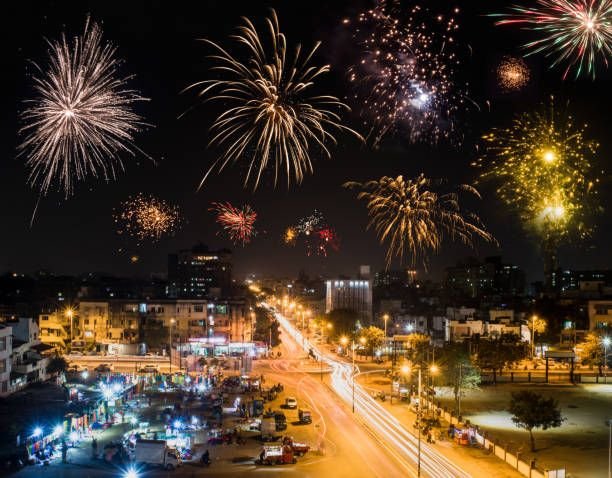
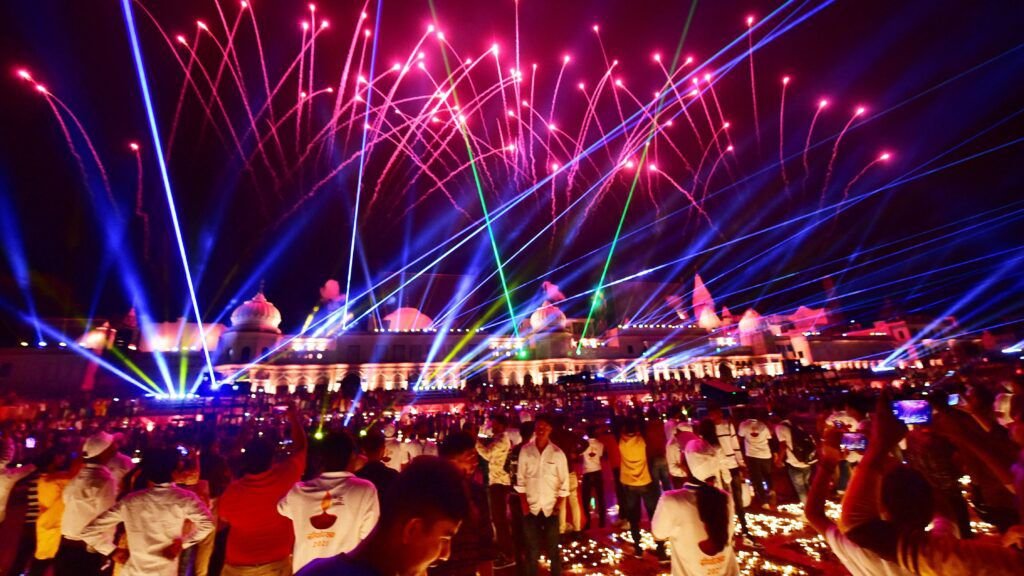
Estimates based on data from the environmental agency Energy and Climate Intelligence Unit (ECIU) and the Central Pollution Control Board (CPCB) indicate that approximately 62,000 tons of explosives were used across India on Diwali night. This figure is approximately 13 percent higher than in 2024. Compared to the daily explosions during the Russo-Ukrainian War, the amount of explosives burned on a single Diwali night is equivalent to three days of bombing during that war.
For the first time, an international analysis has placed India’s cultural festivals on the ammunition scale of global warfare. This is a startling attempt to understand the fine line between celebration and destruction. According to the ECIU, estimates conducted by various national and international agencies indicate that this Diwali’s gunpowder consumption was unprecedented. Based on data from The Energy and Resources Institute, the amount of explosives used in firecrackers alone was 62,000 tons.
The ECIU survey, covering 12 major cities including Delhi-NCR, Mumbai, Chennai, and Jaipur, recorded a quantity of explosives between 61,500 and 63,000 tons. Meanwhile, the Council of Scientific and Industrial Research (CSIR) and the National Environmental Engineering Research Institute (NEERI) based their preliminary chemical data estimated the figure at around 59,000 tons. On average, around 62,000 tons of gunpowder was burned during Diwali. These figures will be finally confirmed in November 2025.
According to the Stockholm International Peace Research Institute (SIPRI) and the Royal United Services Institute (RUSI), an average of 20,000 to 21,000 tons of explosives are being fired daily on the Russia-Ukraine war front. This comparison suggests that the amount of gunpowder burned by India on a single Diwali night is equivalent to approximately three days of war bombing (72 hours). This means that the Diwali celebrations in just one night were nearly three times (295%) more than the total ammunition consumption of a single day of war.
Chemical and Environmental Analysis
The ECIU assessment states that, chemically, Diwali fireworks and war explosions are quite similar. Both emit high temperatures, metallic compounds, and toxic gases. The average temperature generated by firecrackers reaches 1,400 degrees Celsius, while explosions from artillery and bombs can produce temperatures up to 2,800 degrees Celsius. On the night of Diwali, 4.2 lakh tonnes of carbon dioxide was released into the atmosphere, whereas on an average, 1.9 lakh tonnes are emitted daily due to war.
Diwali smoke leaves a 48-hour suffocating layer
On average, Diwali smoke from firecrackers lingers in the atmosphere for 36 to 48 hours, while last year, in densely populated cities like Delhi-NCR, Kanpur, and Jaipur, its effects were felt for three days. The fine particles (PM 2.5, PM 10), sulfur dioxide, and nitrogen oxide present in this smoke combine with moisture in the air to form smog. According to NEERI, it takes at least 48 hours for the air quality index to return to normal levels after Diwali.