Summary: * A strategy to make the world dependent on Chinese platforms through low-cost AI models.
Rising concerns over censorship, data control, and the global expansion of the “Chinese Model.”
In the field of Artificial Intelligence (AI), China is rapidly working on a strategy that could challenge the dominance of American tech companies. According to experts, instead of creating expensive and highly sophisticated models, China is moving toward creating global technological dependence by developing cheap and widely used AI tools.
Recently, the video-generating AI tool ‘Seedance 2.0,’ introduced by TikTok’s parent company Bytedance, is being viewed as an example of this strategy. It can produce movie-like videos from text instructions. On the other hand, the American company Anthropic has alleged that some Chinese AI laboratories have adopted controversial techniques of large-scale data collection to improve their models.
Analysts say that while American companies still lead in advanced AI research, China can achieve rapid entry into the global market by reducing costs. Low-cost AI tools are becoming attractive to developing countries and small businesses, which could lead to future software and digital services becoming dependent on Chinese platforms.
China’s official AI policy aims to make the country a leading global AI innovation hub by 2030. Along with this, Beijing is presenting AI by linking it to the progress of human civilization, which experts consider a strategy of “Technical Soft Power.”
However, concerns regarding security and information control are also growing in Western democracies. According to reports, algorithms and digital platforms in China must promote mainstream values and comply with content control regulations. Due to this, there are fears that along with the global expansion of AI, models of censorship and surveillance may also spread.
According to experts, if Chinese AI becomes a global standard, many countries may face the difficult challenge of balancing the adoption of cheap technology with avoiding political-technological dependence.
China vs. USA: A Comparative Analysis of the AI Race
In the current technological context, the strategies of the two countries are completely different. The main aspects are as follows:
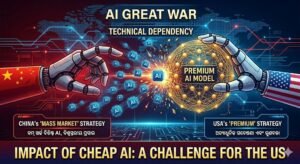
1. America’s ‘Premium’ vs. China’s ‘Mass Market’
American companies (such as OpenAI, Anthropic) are spending incredible amounts of money to build the world’s most powerful AI models. On the other hand, China sees that developing nations and small businesses always look for cheaper options. China is increasing its influence in the global market through these low-cost models.
2. Censorship and Ethics
American AI models are based on democratic values and free information. However, Chinese AI operates according to the country’s strict censorship laws. If Chinese AI becomes a global standard, there is a fear that it will expand information control and surveillance models abroad.
। 3. Geo-political Impact
China is presenting its AI to the world as a “gift” by linking it to the progress of human civilization. This is a form of “Technical Soft Power.” If other countries’ software and digital services become dependent on Chinese platforms, it will be difficult for these countries to remain free from China’s political pressure in the future.
Conclusion:
America is still ahead in terms of research and quality, but China’s “cheap and accessible” strategy is a massive challenge. This is not just a technological war, but a competition over which ideology the future of the world will operate upon.